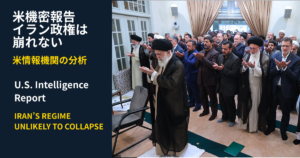
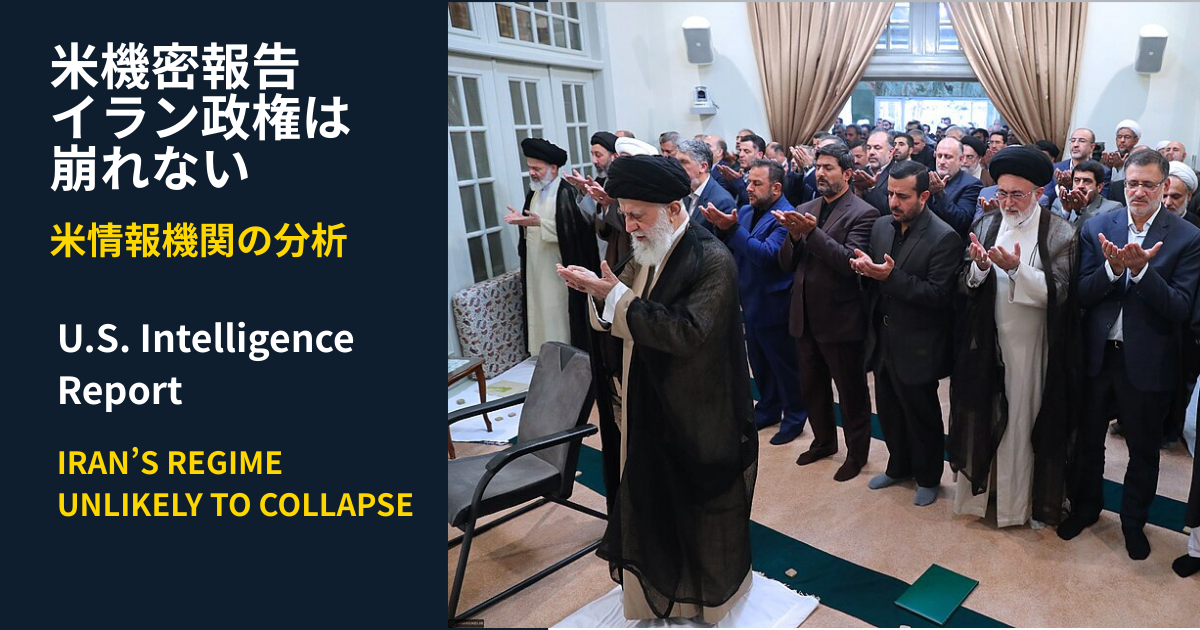
Photo:
Ali Khamenei met with Hajj authorities 2018 05.jpg
, source:
Khamenei.ir
, author: Unknown, licensed under
CC BY 4.0
.
米情報機関の機密報告書
「戦争してもイラン政権は崩れない」
米国の機密情報報告書がリークされた。
結論は、非常にシンプルでありながら重い。
「戦争してもイラン政権は崩れない可能性が高い」
この報告は、米国の情報機関の分析を統合する National Intelligence Council(NIC)によって作成された機密文書である。
内容は米紙『The Washington Post』によって報じられた。
NICはCIAなどを含む米国の18の情報機関の分析を統合する組織であり、その評価は米国のインテリジェンスコミュニティ全体の見解に最も近いものとされている。
その報告は、米国がイランに対して大規模な軍事攻撃を行った場合のシナリオを分析したものだ。
しかし結論は明確だった。
軍事攻撃によってイランの宗教・軍事体制が崩壊する可能性は低い。
米情報機関の分析:軍事攻撃でも体制崩壊は難しい
報告では、指導部を狙った限定的な攻撃から、政府機関を広範囲に破壊する大規模攻撃まで、複数の軍事シナリオが検討された。
具体的には、
- 最高指導者や軍指導部を狙う「斬首作戦」
- 革命防衛隊や政府機関を標的とする大規模空爆
- 指導層と軍事施設を同時に攻撃する複合作戦
といったケースである。
しかし米情報機関の分析では、どのシナリオでもイラン体制が崩壊する可能性は低いとされている。
その理由の一つは、イランの権力構造が個人ではなく制度によって維持されている点にある。
仮に最高指導者や一部の指導層が排除されたとしても、
- 聖職者ネットワーク
- 革命防衛隊
- 国家治安機関
といった権力構造が残る限り、体制は維持される可能性が高いと見られている。
さらに外部からの軍事攻撃は、しばしば国内の政治対立を弱め、国家の結束を強める効果を持つことも知られている。
そのため、外部からの攻撃によって体制が崩壊するどころか、むしろ強硬派が影響力を強める可能性もあると指摘されている。
指導者が殺されても体制は維持される
斬首作戦では政権は崩れない
仮にイラン最高指導者アリー・ハメネイが殺害された場合でも、イランの宗教・軍事エリートは制度化された後継プロセスによって権力の継続を確保すると分析されている。
これは、国家の権力が一人の指導者だけに集中しているわけではなく、宗教機関、軍、治安機関など複数の権力組織によって支えられているためだ。
そのため、最高指導者が排除されたとしても、国家体制そのものが直ちに崩壊する可能性は低いと見られている。
また、歴史的に見ても、外部からの攻撃によって指導者が殺害された場合、国家内部ではむしろ結束が強まり、強硬派が影響力を増すケースも少なくない。
つまり、いわゆる「斬首作戦」によって体制が崩壊するという単純なシナリオは、イランでは現実的ではないと見られている。
後継者を選ぶ制度が存在する
イランには最高指導者の後継者を選出する制度が存在している。
その中心となるのが、聖職者で構成される「専門家会議(Assembly of Experts)」である。
この機関は最高指導者を選出する権限を持ち、指導者が死亡した場合には新たな最高指導者を選ぶことになっている。
さらに実際の権力構造では、革命防衛隊や国家安全保障機関などの影響力も大きく、政治・軍事のエリート層が体制維持に関与する。
こうした制度的な仕組みが存在するため、個人の排除がそのまま国家体制の崩壊につながるわけではない。
反体制派が政権を取る可能性は低い
反体制勢力は分裂している
西側の議論ではしばしば、「政権が崩れれば民主勢力が台頭する」という前提が語られる。
しかし、米情報機関の評価はかなり冷静だ。イランの反体制勢力は一枚岩ではなく、亡命勢力、国内の改革派、少数民族勢力、体制内不満分子などに分かれており、政治的な立場や目指す国家像も大きく異なっている。
王政復古を望む勢力もいれば、世俗的な共和国を目指す勢力もあり、また民族自治や分離に重きを置く勢力もある。つまり「反体制」であることは共通していても、その先に作りたい国家の姿は一致していない。
そのため、仮に現体制が弱体化したとしても、反体制派がすぐに結束して新たな政権を築けるとは考えにくい。
むしろ体制崩壊後に権力の空白が生じれば、反体制派同士の主導権争いや路線対立が表面化し、かえって混乱が深まる可能性もある。
これは多くの国で見られてきた典型的な問題であり、共通の敵がいる間は連携できても、その敵が弱まった瞬間に内部対立が激化することは珍しくない。
国家を統治する能力の問題
さらに問題なのは、反体制派が国家を安定的に統治できるだけの制度的基盤や組織力を持っているとは言い難い点である。
国家運営には、軍や官僚機構の掌握、治安維持、経済運営、地方統治、インフラ管理、外交対応など、多層的で継続的な能力が必要になる。
しかし現在のイラン反体制勢力には、それらを一体として担える共通の指導部や政治基盤が見当たらない。
亡命勢力は国外での発信力を持っていても、国内の行政機構や治安機関を実際に掌握しているわけではない。逆に国内に不満を持つ人々がいても、それがすぐに全国規模の統治能力へとつながるわけではない。
特に問題なのは、国家権力が崩れた直後こそ、最も高度な統治能力が求められるという点だ。食料やエネルギーの供給、治安の維持、地方行政の継続、報復や私刑の抑制など、国家が機能し続けるための実務は一日たりとも止めることができない。
もしそれを担う準備がないまま体制だけが崩れれば、民主化ではなく、権力の空白、治安悪化、地域分裂へと進む危険がある。
米情報機関が反体制派による政権掌握を「可能性が低い」と見るのは、単に人気や支持の問題ではなく、国家を動かす現実的な能力の不足を重視しているためだ。
政権に反対することと、国家を運営できることはまったく別の問題である。
なぜイラン体制は崩れにくいのか
宗教と政治が結びついた国家構造
イランでは、宗教指導層、軍、治安機関が複雑に結びついた政治体制が長年にわたって形成されてきた。
これは単なる「宗教国家」という一言では片づけられない。イランの体制は、宗教的正統性、国家官僚機構、治安装置、革命後の政治理念が重なり合って維持されている。
そのため、外部から見れば一人の最高指導者が頂点に立つ強権体制に見えても、実際には複数の制度や組織が相互に支え合う構造になっている。
例えば、宗教指導層は単なる象徴ではなく、政治的な正統性の源泉として機能している。一方で国家官僚機構は日々の行政を担い、治安機関は体制維持の実務を支えている。
つまり、体制は一人のカリスマや一つの機関で成り立っているのではなく、宗教・政治・治安が重なり合う複層的な国家構造によって支えられているのである。
このような体制では、外部からの軍事攻撃によって一部の指導者や施設が失われても、国家全体が一気に瓦解するとは限らない。
むしろ外敵の出現は、内部の不満や対立を一時的に後景化させ、体制の正統性を「国家防衛」の論理で再強化する方向に働くことがある。
イランでは反米・反外圧の歴史認識が体制の自己正当化と結びついているため、外部からの攻撃は単なる軍事的圧力ではなく、体制側にとっては国内の結束を促す政治資源にもなりうる。
そのため、外部から見れば「大きな打撃」に見える攻撃であっても、内部では必ずしも体制崩壊には直結しない。
革命防衛隊の強い影響力
特に革命防衛隊は、イラン体制を支えるうえで極めて重要な存在である。
革命防衛隊は単なる軍事組織ではない。軍事力を持つだけでなく、政治、経済、治安、対外工作にまで広く関与しており、国家の中枢に深く組み込まれている。
そのため、外部から軍事施設を攻撃したとしても、革命防衛隊の影響力そのものを一度に取り除くことは難しい。
さらに革命防衛隊は、体制防衛を自らの存在意義としており、外部からの攻撃が強まるほど、むしろその役割と発言力が増す可能性がある。
これは通常の国家軍とは少し異なる。革命防衛隊は「国を守る軍」であると同時に、「体制そのものを守る組織」でもあるからだ。
加えて、政治・経済分野への浸透が深いため、仮に軍事的損害を受けても、すぐに国家全体の支配能力を失うわけではない。
こうした構造があるため、イランでは外部からの攻撃がそのまま体制の崩壊につながりにくい。
むしろ圧力が強まるほど、革命防衛隊のような強硬派組織が「国家を守る存在」として前面に出やすくなる。
このことが、イラン体制の持久力を支える大きな要因になっている。
米国内部の意見の違い
情報機関の分析
今回の報道で興味深いのは、米国政府内部の認識の違いが浮き彫りになっている点だ。
情報機関の評価は、「戦争してもイラン政権は崩れない」というものである。
しかもこれは、一部の個人的見解ではなく、国家情報会議(NIC)がまとめた評価だとされている。NICは米国の複数の情報機関の分析を統合する位置にあり、その報告はワシントンの政策判断における重要な材料の一つになる。
つまり今回の機密報告は、単に「慎重論がある」という話ではなく、米国の情報コミュニティ内部で、イランへの大規模攻撃がそのまま政権崩壊につながるとは見られていないことを示している。
情報機関の役割は、本来、願望ではなく現実を評価することにある。相手国の体制、社会構造、継承制度、軍・治安機関の耐久力を見たうえで、戦争がどの程度の政治的成果を生むかを冷静に見積もる。
その観点から見れば、たとえ軍事的に大きな損害を与えたとしても、イラン体制が直ちに崩壊するとは言えず、むしろ予想外の長期化や地域不安定化を招く可能性がある、というのが情報機関の現実的な見立てなのだろう。
ここで重要なのは、軍事的成功と政治的成功は同じではないという点である。
敵の施設を破壊することはできても、その結果として望ましい政権を誕生させられるとは限らない。今回の報告は、そのズレをかなりはっきり示している。
政治の判断
しかし一方で、トランプ政権はイラン指導部の排除や新しい政権の樹立といった、いわゆるレジームチェンジ(体制転換)を示唆する発言を続けている。
つまり、情報機関は戦争の効果に懐疑的だが、政治はそれでも軍事行動を進めているという構図が見えてくる。
このズレは偶然ではない。政治の判断は、純粋な情報分析だけで決まるわけではなく、国内世論、同盟国との関係、政権の求心力、イデオロギー、軍事的威信、選挙上の思惑など、さまざまな要因に左右される。
特に戦争は、しばしば「現実的な効果」よりも、「強さを示しているように見えるか」「主導権を握っているように見えるか」といった政治的演出と結びつく。
そのため、情報機関が慎重な見方を示していても、政治指導者がより強硬な方針を選ぶことは十分ありうる。
こうした状況は米国政治では珍しいことではない。イラク戦争の際にも、情報機関の一部は大量破壊兵器の存在に疑問を示していたが、政治判断として戦争は実行された。
そしてその結果、軍事行動そのものは成功しても、その後の統治と地域安定化では大きな混乱を招いた。これはまさに、軍事的勝利と政治的成功が一致しない典型例だった。
今回のイラン情勢でも、同じ問題が再び浮上しているように見える。
情報機関は「その戦争で何が実現できるのか」を見ており、政治は「それでも戦争をする理由」を別の次元で組み立てている。
この違いこそが、今回の報道の最も重要なポイントの一つである。
日本にとっての示唆
軍事力だけでは問題は解決しない
今回の報道は、日本の安全保障議論にも重要な示唆を与えている。
日本では近年、「感情論ではなくリアリズム」という言葉が頻繁に使われるようになった。
そしてそのリアリズムは、しばしば軍備増強、抑止力の強化、軍事同盟の強化を正当化する言葉として用いられている。
しかし、今回の米情報機関の分析は、現実の戦争がそれほど単純ではないことを示している。
圧倒的な軍事力を持つ国家が攻撃しても、必ずしも相手の政権が崩壊するとは限らない。
むしろ、国家が結束し、強硬派が台頭し、地域が長期的に不安定化することも少なくない。
これは日本の安全保障論にとって重い意味を持つ。なぜなら日本では一部の安全保障論では、軍事力を積み増せば情勢をコントロールしやすくなるかのような議論がしばしば語られるからだ。
しかし実際の国際政治では、軍事力は相手を従わせる万能の道具ではない。相手国の体制、歴史、宗教、ナショナリズム、社会構造が絡み合う以上、外から力を加えれば加えるほど、逆に抵抗と結束を強める場合もある。
つまり、軍事的圧力を高めることと、政治的に望ましい結果を得ることは同じではない。
今回の報告は、まさにその現実を示している。戦争はしばしば「解決策」として語られるが、実際には問題を別の形で長期化させることも多い。
安全保障の現実
実際、イラク、リビア、シリアなどの例はその典型である。
軍事介入によって既存の体制は弱体化しても、その後に安定した政治秩序が生まれるとは限らなかった。むしろ権力の空白、治安悪化、内戦、難民流出、地域不安定化といった問題が連鎖した。
今回の報道は、日本の「リアリズム安全保障論」が想定しているほど、軍事力が万能ではないことを示している。
日本にとって本当に重要なのは、単に軍事的な能力を語ることではなく、どのような地域秩序を目指すのか、そのために外交・経済・国際協調をどう組み合わせるのかを考えることだろう。
日本は中東からのエネルギー供給に大きく依存しており、この地域の長期不安定化は日本経済に直接跳ね返ってくる。そうである以上、日本の国益は戦争の拡大そのものではなく、むしろ緊張の抑制と航路・エネルギー供給の安定にあるはずだ。
それにもかかわらず、安全保障を「米国にどこまで追随するか」という発想だけで考えるなら、日本は自国にとっての現実を見失うことになる。
本来のリアリズムとは、強い側に同調することではなく、自国の国益と地域の安定を冷静に見極めることのはずである。
今回の米情報機関の分析は、その意味で日本にも重要な問いを突きつけている。
軍事力を積み上げることと、安全をつくることは同じではない。
国際政治の現実
国際政治はしばしば、軍事力だけで決まるものではない。
宗教、民族、政治体制、国内事情、歴史認識、周辺国との関係など、多くの要因が複雑に絡み合っている。
そのため、軍事的には圧倒的に優位な国家であっても、相手国の体制や社会を思い通りに動かせるとは限らない。
施設を破壊し、指導者を排除し、軍事的に大きな打撃を与えることはできても、その先に安定した政治秩序を作れるとは限らないのである。
今回の米情報機関の機密報告書は、まさにその現実を改めて示している。
戦争はしばしば「解決策」として語られる。
しかし実際には、体制崩壊ではなく体制の硬化を招き、民主化ではなく権力の空白を生み、安定ではなく長期的な混乱を広げることの方が少なくない。
イラク、リビア、シリアなどの例を見ても分かるように、軍事介入は「始めること」よりも「終わらせること」の方がはるかに難しい。
そして、その代償を最も重く負わされるのは、いつも現地の一般市民である。
私は、日本がこうした現実を直視せずに、ただ「リアリズム」や「抑止力」という言葉だけで軍事強化を正当化していくことに強い危うさを感じる。
本来のリアリズムとは、強い側に追随することではない。
戦争が本当に何をもたらすのか、そして自国の国益と地域の安定にとって何が最も現実的なのかを冷静に見極めることのはずだ。
今回の報道は、その意味で日本にも重い問いを突きつけている。
軍事力を積み上げることと、平和と安定をつくることは同じではない。
中東情勢をめぐる今後の展開は、そのことを改めて示すことになるのかもしれない。
Classified U.S. Intelligence Report:
“War Is Unlikely to Bring Down Iran’s Regime”
A classified U.S. intelligence report has been leaked.
Its conclusion is simple, but deeply significant.
“Even war is unlikely to bring down Iran’s regime.”
This report was a classified document produced by the National Intelligence Council (NIC), which integrates analysis from across the U.S. intelligence community.
Its contents were reported by The Washington Post.
The NIC is an organization that synthesizes analysis from 18 U.S. intelligence agencies, including the CIA, and its assessments are widely regarded as the closest reflection of the U.S. intelligence community’s overall judgment.
The report analyzed scenarios in which the United States would launch a large-scale military attack on Iran.
But its conclusion was clear.
A military assault is unlikely to destroy Iran’s clerical-military system.
U.S. Intelligence Assessment: Even Military Strikes Are Unlikely to Collapse the Regime
The report examined multiple military scenarios, ranging from limited attacks aimed at the leadership to large-scale strikes designed to destroy government institutions across a broad area.
More specifically, it considered cases such as:
- a “decapitation strike” targeting the supreme leader or senior military commanders
- large-scale airstrikes aimed at the Islamic Revolutionary Guard Corps and government institutions
- combined operations targeting both the leadership and military facilities at the same time
Yet according to the U.S. intelligence assessment, none of these scenarios is likely to bring down Iran’s regime.
One reason is that Iran’s power structure is sustained not by a single individual, but by institutions.
Even if the supreme leader or part of the leadership were removed, the regime would likely endure as long as the following power structures remained in place:
- the clerical network
- the Islamic Revolutionary Guard Corps
- the state security apparatus
In addition, external military attacks are also known to weaken domestic political divisions and often strengthen national cohesion.
As a result, outside attacks may not weaken the regime. On the contrary, they may actually strengthen the influence of hard-liners.
Even If the Leader Is Killed, the System Would Likely Endure
A Decapitation Strike Would Not Collapse the Regime
Even if Iran’s Supreme Leader Ali Khamenei were killed, analysts believe Iran’s clerical and military elites would preserve continuity of power through an institutionalized succession process.
This is because power in Iran is not concentrated in a single individual alone. It is supported by multiple power centers, including religious institutions, the military, and the security apparatus.
For that reason, even if the supreme leader were removed, the state itself would not be likely to collapse immediately.
Historically as well, when leaders are killed by outside attacks, the result is often not regime breakdown but stronger internal cohesion and increased influence for hard-liners.
In other words, the simple scenario in which a so-called “decapitation strike” causes the regime to collapse is not seen as realistic in Iran’s case.
There Is an Institutional Mechanism for Choosing a Successor
Iran has an established system for selecting the successor to the supreme leader.
The central body in that process is the Assembly of Experts, a council made up of clerics.
This body has the authority to choose the supreme leader, and if the current leader dies, it is expected to select a new one.
In practice, however, the real power structure also includes major influence from the Islamic Revolutionary Guard Corps and national security institutions, meaning that political and military elites are deeply involved in preserving the system.
Because such institutional arrangements exist, the removal of one individual does not automatically lead to the collapse of the state.
Iran’s Opposition Is Unlikely to Take Power
The Opposition Is Fragmented
In Western discussions, it is often assumed that if the regime collapses, democratic forces will naturally rise in its place.
But the U.S. intelligence assessment is far more cautious. Iran’s opposition is not a unified bloc. It is divided among exile groups, domestic reformists, ethnic minority movements, and elements dissatisfied from within the system, and their political positions and visions for the country differ sharply.
Some favor a restoration of monarchy, others seek a secular republic, and still others place greater emphasis on ethnic autonomy or even separation. In other words, they may share opposition to the current regime, but they do not agree on what kind of state should come next.
For that reason, even if the current system were weakened, it is difficult to assume that the opposition would quickly unite and build a new government.
On the contrary, if a power vacuum emerged after regime weakening or collapse, rivalries over leadership and disputes over political direction could surface among opposition forces themselves, deepening instability rather than resolving it.
This is a pattern seen in many countries: groups may cooperate while they share a common enemy, but once that enemy weakens, internal divisions often intensify.
The Problem of Governing a State
An even greater problem is that Iran’s opposition does not appear to possess the institutional foundation or organizational capacity needed to govern the country in a stable way.
Running a state requires layered and continuous capabilities: control over the military and bureaucracy, maintenance of public order, economic management, local administration, infrastructure management, and foreign policy coordination.
But the current Iranian opposition lacks a unified leadership and political base capable of carrying all of these functions together.
Exile groups may have voices abroad, but they do not actually control Iran’s domestic administrative machinery or security institutions. Conversely, even if many people inside the country are dissatisfied, that does not automatically translate into nationwide governing capacity.
The most difficult moment comes immediately after state authority begins to break down. That is precisely when the highest degree of governing ability is required. Food and energy supply, public order, continuity of local administration, and the prevention of reprisals and vigilante violence cannot be paused even for a single day.
If the regime were to collapse without a force prepared to take over those tasks, the result would likely not be democratization, but a power vacuum, worsening disorder, and possible regional fragmentation.
The reason U.S. intelligence agencies judge an opposition takeover to be “unlikely” is not simply a matter of popularity or support. It is rooted in the opposition’s lack of practical capacity to run a state.
Opposing a regime and being able to govern a country are entirely different things.
Why Iran’s System Is Difficult to Overthrow
A State Structure Where Religion and Politics Are Intertwined
In Iran, a political system has been built over many years in which the religious leadership, the military, and the security apparatus are tightly intertwined.
This cannot be reduced to the simple label of a “religious state.” Iran’s system is sustained by an overlapping structure of religious legitimacy, state bureaucracy, security institutions, and the political ideology formed after the revolution.
As a result, while it may look from the outside like a rigid hierarchy centered on a single supreme leader, in reality it is a structure in which multiple institutions and organizations support one another.
For example, the religious leadership does not function merely as a symbol; it serves as a source of political legitimacy. At the same time, the state bureaucracy handles day-to-day administration, and the security apparatus supports the practical work of preserving the system.
In other words, the system does not rest on one charismatic individual or a single institution. It is upheld by a layered state structure in which religion, politics, and security overlap.
In such a system, even if outside military strikes eliminate some leaders or destroy certain facilities, that does not necessarily mean the state as a whole will collapse all at once.
On the contrary, the appearance of an external enemy can temporarily push domestic discontent and internal divisions into the background, while reinforcing the regime’s legitimacy through the logic of “national defense.”
In Iran, anti-U.S. and anti-foreign-pressure narratives are closely tied to the regime’s self-justification, so outside attacks are not merely military pressure. For the regime, they can also become political resources that encourage internal cohesion.
That is why, even if an attack looks like a “major blow” from the outside, it does not necessarily translate into regime collapse from within.
The Strong Influence of the Islamic Revolutionary Guard Corps
The Islamic Revolutionary Guard Corps (IRGC), in particular, is an extremely important pillar of Iran’s system.
The IRGC is not merely a military organization. It possesses armed force, but it is also deeply involved in politics, the economy, security, and foreign operations, and is embedded in the core of the state.
For that reason, even if outside forces strike military facilities, it would be difficult to remove the IRGC’s influence itself in a single blow.
Moreover, the IRGC defines its own mission as the defense of the system, so the stronger outside pressure becomes, the more its role and influence may actually expand.
This is different from the military in an ordinary nation-state. The IRGC is not only a force that “defends the country,” but also an organization that protects the regime itself.
In addition, because its influence penetrates politics and the economy, even if it suffers military losses, that does not mean the state as a whole immediately loses its capacity to function.
Because of this structure, outside attacks in Iran do not easily translate into the collapse of the regime itself.
On the contrary, as pressure intensifies, hard-line organizations such as the IRGC are more likely to move to the forefront as “defenders of the nation.”
This is one of the major reasons Iran’s system has such strong staying power.
Differences of Opinion Inside the United States
The Intelligence Community’s Assessment
What makes this report especially interesting is that it highlights a clear difference in perception within the U.S. government.
The intelligence assessment is straightforward: “Even war is unlikely to bring down Iran’s regime.”
And this is not presented as the view of only a few individuals. It is described as an assessment compiled by the National Intelligence Council (NIC). The NIC occupies a position that integrates analysis from multiple U.S. intelligence agencies, and its reports become one of the important reference points in Washington’s policymaking.
In other words, this classified report does not merely suggest that “some people are cautious.” It indicates that within the U.S. intelligence community, a large-scale attack on Iran is not generally seen as something that would automatically lead to regime collapse.
The role of intelligence is, by nature, to assess reality rather than desire. It examines the structure of the target state, its social organization, succession mechanisms, and the resilience of its military and security institutions, and then estimates as coolly as possible what kind of political results war is actually likely to produce.
From that perspective, even if Iran were to suffer major military damage, that would not necessarily mean the regime would collapse immediately. Rather, it could lead to prolonged conflict and broader regional instability. That appears to be the realistic conclusion reached by the intelligence community.
The key point here is that military success and political success are not the same thing.
It may be possible to destroy an enemy’s facilities, but that does not mean the desired new government can be created as a result. This report makes that gap unusually clear.
The Political Decision
At the same time, however, the Trump administration has continued to make statements suggesting the removal of Iran’s leadership and the establishment of a new government—that is, a form of regime change.
In other words, the intelligence community is skeptical about the effectiveness of war, while politics is moving ahead with military action anyway.
This gap is not accidental. Political decisions are not determined by intelligence analysis alone. They are shaped by many factors, including domestic public opinion, relations with allies, the governing coalition’s search for political momentum, ideology, military prestige, and electoral calculations.
War in particular is often tied less to “what it will realistically achieve” than to political theater—whether leaders appear strong, whether they seem to be in control, and whether they can project an image of decisive action.
For that reason, even when intelligence agencies present a cautious assessment, political leaders may still choose a more aggressive course.
This is not unusual in U.S. politics. During the Iraq War, for example, parts of the intelligence community raised doubts about the existence of weapons of mass destruction, yet war was ultimately carried out as a political decision.
And the result was that even if the military campaign itself succeeded, the attempt to govern and stabilize the region afterward produced enormous disorder. It was a classic example of military victory and political success failing to align.
In the current Iran situation, the same problem appears to be resurfacing.
The intelligence community is asking what that war can actually accomplish, while politics is constructing reasons to wage it on a different plane.
That difference is one of the most important points in this report.
Implications for Japan
Military Power Alone Does Not Solve the Problem
This report also carries important implications for Japan’s security debate.
In Japan, the word “realism” has in recent years been used more and more frequently in discussions of national security.
And that “realism” is often invoked to justify military expansion, stronger deterrence, and tighter military alliances.
Yet the latest U.S. intelligence assessment shows that real war is not nearly that simple.
Even when a state with overwhelming military power launches an attack, it does not necessarily follow that the other side’s regime will collapse.
On the contrary, the attacked state may become more cohesive, hard-liners may gain influence, and the region may become unstable for the long term.
This has serious implications for Japan’s own security debate. In part of Japan’s security discourse, it is often assumed that the more military power one accumulates, the easier it becomes to control events.
But in real international politics, military force is not an all-purpose tool that automatically compels the other side to submit. As long as a country’s political system, history, religion, nationalism, and social structure are deeply intertwined, applying more outside pressure can sometimes strengthen resistance and internal cohesion instead.
In other words, increasing military pressure is not the same thing as achieving politically desirable results.
This report shows exactly that. War is often described as a “solution,” but in reality it often prolongs problems in a different form.
The Reality of Security Policy
Iraq, Libya, and Syria are clear examples of this pattern.
Even when military intervention weakened an existing regime, it did not necessarily produce a stable political order afterward. Instead, it often triggered a chain of consequences: power vacuums, worsening public order, civil conflict, refugee outflows, and wider regional instability.
This report suggests that military power is far from omnipotent, despite what some versions of “realist security policy” in Japan tend to assume.
What truly matters for Japan is not simply discussing military capability in the abstract, but deciding what kind of regional order it wants to preserve, and how diplomacy, economic policy, and international cooperation should be combined to support that goal.
Japan depends heavily on energy supplies from the Middle East, and prolonged instability in that region directly affects the Japanese economy. If so, Japan’s national interest lies not in the expansion of war, but in the containment of tensions and the stability of shipping lanes and energy supplies.
If security policy is discussed only in terms of how far Japan should align itself with the United States, Japan risks losing sight of its own reality.
Real realism does not mean simply siding with the stronger power. It means coolly identifying Japan’s own national interest and the conditions for regional stability.
In that sense, this U.S. intelligence assessment poses an important question for Japan as well.
Building up military power and creating security are not the same thing.
The Reality of International Politics
International politics is often not determined by military power alone.
Religion, ethnicity, political systems, domestic circumstances, historical memory, and relations with neighboring countries are all intertwined in complex ways.
For that reason, even a state with overwhelming military superiority cannot necessarily move another society or political system exactly as it wishes.
It may be able to destroy facilities, remove leaders, and inflict major military damage, but that does not mean it can create a stable political order afterward.
This classified U.S. intelligence report underscores that reality once again.
War is often described as a “solution.”
But in practice, it more often hardens regimes rather than toppling them, creates power vacuums rather than democracy, and spreads prolonged disorder rather than stability.
As the cases of Iraq, Libya, and Syria show, the hardest part of military intervention is often not how to begin it, but how to end it.
And the heaviest price is almost always paid by ordinary civilians on the ground.
I am deeply uneasy when Japan fails to face that reality and instead justifies military expansion merely through words like “realism” and “deterrence.”
Real realism does not mean following the stronger side.
It means coolly asking what war actually brings, and what is truly most realistic for Japan’s national interest and for regional stability.
In that sense, this report poses a serious question for Japan as well.
Expanding military power is not the same thing as creating peace and stability.
The future course of the Middle East may once again make that painfully clear.
参考文献(References)
The Washington Post – Intel report warns large-scale war ‘unlikely’ to oust Iran’s regime.
The New York Times – U.S. Ability to Determine What Comes Next in Iran Might Be Limited.
The Wall Street Journal – Reporting and analysis on U.S.–Iran tensions.
This article is based on reporting by major international media including The Washington Post, The New York Times, Reuters, and The Wall Street Journal.
※本記事の分析パートは、海外報道・学術研究・公開データを基に編集部が独自に再構成したものです。
※The analytical sections in this article are independently compiled by the Editorial Desk based on international reporting, academic research, and publicly available data.

海外ニュースを多言語で読み比べ、「同じニュースが、言語や読者層によってどう書き換わるのか」 を分析しています。
日本の報道だけでは見えにくい 国際政治・情報戦・背景文脈 を、静かで冷静な筆致で読み解きます。
Calm insight from Tokyo.