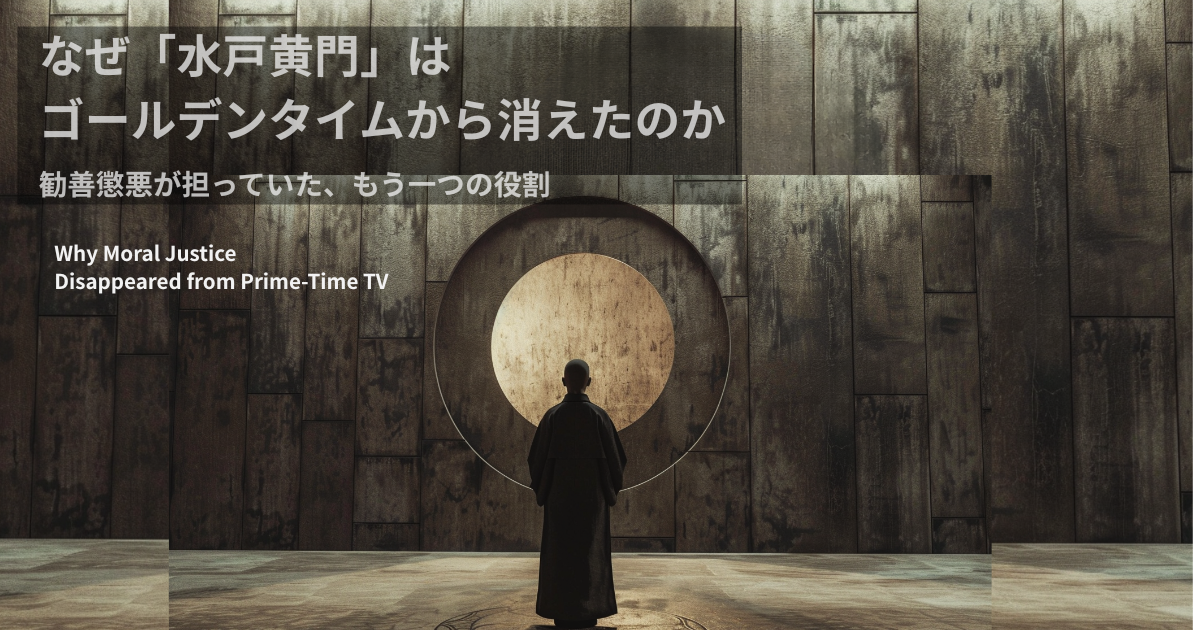
年末に、ひとつだけ考えておきたいこと
今年も残りわずかになりました。
今年は、急激に日本が劣化しているように見えます。
政治、報道、言論、そして社会全体の空気。
何が悪いのかが曖昧にされ、
誰も責任を取らないまま物事が進んでいく感覚が、
この一年で一気に強まったように感じられます。
その一因に、私はふと、
水戸黄門のような「勧善懲悪」の時代劇が、
ゴールデンタイムから姿を消したことがあるのではないか、
と思うようになりました。
年末という区切りの時期だからこそ、
この点について、少し立ち止まって分析してみたいと思います。
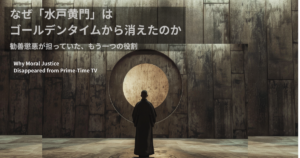
『水戸黄門』は、ただの時代劇ではなかった
『水戸黄門』は、勧善懲悪の象徴として語られがちだ。
だが実際には、極めて現実的な社会ドラマだった。
- 権力を持つ者が、弱者を踏みつける
- 役人と地元有力者が癒着する
- 声を上げた者が不利益を被る
構図は、時代劇の衣装をまとっていただけで、
中身はいつの時代にも存在する社会問題そのものだった。
そして最後に必ず示される。
「それは間違っている」という、はっきりした線引きが。
いつから、勧善懲悪は消えたのか
大きな転換は2000年代以降だ。
もちろん、時代劇そのものがゼロになったわけではない。
単発の特番や、深夜枠、専門チャンネル、配信には残った。
消えたのは「家族で同じ時間に見るゴールデン枠の定番」としての時代劇であり、
それに付随して、善悪を明確に描く“共有される物語”だった。
この変化には、いくつかの現実的な要因が重なっている。
① 産業としての条件が変わった(制作コストとリスク)
時代劇はセット・衣装・小道具・所作指導・ロケなど、制作要素が多い。
しかも「毎週同じ品質で回す」には、熟練のスタッフと現場の積み上げが要る。
一方でテレビ局は、制作費の圧縮と外注化を進め、
“熟練の現場”の維持が難しくなった。
結果として、コストに見合うだけの視聴率が読めない定番枠は、真っ先に削られやすい。
② 視聴の前提が崩れた(家族の同時視聴の解体)
かつてゴールデンタイムは、家族が同じ番組を見る時間だった。
今は、年齢層ごとに視聴が分断され、
“全世代が一緒に見る前提”が弱くなった。
この分断は、時代劇に限らず、
ゴールデン枠そのものを「国民的共有体験」から遠ざけた。
③ 広告モデルが変わった(嫌われないことが最優先に)
スポンサーにとって重要なのは、
番組が“好き”であること以上に、“嫌われない”ことになった。
悪を描けば、誰かが不快になる。
正義を語れば、立場を問われる。
そうした環境では、
善悪の線引きを明確にする作品ほど「面倒な火種」として扱われやすい。
④ 「政治的」に見えることへの過敏さ
勧善懲悪は、現代社会に接続すると一気にリアルになる。
利権、癒着、隠蔽、弱者の泣き寝入り。
だからこそ効くのだが、
同時に、誰かが「これはどこを批判しているのか」と読み替え始める。
結果として、テレビは“批判の矛先”を避ける方向へ傾き、
善悪をはっきり言う物語が、無難なものに置き換えられていった。
⑤ 相対主義の過剰適用
代わりに増えたのは、
「どちらも悪くない」「事情がある」という語り口。
それ自体は必要な視点だ。
ただし、社会全体がそれだけになると、
“怒っていいライン”が分からなくなる。
善悪を単純化しないことが成熟なのではなく、
線引きの議論そのものを避けることが“成熟”と誤解されてしまった。
現代社会の悪は、個人ではなく構造になった
今の社会では、
悪はもはや悪代官の顔をしていない。
制度、慣行、忖度、責任の分散。
誰も決定していないのに、
なぜか被害だけが生まれる。
だからこそ本来、
物語として一度シンプルに整理する装置が必要だった。
「これはおかしい」
「ここで線を引くべきだ」
そう確認するための共有体験として、
勧善懲悪の時代劇は機能していた。
ゴールデンタイムでやる意味
深夜でも、配信でもない。
家族が同じ時間に見るゴールデンタイムだったからこそ、
あの物語は意味を持っていた。
子どもも、高齢者も、
特別な知識がなくても分かる。
それは、民主主義の感情的な基礎訓練でもあった。
来年に向けて
勧善懲悪は、思考停止ではない。
むしろ、
複雑な現実を前に、
「最低限ここまでは許されない」という
社会の共通認識を作るための土台だった。
正義を語ることを怖がり、
善悪の線引きを放棄した社会は、
結局、誰の責任も問えなくなる。
来年に向けて必要なのは、
過激な答えではない。
まず、
怒っていいことに、きちんと怒れる社会であること。
かつてテレビが当たり前にやっていたことを、
私たちはもう一度、問い直してもいい時期に来ている。
One Thing Worth Reflecting on at the End of the Year
The year is almost over.
This year, it feels as though Japan has deteriorated at an alarming pace.
Politics, the media, public discourse, and the general social atmosphere.
The sense that wrongdoing is left undefined,
and that events move forward without anyone taking responsibility,
has intensified noticeably over the past year.
One possible reason came to mind.
Could it be that period dramas built around clear moral justice—
shows like Mito Kōmon—
have disappeared from prime-time television?
Mito Kōmon was a long-running Japanese prime-time television series, in which a retired feudal lord traveled the country in disguise, exposing corruption and abuse of power. Each episode ended with a clear moral judgment: wrongdoing by those in authority would not be tolerated.
Because this is the end of the year, a moment of pause and reflection,
I would like to examine this question calmly and analytically.
Mito Kōmon Was Not Just a Period Drama
The show is often dismissed as a simple morality tale.
In reality, it functioned as a highly practical social drama.
- Those in power exploiting the vulnerable
- Collusion between officials and local elites
- Ordinary people suffering for speaking out
The historical setting was merely a disguise.
The substance reflected social problems that exist in every era.
And in every episode, the conclusion was unmistakable:
“This is wrong.” A clear moral line was drawn.
When Did Moral Clarity Disappear?
The turning point came in the 2000s.
Period dramas themselves did not vanish entirely.
They survived as special programs, late-night shows, niche channels, or streaming content.
What disappeared was the prime-time staple—
a shared story watched simultaneously by families across generations.
Several concrete factors contributed to this shift.
1) Changes in Production Economics
Period dramas are costly.
Sets, costumes, props, choreography, and location shoots all require skilled labor.
Maintaining consistent quality week after week depends on experienced crews.
As television networks reduced budgets and outsourced production,
sustaining such craftsmanship became increasingly difficult.
Predictable ratings could no longer justify the cost.
2) The Collapse of Shared Viewing
Prime time was once family time.
Today, audiences are fragmented by age and platform.
The assumption that all generations watch together has largely disappeared.
This fragmentation weakened not only period dramas,
but the very idea of prime time as a shared national experience.
3) A Shift in Advertising Logic
For advertisers, being uncontroversial became more important than being memorable.
Portraying evil risks offending someone.
Declaring justice invites scrutiny.
In such an environment, stories with clear moral judgment are treated as liabilities.
4) Hypersensitivity to Being “Political”
Moral justice becomes uncomfortable when applied to the present.
Corruption, collusion, concealment, the silencing of the weak.
Precisely because these themes resonate,
they provoke defensive interpretations: “Who is this criticizing?”
To avoid such reactions, television gradually shifted toward safer, blander narratives.
5) The Overextension of Relativism
Stories increasingly emphasize that “both sides have their reasons.”
This perspective has value.
But when it dominates everything,
society loses its sense of where outrage is justified.
Avoiding moral boundaries came to be mistaken for maturity.
Today’s Evil Is Structural, Not Personal
In contemporary society, wrongdoing rarely has a single villain’s face.
Systems, customs, tacit consent, dispersed responsibility.
No one decides—yet harm occurs.
This is precisely why society once needed narratives that simplified complexity.
“This is wrong.”
“This is where the line should be drawn.”
Such confirmation, shared collectively, was the function of moral period dramas.
Why Prime Time Mattered
Not late night. Not streaming.
Prime time mattered because families watched together.
Children, adults, and the elderly could all understand—without explanation.
It was, in effect, an emotional foundation for democratic judgment.
Looking Ahead to the New Year
Moral clarity is not intellectual laziness.
It is the groundwork that defines what must not be tolerated,
even in a complex world.
A society afraid to speak of justice,
and unwilling to draw moral lines,
ultimately becomes a society where no one is accountable.
What we need in the coming year is not radical answers.
We need a society that knows when it is right to be angry.
It may be time to reconsider what television once did naturally— and why it mattered.

海外ニュースを多言語で読み比べ、「同じニュースが、言語や読者層によってどう書き換わるのか」 を分析しています。
日本の報道だけでは見えにくい 国際政治・情報戦・背景文脈 を、静かで冷静な筆致で読み解きます。
Calm insight from Tokyo.