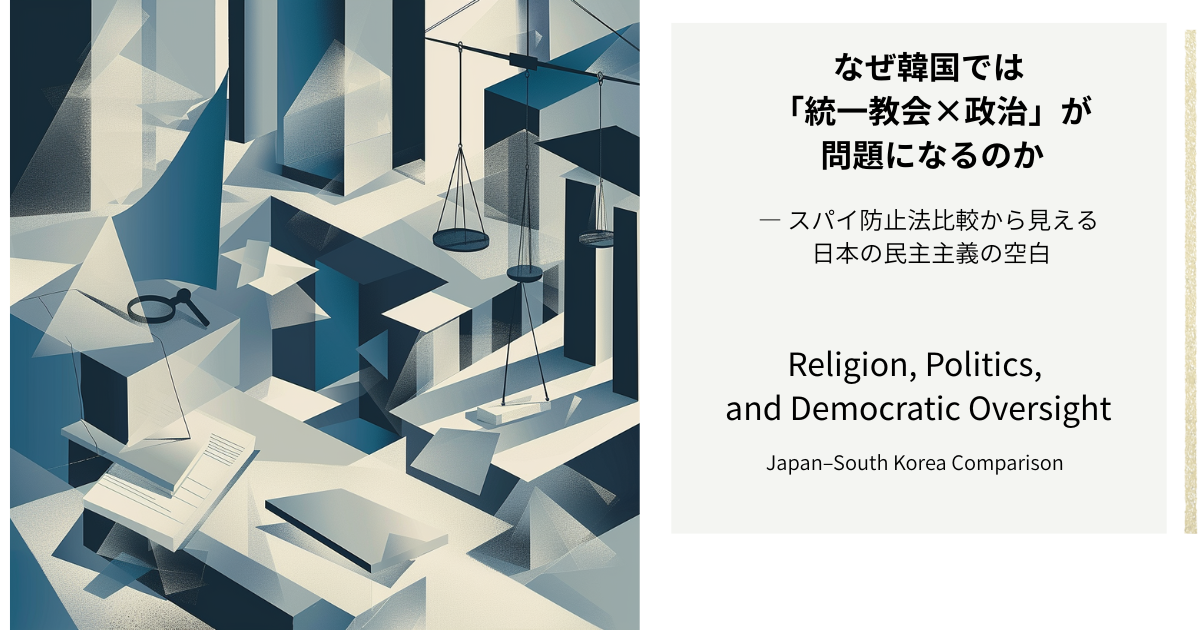
なぜ韓国では「統一教会×政治」が問題になり
日本では問題にならないのか
――スパイ防止法比較から見える、日本の民主主義の空白
1. 問題は「宗教」ではなく「国家の自己検証能力」だ
韓国で統一教会(旧統一教会)をめぐる問題が再燃し、その過程で日本の政治家との関係が言及されている。
この動きに対し、日本では「またか」という空気とともに、比較的早く沈静化が図られている。
だが、ここで問うべきなのは
「統一教会が危険かどうか」でも
「どの政治家が関係していたか」でもない。
本質的な問いは、もっと別のところにある。
なぜ韓国では、宗教団体の政治関与が国家の問題として扱われ、
日本では個々の説明責任に分解されて終わるのか。
これは宗教の違いではない。
国家が自分自身を検証できるかどうかの差だ。
2. 韓国では、なぜ政治と宗教の関係が問題化できるのか
韓国では、宗教団体であっても
政治・安全保障・国家意思決定に影響を及ぼす存在であれば、
それは「公共的な問題」として扱われる。
その背景にあるのが、国家保安法の存在だ。
この法律は賛否の多い法律であり、
表現の自由を侵すリスクが指摘されてきたのも事実である。
しかし一方で、ここには日本と決定的に異なる前提がある。
立場ではなく、行為を見る。
宗教であっても、右派であっても、
国家に不当な影響を与えれば対象になる。
韓国では、
「政治に影響を与える主体」は、
私人であれ団体であれ、検証の対象になりうる。
3. 日本では、なぜ問題が「個人の説明」で終わるのか
一方、日本ではどうか。
日本で統一教会問題が浮上すると、
議論はほぼ必ず次の形に収束する。
- 関係があったか、なかったか
- 違法性があったか、なかったか
- 説明責任は果たしたか
ここで一度「説明した」とされれば、
検証は始まらない。
なぜなら日本には、
- 政治と宗教の関係を
継続的に調査する制度 - 外国勢力の政治介入を
第三者が検証する枠組み - 権力側の説明を
制度として疑う装置
が、ほぼ存在しないからだ。
4. スパイ防止法をめぐる、決定的なねじれ
この文脈で重要なのが、
統一教会が日本で「スパイ防止法制定」を支持・期待してきた事実である。
直感的には、奇妙に見えるかもしれない。
本来、スパイ防止法とは
外国勢力による政治介入や諜報活動を取り締まるための法制度のはずだからだ。
しかし、日本では事情が異なる。
日本で語られるスパイ防止法は、しばしば
制度設計の問題ではなく、
次のような思想ラベルで語られてきた。
- 「愛国か、反日か」
- 「味方か、敵か」
- 「国家を守る側か、疑わしい側か」
この枠組みが前提になると、
ある種の逆転が起きる。
国家に近い位置にいる宗教団体や政治勢力は、
その立場ゆえに、最初から「守る側」に置かれてしまうのだ。
「反共」という免罪符
ここで、もう一つ見逃せない要素がある。
それが、「反共」という政治的免罪符である。
統一教会は長年、強い反共イデオロギーを掲げてきた。
冷戦期以降の日本政治において、
「反共」はしばしば
「国家にとって有益な立場」として受け取られてきた。
その結果、次のような構図が生まれる。
「敵と戦っている側」を、
制度として疑うこと自体が、ためらわれる。
反共であることが、
政治資金の流れや動員の実態、
政策への影響力を
検証の対象から外す理由のように扱われてしまうのだ。
だが、本来問われるべきなのは、
思想や立場ではなく、行為である。
反共であるかどうかは、
国家意思決定への不当な関与を
免責する理由にはならない。
反共は単なるスローガンではない。
日本では「勝共」運動(勝共系の政治活動)として制度外に根を張り、
政治と宗教の接触を「正当化しやすい回路」として機能してきた。
「守る法」が「選別の法」に変わるとき
このような前提のもとでは、
スパイ防止法をめぐる議論は、容易に歪む。
本来であれば、
スパイ防止法とは
誰であれ、どの団体であれ、国家に不当な影響を与える行為を検証するための法であるはずだ。
しかし日本では、
スパイ防止法を望む勢力が、
その法律で最初に調べられるとは限らない
という逆転が起きうる。
法は「守る盾」ではなく、
疑う相手を選別する武器へと変質してしまう。
ここにあるのは、
法が危険なのではない。
検証を前提としない制度設計が、法を危険なものに変えてしまうという問題だ。
このねじれこそが、
日本でスパイ防止法が繰り返し議論されながら、
同時に強い不信を招いてきた理由でもある。
そしてこの構造は、
次章で見るドイツやフランスとの比較によって、
さらに鮮明になる。
5. ドイツ・フランスとの比較で見える、日本の特殊性
この問題は、国際比較で見るとさらに明確になる。
スパイ行為や外国勢力による政治介入は、どの民主主義国家にとっても深刻なリスクだ。
重要なのは「危険があるか」ではない。
それを、どんな思想と設計で扱っているかである。
スパイ防止法(相当)を持つ国は、どんな国か
まず前提として、いわゆる「スパイ防止法」は一枚岩ではない。
多くの国は、単独の「スパイ防止法」という名前ではなく、
- スパイ行為(外国情報機関への協力・工作)を処罰する規定
- 国家機密・防衛情報の漏えいを処罰する規定
- 外国勢力による干渉(foreign interference)を処罰・可視化する枠組み
を、刑法・安全保障法・公務員秘密法などに分散して持っている。
代表例を挙げると、たとえば次のような国が「スパイ行為」や「機密漏えい」を明確に犯罪化している。
- 米国:防衛情報の漏えい等を処罰する枠組み(Espionage Act など)
- 英国:スパイ活動・外国勢力工作を扱う枠組み(National Security Act 2023 で近代化)
- ドイツ:刑法典に「外国情報機関の代理活動」等の規定を置く
- フランス:刑法典に「反逆・スパイ行為」章を置き、国外勢力への提供等を規定
- カナダ:国家安全・情報保護に関する枠組みでスパイや経済スパイ等を犯罪化
- オーストラリア:刑法の改正等でスパイ罪・外国干渉罪を整備
ここで重要なのは、単に「罰則がある」ことではない。
これらの国の多くは、スパイ対策を権限の強化としてだけではなく、
統制の設計とセットで組み立てようとしている点だ。
ドイツの場合:強い国家と、強い統制がセット
ドイツでは、スパイ行為や国家安全保障への侵害に対する法の射程は厳格だ。
同時に、権力側が情報を扱うときの統制(止める仕組み)が制度として強い。
ここにある前提は明確である。
国家は必要な権限を持つ。だが国家は誤る。
だからこそ「国家を守るための仕組み」は、必ず「国家を縛る仕組み」を含む。
この設計があるから、ドイツでは安全保障が“思想ラベル”に寄りかかりにくい。
「誰が正しいか」ではなく、「何をしたか」「どこで止めるか」に重心が置かれる。
フランスの場合:安全保障と宗教の切断が徹底される
フランスも、安全保障法制は強い。
しかし同時に、宗教と政治の関係については、制度として極めて厳格だ。
フランスの特徴は単純である。
- 宗教団体が政治的正当性の代理人になりにくい
- 宗教が「国家を守る側」を自称して安全保障言説に入り込む余地が小さい
この切断があるから、宗教団体の政治関与は「信仰の自由」で覆い隠されにくい。
信仰の自由は守りつつ、団体の政治作用は公共領域で検証される。
比較で浮かび上がる、日本の位置
ここまでの比較が示すのは、単純な優劣ではない。
ポイントは「強い法」と「強い統制」が、どれだけセットで設計されているかだ。
ドイツやフランス(そして英・加・豪などの多く)では、
スパイ対策は「国家を強くする」だけでなく、
国家を誤らせないための統制設計と不可分になりやすい。
一方、日本では議論がしばしば逆順になる。
- 危機が語られる
- 強い法が欲しがられる
- しかし「誰が運用し、誰が止めるか」が弱いまま残る
その結果、日本の特殊性はここに現れる。
「国家を強くする法」だけが先に欲しがられ、
「国家を疑い、制御する制度」が後景に退く。
ここで注意したいのは、これは日本が権威主義国家だという意味ではない、という点だ。
日本は明確に民主主義国家である。
しかし同時に、
権力を恒常的に検証する設計が弱い状態が続くと、
権威主義国に見られる特徴――「疑うことが制度上想定されない」という性質が、
民主主義国家の内部にも部分的に現れ始める。
つまり問題は「体制の同一視」ではなく、
権威主義的な挙動が入り込む余地を、制度不在という形で無意識に温存してきたことにある。
この位置づけこそが、次章のテーマ――
日本に欠けているのは「法」ではなく「設計思想」だ――という結論につながっていく。
6. 日本に欠けているのは「法」ではなく「設計思想」
こうして比較してみると、日本の問題ははっきりする。
日本は、
- スパイ防止法がない
- しかし
- 権力を恒常的に監視する制度も弱い
という、二重の空白を抱えた状態にある。
この状況はしばしば、
「スパイ防止法がないから日本は無防備だ」
という単純な不足論として語られる。
だが、問題の核心はそこではない。
本当に欠けているのは、
国家権力をどのように疑い、どの段階で止めるのかという設計思想そのものだ。
なぜ「法」だけが先に欲しがられるのか
日本では、安全保障や危機が語られるたびに、
「新しい法が必要だ」という議論が先に立つ。
しかし同時に、
- その法を誰が運用するのか
- その運用を誰が、どこまで、どう監視するのか
- 誤った運用を、誰が止められるのか
という問いは、ほとんど深められない。
つまり日本では、
「権力を縛る設計」を先に考えるのではなく、
「権力に力を与える法」だけが先に欲しがられる
という逆転が、繰り返し起きてきた。
設計思想が欠けたまま法を作ると何が起きるのか
権力監視の設計が弱いまま、
強い法だけが先に導入されれば、
その法は本来の目的とは異なる機能を帯び始める。
- 外国勢力を防ぐための法が、国内の言論を萎縮させる
- 国家を守るための法が、国家を批判する側を選別する
- 安全保障の名の下に、「疑われる側」が固定化される
このとき法は、民主主義を守る盾ではなく、
疑う相手を事前に仕分ける装置へと変質する。
これは理論上の危険ではない。
権力を疑う制度が弱い社会では、
ほぼ必然的に起きる現象だ。
なぜ日本ではそれが問題になりにくいのか
では、なぜ日本では、
この設計思想の欠如自体が問題になりにくいのか。
理由は単純だ。
日本の政治制度は、
- 「国家は基本的に善意で行動する」
- 「大きな逸脱は例外である」
という暗黙の前提の上に組み立てられてきた。
この前提に立つ限り、
権力を恒常的に疑う制度は、
「不信」「分断」「過剰反応」として後景に退けられる。
結果として日本では、
- 問題は個人の資質に回収され
- 説明が行われ
- 検証に入る前に幕が引かれる
という処理が、常態化する。
ここにあるのは、
権力を疑わないことによって維持される安定だ。
だがそれは、
検証を制度として放棄することで成立する、
きわめて脆い安定でもある。
統一教会問題が示しているのは、
まさにこの設計上の空白だ。
7. 統一教会問題が突きつけている「本当の問い」
統一教会問題は、宗教の是非を問う問題ではない。
また、特定の政治家の資質や道徳を裁く話でもない。
この問題が突きつけているのは、
もっと根源的な問いだ。
日本は、
「権力にとって都合の悪い問い」を
制度として発生させられる国なのか。
日本では、問題が起きるたびに
「説明責任」という言葉が使われる。
だが、その説明が
検証に接続された例はほとんどない。
説明とは本来、
検証の出発点であるはずだ。
しかし日本では、
説明は「区切り」として機能する。
説明した。
謝罪した。
関係は解消した。
――それで終わる。
ここにあるのは、
説明は求めるが、検証は設計しない国家
という歪な姿だ。
■ なぜ「構造」が見えなくなるのか
統一教会問題が
いつも「個々の関係」に分解されるのは偶然ではない。
構造を問うということは、
次の問いを不可避に含んでしまうからだ。
- なぜ長年、問題にならなかったのか
- なぜ特定の政治勢力と親和性を持ったのか
- なぜ資金・動員・推薦の流れが検証されないのか
- なぜ同じ構図が繰り返されるのか
これらを問えば、
個人ではなく、政治の設計そのものが俎上に載る。
日本政治は、
そこに踏み込む問いを
制度的に発生させないことで安定してきた。
統一教会問題は、
その「安定」の代償を可視化したにすぎない。
■ 「信教の自由」が守っているもの
日本では、
この問題が語られるとき、
必ず「信教の自由」が持ち出される。
だが、ここで守られているのは
本当に信教の自由だろうか。
問われているのは、
個人が何を信じるかではない。
宗教団体が
- 組織として
- 政治にどのような影響を与えてきたのか
という、公共性の問題である。
それを「信教の自由」に回収することで、
政治は最も都合の悪い検証から逃れる。
結果として守られているのは、
信仰ではなく、
説明で終わらせる権力の慣行だ。
結びに代えて
――日本は「疑わない国家」であり続けるのか
スパイ防止法があるかどうかは、本質ではない。
統一教会が問題なのかどうかも、本質ではない。
本当に問われているのは、これだ。
日本は、
国家に近い存在を
例外なく疑う制度を
持とうとしているのか。
疑わない国家は、
一見、穏やかで安定して見える。
だがその安定は、
検証を放棄することで維持される沈黙だ。
説明で終わる国。
検証が始まらない国。
構造を問わないことで
同じ問題を繰り返す国。
統一教会問題は、
その静かな劣化を照らしている。
これは過去の不祥事ではない。
いま現在の、政治の設計の問題だ。
日本がこの問いから
再び目を逸らすなら、
次に問題になるのは
別の宗教かもしれない。
別の団体かもしれない。
別の外国勢力かもしれない。
だが、構造が変わらなければ、
結末だけは同じだ。
説明が行われ、
検証は行われず、
そして忘れられる。
それを
民主主義と呼び続けるのかどうか。
いま、日本は
その瀬戸際に立っている。
Why does “Unification Church × Politics” become a national issue in South Korea—
but not in Japan?
—The democratic blind spot revealed by comparing counter-espionage laws
1. The real issue is not “religion,” but a state’s capacity for self-audit
In South Korea, controversy surrounding the Unification Church (formerly the Holy Spirit Association for the Unification of World Christianity) has resurfaced, and in that process connections to Japanese politicians have been mentioned.
In Japan, the reaction tends to be: “Here we go again,” followed by a quick drift toward quiet resolution.
But what we should be asking is not:
- “Is the Unification Church dangerous?”
- “Which politician was involved?”
The core question lies elsewhere.
Why is religious political influence treated as a national issue in South Korea, while in Japan it gets reduced to individual explanations—and ends there?
This is not a difference of religion. It is a difference in whether a country can institutionally examine itself.
2. Why South Korea can problematize politics–religion entanglement
In South Korea, even if the actor is a religious organization, if it affects politics, security policy, or national decision-making, it is treated as a public matter.
One background factor is the existence of the National Security Act.
This law is controversial, and it has long been criticized for risks to freedom of expression. Yet it also reflects a decisively different premise from Japan:
Focus on actions, not labels.
Even if an actor is religious, even if it is right-leaning, if it exerts improper influence on the state, it can become subject to scrutiny.
In South Korea, those who influence politics can, in principle, be investigated—whether individuals or organizations.
3. Why Japan’s debate ends with “individual explanations”
In Japan, when the Unification Church issue surfaces, the debate almost always collapses into a familiar checklist:
- Was there a relationship or not?
- Was anything illegal or not?
- Was “accountability” satisfied?
Once someone is deemed to have “explained,” institutional verification rarely begins.
Because Japan largely lacks:
- an ongoing mechanism to investigate politics–religion entanglement,
- a third-party framework to examine foreign political interference,
- an institutional apparatus designed to doubt and test the government’s explanations.
4. A Fundamental Distortion Surrounding Spy Protection Laws
In this context, one fact deserves particular attention:
the long-standing support and expectation expressed by the Unification Church in Japan for the enactment of a spy protection law.
At first glance, this may appear counterintuitive.
In principle, a spy protection law is meant to
prevent foreign interference and illicit intelligence activities that distort national decision-making.
Japan, however, presents a different situation.
Debates over spy protection laws in Japan have often been framed not as questions of institutional design, but through ideological labels, such as:
- “patriotic or unpatriotic”
- “ally or enemy”
- “defender of the state or a suspicious actor”
Once this framework is established, a critical reversal occurs.
Religious organizations or political actors positioned close to state power are,
by default, placed on the side of those who are presumed to be ‘protecting’ the nation—and thus escape scrutiny.
Anti-Communism as a Political Exemption
There is another factor that must not be overlooked:
anti-communism as a political exemption.
The Unification Church has long promoted a strong anti-communist ideology.
In post–Cold War Japanese politics, “anti-communism” has frequently been interpreted as
a position aligned with national interest.
This has produced a distinctive dynamic.
Questioning actors perceived as “fighting the enemy” becomes institutionally uncomfortable.
Anti-communism is treated, implicitly, as if it were a justification for excluding
financial flows, mobilization networks, and policy influence
from systematic examination.
Yet what should be examined is not ideological alignment, but conduct.
Whether an actor is anti-communist cannot serve as a legitimate exemption from scrutiny over undue influence on state decision-making.
Anti-communism, in this sense, is not merely a slogan.
In Japan, it has taken institutional form through so-called “Victory over Communism” (Shōkyō) movements—extra-institutional political activities that have functioned as
circuits through which political and religious proximity could be more easily legitimized.
When a Protective Law Becomes a Law of Selection
Under such conditions, debates surrounding spy protection laws become structurally distorted.
In theory, such laws should apply equally to any individual or organization whose actions exert undue influence on national governance.
In Japan, however, a reversal remains possible:
those who most strongly advocate for a spy protection law are not necessarily the first to be examined under it.
The law ceases to function as a shield safeguarding democratic integrity and instead risks becoming
a tool for selecting who is subject to suspicion and who is not.
The danger lies not in the law itself, but in
an institutional design that lacks mechanisms of prior and continuous verification.
This structural distortion helps explain why spy protection laws in Japan have repeatedly generated deep public distrust.
As the next chapter demonstrates, this contrast becomes even clearer when compared with institutional frameworks in Germany and France.
5. Japan’s uniqueness, revealed by comparison with Germany and France
International comparison sharpens the picture.
Espionage and foreign interference are severe risks for any democracy. The key is not whether a risk exists, but what design philosophy governs the response.
Which countries have “anti-spy laws” (or their functional equivalents)?
So-called “anti-spy laws” are not one uniform statute. Many countries do not have a single law literally titled “Anti-Spy Act.” Instead, they distribute provisions across criminal codes and security frameworks, such as:
- rules that punish espionage (cooperation with or acting for foreign intelligence services),
- rules that punish leaking state secrets or defense information,
- frameworks that criminalize or expose foreign interference.
Representative examples include countries that clearly criminalize espionage and/or classified-information leaks:
- United States: frameworks punishing disclosure of defense information (e.g., the Espionage Act and related statutes)
- United Kingdom: updated frameworks addressing espionage and hostile foreign activity (National Security Act 2023)
- Germany: criminal-code provisions including activity conducted on behalf of foreign intelligence services
- France: criminal-code provisions addressing treason/espionage and provision of sensitive information to foreign powers
- Canada: national security / information-protection frameworks criminalizing espionage (including economic espionage)
- Australia: reforms establishing espionage and foreign-interference offenses
The crucial point is not simply “there are penalties.” Many of these countries attempt to pair stronger security enforcement with designed oversight and control.
Germany: a strong state paired with strong restraints
Germany treats espionage and national-security violations with strict legal reach. At the same time, institutional restraints on state power—especially on how authorities handle sensitive information—tend to be robust.
The premise is clear:
The state needs authority. But the state can also be wrong.
Therefore, mechanisms that “protect the state” must include mechanisms that “bind the state.”
Because this design exists, security debates are less likely to rely on ideological labeling. The focus shifts to what was done and where the brakes exist.
France: security policy combined with a firm separation from religion
France also maintains strong security legislation. But it is equally strict about keeping religion at a distance from political legitimacy.
- Religious groups have little room to claim political authority.
- Religious actors have limited space to enter security discourse by presenting themselves as “defenders of the nation.”
Because of that separation, political influence by religious organizations is less easily shielded by vague appeals to “freedom of religion.” Freedom of belief is protected, while organizational political effects remain open to public scrutiny.
Japan’s position, as revealed by the comparison
This comparison is not about ranking countries. The point is how often “strong law” and “strong oversight” are designed as a package.
In Germany and France (and in many cases the UK, Canada, Australia, and others), counter-espionage measures tend to be paired with institutional designs meant to prevent state power from drifting.
In Japan, the sequence often flips:
- a “threat” is emphasized,
- stronger law is demanded,
- but the questions of “who operates it” and “who stops it” remain weak.
Japan’s peculiar vulnerability appears here:
“Laws that strengthen the state” are sought first,
while “institutions that doubt and control the state” recede into the background.
To be clear: this does not mean Japan is an authoritarian state. Japan is plainly a democracy.
Yet when the design to continuously verify power remains weak for long periods, features seen in authoritarian systems—namely a situation in which “doubt itself is not institutionally assumed”—can begin to appear partially inside a democracy.
In other words, the issue is not “identical regimes,” but that Japan has unconsciously preserved—in the form of institutional absence—space where authoritarian-style behavior can slip in.
This positioning leads directly to the next chapter’s theme: what Japan lacks is not “a law,” but a design philosophy.
6. What Japan lacks is not “a law,” but a “design philosophy”
Seen through this comparison, Japan’s problem becomes clearer.
Japan faces a double vacuum:
- no comprehensive counter-espionage legislation, and
- weak institutional capacity to continuously oversee power.
This is often framed as a simple deficiency—“Japan is defenseless because it lacks an anti-spy law.”
But the core problem is different.
What is missing is the design philosophy of how to doubt state power and where, institutionally, to stop it.
Why only “law” tends to be demanded first
Whenever security threats are emphasized in Japan, debate quickly shifts to “we need a new law.”
But questions like these remain underdeveloped:
- Who will operate the law?
- How—and to what extent—will that operation be overseen?
- Who can stop misuse or drift?
As a result, Japan repeatedly falls into a reversal:
Rather than designing how to restrain power,
only laws that empower the restraining side get demanded first.
What happens when law comes before design
If oversight design remains weak while strong law arrives first, the law begins to acquire functions beyond its stated purpose:
- a law to deter foreign powers can chill domestic speech,
- a law to “protect the nation” can become a tool for sorting critics,
- under the banner of security, “the suspicious side” can become fixed.
At that point, law can shift from a shield for democracy into a device that pre-selects who gets doubted.
This is not merely theoretical. In societies where institutions to doubt power are weak, such drift is structurally likely.
Why it is hard for Japan to treat this as a problem
Why does the absence of design itself fail to become an issue?
Because Japan’s political culture has often been built on an implicit assumption:
- “The state basically acts in good faith,”
- “Major deviation is exceptional.”
Within that assumption, institutional doubt looks like “distrust,” “division,” or “overreaction.”
So problems are routinely processed as:
- reduced to personal responsibility,
- followed by “explanations,”
- then closed before verification begins.
What remains is stability maintained by not doubting power—yet it is a fragile stability built on the abandonment of verification.
The Unification Church issue exposes precisely this design vacuum.
7. The question the Unification Church issue truly forces upon Japan
This is not a debate about whether religion is good or bad. Nor is it merely a moral trial of individual politicians.
The deeper question is this:
Can Japan generate—by institutional design—questions that are inconvenient for those in power?
In Japan, “accountability” is demanded whenever scandal arises. Yet “explanation” rarely becomes the start of institutional verification.
Explanation should be the beginning. In Japan, it functions as closure:
Explained. Apologized. Relationship ended. —And that is that.
What appears here is a distorted state: one that requests explanations but does not design verification.
Why “structure” disappears
This issue is repeatedly broken down into “individual ties.” That is not accidental.
To ask about structure inevitably forces questions such as:
- Why did it go unchallenged for so long?
- Why did it align with particular political forces?
- Why are money, mobilization, and endorsements not examined as a flow?
- Why does the same pattern recur?
Ask these and the focus shifts from individuals to the political system’s design itself. Japan has remained stable by not institutionally generating that question.
What “freedom of religion” ends up protecting
In Japan, “freedom of religion” is often invoked. But what is at issue is not what individuals believe.
The public question is what an organization, as an organization, has done to politics.
By collapsing the issue into “freedom of religion,” politics escapes verification. What is protected is not faith but the governing habit of ending with explanations.
Conclusion
—Will Japan remain a state that does not doubt?
Whether Japan has an “anti-spy law” is not the essence. Whether the Unification Church is uniquely problematic is not the essence.
The real question is:
Is Japan willing to build institutions that doubt—even those close to the state—without exception?
A state that does not doubt can look calm and stable. But that stability is silence maintained by abandoning verification.
A country where explanations end everything. Where verification never begins. Where structure is never asked—and the same problem repeats.
This is not a past scandal. It is a present design problem.
If Japan looks away again, the next case may involve a different religion, a different organization, or a different foreign actor. But if structure does not change, the ending will remain the same:
Explanation. No verification. Forgetting.
Whether we continue to call that “democracy” is the line Japan is now standing on.
参考文献・資料
■ 統一教会と政治・宗教団体の公共性(日本語文献)
-
文化庁:宗教法人と宗務行政
-
宗教学会:宗教法人の現状について
-
カルト宗教のトラブル対策:日本と欧米の実情と取り組み
山口 広 著(教育史料出版会/2000年) -
カルト宗教
紀藤 正樹 著(アスコム) -
自民党の統一教会汚染 追跡3000日
鈴木 エイト 著(小学館/2022年) -
統一教会との格闘、22年
鈴木 エイト 著(角川新書/2025年)
■ 参考文献(報道記事・リンク付き)
-
Reuters,
At trial of South Korea’s Unification Church head, prosecutors allege luxury bribes
(統一教会指導部をめぐる贈賄疑惑と裁判開始) -
Reuters,
South Korea’s former first lady received bribes and meddled in state affairs, prosecutors say
(元大統領夫人への贈賄・国家事務関与疑惑) -
South China Morning Post (SCMP),
South Korean politicians agree to Unification Church special probe in rare move
(与野党が統一教会の政治関与を調べる特別検察に合意) -
The Korea Times,
Explainer: Unification Church lobbying probe roils Korean politics
(統一教会ロビー活動疑惑と韓国政治への影響解説) -
The Straits Times,
Mass weddings and political power: Why the Unification Church keeps resurfacing in South Korean politics
(統一教会の歴史的背景と政治関与の構造分析)
■ 韓国地元メディア(関連記事・公式サイト)
- ハンギョレ新聞(한겨레) https://www.hani.co.kr (統一教会の政治介入・特検関連記事)
- キョンヒャン新聞(경향신문) https://www.khan.co.kr (統一教会・政界癒着疑惑の連続報道)
- 中央日報(중앙일보) https://www.joongang.co.kr (検察捜査・政界波及の報道)
- 朝鮮日報(조선일보) https://www.chosun.com (統一教会幹部裁判と政治的影響)
- KBS News / SBS News https://news.kbs.co.kr / https://news.sbs.co.kr (検察・特別検察の捜査動向)
※ 上記はすべて一次報道または主要メディアによる事実報道であり、
宗教の是非ではなく、政治・司法・制度への影響として統一教会問題を扱った記事である。
■ スパイ行為・外国干渉・安全保障法制(国際比較)
- United States, Espionage Act (18 U.S.C. §§ 793–798)
- United Kingdom, National Security Act 2023
- Germany, Strafgesetzbuch (StGB) §§94–100a(国家機密・外国諜報)
- France, Code pénal(反逆・スパイ行為関連条項)
- Canada, Security of Information Act
- Australia, Criminal Code(Espionage and Foreign Interference reforms)
■ 権力監視・民主主義・制度設計・宗教と政治(理論・比較政治)
- Bruce Ackerman, The Decline and Fall of the American Republic
- Mark Tushnet, Weak Courts, Strong Rights
- Guillermo O’Donnell, “Delegative Democracy,” Journal of Democracy
- Steven Levitsky & Daniel Ziblatt, How Democracies Die
- José Casanova, Public Religions in the Modern World
- Talal Asad, Formations of the Secular
- フランス政府公式資料:Laïcité(政教分離原則)
■ 日本の政治思想・民主主義論
- 丸山眞男『日本の思想』
- 宇野重規『民主主義とは何か』 (講談社)
- 苅部直『日本政治思想史』 (岩波新書)
※ 本稿は特定の宗教団体や法制度を断罪することを目的とするものではなく、
宗教・政治・安全保障が交差する場面における「制度設計」と「民主主義の自己検証能力」を比較検討するためのものである。
※本記事の分析パートは、海外報道・学術研究・公開データを基に編集部が独自に再構成したものです。
※The analytical sections in this article are independently compiled by the Editorial Desk based on international reporting, academic research, and publicly available data.

海外ニュースを多言語で読み比べ、「同じニュースが、言語や読者層によってどう書き換わるのか」 を分析しています。
日本の報道だけでは見えにくい 国際政治・情報戦・背景文脈 を、静かで冷静な筆致で読み解きます。
Calm insight from Tokyo.

コメント
コメント一覧 (2件)
記事を拝聴させていただきましたが、とても深い慧眼をお持ちのようです。
法ではなく、権力の監視へ検討不足を指摘されているのは、とても素晴らしい着眼点と思います。
ただ、現状の官僚制度においては、目の前の問題解決のための立法や法改正でしかできておりません。そのテコ入れでさえも相当なコスト(時間・労力・人件費)がかかっております。
世界の潮流を見ますと、科学の発展に伴い、物流のみに限らず、デジタル分野においては目まぐるしく進化が早く、その脅威(各種犯罪及びそれに伴うマネロン)に対する対策は、法律では全く間に合っておりません。
法律以外の何かしらの強制力を持った取り組みによって国内をコントロールする必要があると考えております。
ただ、日本は法治国家という建前で国際社会に認められているものですから、法律以外の第3のルールによって国を統制しようとなれば、新たな余波を生むことになると思います。
真に必要な討論が国会でできていない現状を打破する方法は一体どうすればいいのでしょうか?
丁寧に読んでいただき、ありがとうございます。
ご指摘の通り、
日本が法治国家として国際的に信頼されてきたこと、
また、法の外側での強権的コントロールが望ましくないことには、
私も同意します。
この記事で問題にしているのは、
「スパイ防止法が必要か否か」そのものではありません。
また、「法以外の手段で制御すべきだ」という主張でもありません。
問うているのは、
・新しい法を作る前に
・その法が誰に、どのように適用されるのか
・権力側を検証する仕組みが設計されているのか
という点が、日本ではほとんど議論されないまま、
「危機」や「必要性」だけが先行してしまう構造です。
韓国や欧州諸国との比較で示したかったのは、
強い法があるかどうかではなく、
強い法と同時に、
権力を疑い、検証する制度がセットで存在しているかどうか、
という違いでした。
ご指摘いただいた
「真に必要な議論が国会でできていない」という点は、
まさに本稿の問題意識と重なっています。