米大統領ドナルド・トランプが、NVIDIAの先端AI半導体「H200」を中国を含む“承認された顧客”へ輸出可能にする方針を投稿で発表した。
この発言は、単なる貿易措置ではなく米中技術覇権や経済安全保障にも影響を及ぼす内容だと受け止められている。
一見すると、米中関係の緊張緩和と米国産業の支援を両立する“取引”にも見えるが、この発言は、AI機密技術・国家安全保障・国際秩序に深い影響を及ぼす複雑な問題を抱えている。
本記事では、トランプの投稿内容を一次情報から検証し、その背後にある政治的レトリックと政策上の矛盾を徹底的に読み解いていく。
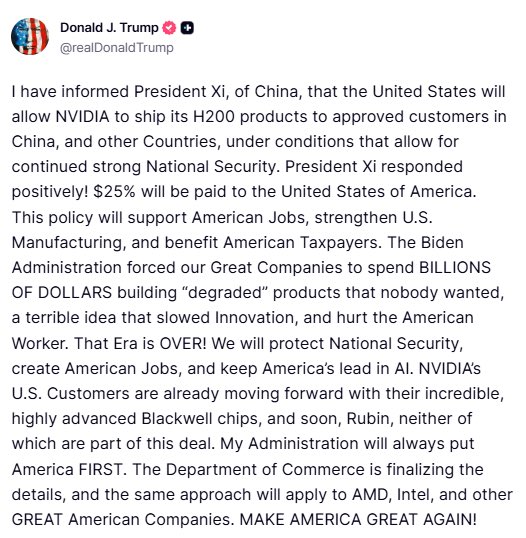
トランプの投稿(原文)
【トランプ投稿の日本語翻訳】
私は習近平主席に、アメリカは NVIDIA の H200 を中国およびその他の国々に対し、 「承認された顧客」に限って輸出を認める方針だと伝えました。 その条件とは、アメリカの強固な国家安全保障が維持されることです。 習主席は前向きに応じました! 売上の25%がアメリカに支払われることになります。
この方針はアメリカの雇用を支え、製造業を強化し、納税者の利益にもつながります。 バイデン政権は、我々の偉大な企業に対し、誰も望まない「性能を落とした」製品に 数十億ドルを費やさせました。これはイノベーションを遅らせ、アメリカの労働者を 傷つける最悪の発想でした。
だが、その時代は終わりです! 私たちは国家安全保障を守り、アメリカの雇用を創出し、 AI分野でのアメリカのリードを維持します。すでに米国内の NVIDIA 顧客は、 極めて高度な Blackwell チップ、そして Rubin へと移行しています。 これらは性能を落とした製品ではありません。私の政権は常に「アメリカ第一」です。
商務省は現在その詳細を最終調整しており、同じ方針は AMD、Intel、その他の 偉大なアメリカ企業にも適用されます。 MAKE AMERICA GREAT AGAIN!
トランプ発言の背景と問題点
1. AI半導体の輸出は「国家安全保障の中核」
H200クラスのAIチップは、
- 生成AI
- 監視技術
- ミサイル誘導
- 大規模モデルの軍事応用
など、軍事転用リスクが最も高いカテゴリーに属する。
そのためバイデン政権は2022〜2023年にかけて厳格な輸出規制を敷き、中国向けには性能を制限した専用モデル(A800/H800)しか売れない状況が続いていた。
トランプが示した“条件付き解禁”は、その輸出規制の根幹を揺るがす方針転換となる。
2. しかし「安全保障上の条件」が全く説明されていない
トランプは「強固な国家安全保障を維持する条件付き」と述べているが、
- どの国・企業が“承認顧客”なのか
- 転売・再輸出をどう防ぐのか
- 軍事利用の監視をどう行うのか
といった輸出管理の本質的な要素は一切語られていない。
AI半導体の輸出管理は世界で最も複雑な分野であり、単純に“条件付きで売れる”という話では済まない。
3. 「25%がアメリカに支払われる」発言の根拠は不明
投稿では、NVIDIAの売上の25%が米国に支払われると述べているが、そのような仕組みは現在の輸出制度に存在しない。
関税なのか、特別徴収制度なのか、あるいは単なる政治的レトリックなのか。
少なくとも現段階では、検証不能な主張と言わざるを得ない。
4. トランプの主張は「バイデン批判」に収斂する
トランプはバイデン政権を批判し、「性能を落とした“degraded”製品を作らせただけの愚策だった」と述べている。
これには誇張が含まれる。たしかに輸出規制のためNVIDIAは性能を抑えたモデルを作ったが、これは国家安全保障を守るための措置であり、企業は規制に合わせて戦略的に対応してきただけである。
トランプの語り口は、
- バイデン政権=企業の邪魔
- トランプ政権=企業を救う
という選挙戦略上の構図に沿っている。
5. Blackwell/Rubin世代はそもそも「規制対応前提」で設計
投稿では「Blackwell や Rubin は degraded ではない」と強調しているが、これは事実。
ただし背景には、NVIDIAが規制を見越して設計段階で複数モデルを用意したという企業側の技術戦略がある。
つまり、トランプの手柄ではなく、企業の適応力と先回りした設計によるものである。
6. 習近平が「前向きに反応した」かどうかは確認不能
外交交渉の詳細は公開されないため、この発言が事実に基づくのか、それとも「トランプ外交の自己物語化」なのかを判断することはできない。
過去の例を見ても、トランプは「相手国のトップと特別な関係を築いた」というナラティブを好んで使う傾向がある。
7. 本質:これは“政策説明”ではなく“政治パフォーマンス”
今回の投稿は、
- 「アメリカの雇用」
- 「製造業の復活」
- 「国家安全保障」
- 「AIでの覇権維持」
といった選挙用の象徴ワードが並び、実務的な政策詳細はほぼ欠落している。
つまりこれは、米中AI競争の「複雑さ」を排除し、「自分がアメリカの技術産業を救う」という物語を構築するための政治的メッセージである。
8. アメリカは本当に「売りたい国」なのか、「止めたい国」なのか
AI半導体の輸出をめぐるアメリカの本音は常に二重構造である。
売りたいインセンティブ:
- NVIDIAやAMD、クラウド企業は、中国市場からの売上が依然として大きい。
- 開発費が年数千億〜1兆円規模になっている今、「中国を完全に切り捨てる」ことは株主から見ればリスク。
止めたいインセンティブ:
- 軍・情報機関・安全保障専門家は、「中国に先端AI計算能力を渡すのは自殺行為だ」と見ている。
- 監視国家システム・軍事AI・サイバー攻撃能力の強化に直結するため、長期的には“自分の首を絞める輸出”になりかねない。
バイデン政権は、この二つの力の間で「安全保障を優先しつつ、企業には抜け道を残す」というぎりぎりの線を探ってきた。
トランプの投稿は、このバランスを「もっと売れるようにしてやる。安全保障? 大丈夫、俺が守る」という単純な物語へ置き換えている。
9. 「条件付き解禁」は、実務レベルでは最も難しい選択肢
安全保障の専門家の視点から見ると、実は扱いが最も難しいのが“条件付きで売る”という選択肢である。
完全禁止:
企業は痛いが、ルールはシンプルで監視コストも比較的低い。
完全解禁:
安全保障リスクは高いが、行政の仕事は減る。
しかし「条件付き解禁」は、
- どこまでの性能なら許可するのか
- どのエンドユーザーまでなら許可するのか
- 禁止対象との境界線をどう更新するのか
- 曖昧なグレーゾーン案件を誰が、どの基準で裁くのか
といった“永遠に増え続ける判断コスト”を生む。
トランプの言う「承認された顧客にだけ売る」というのは、一見「慎重」なようでいて、実務的には最も不安定で、ロビー活動と政治介入の温床になりやすい選択肢である。
10. 「25%支払い」発言が危うい2つの理由
❶ 経済合理性の問題
- もし本当に25%を米政府に支払わせるようなスキームを導入すれば、中国側は別サプライヤーへ急速にシフトする。
- NVIDIA側も「中国市場を維持するコスト」として割に合わなくなる可能性が高い。
つまり、やればやるほど“自国企業の競争力を削ぐ”構造になりかねない。
❷ 同盟国へのメッセージとしての問題
米国が「中国に売るチップから25%取り立てる」という枠組みを採用すれば、ヨーロッパや日本、台湾に対しては、
「安全保障リスクはあっても、金になれば売る」
というシグナルにも見えてしまう。
同盟国は、「安全保障のために中国依存を減らせ」と言われている側なのに、当のアメリカが「実は高いマージンを取って売っていました」となれば、説得力が崩れる。
11. 中国側から見た“絶好のプロパガンダ材料”になる可能性
この投稿がそのまま政策化されるかは別として、中国共産党にとっては次のような“語り”に使いやすい素材である。
- 「アメリカは結局、金さえ払えば技術を売る国だ」
- 「制裁と言いながら、実は自分たちの企業を儲けさせたいだけ」
- 「中国の市場力がアメリメリカをひざまずかせた」
対外宣伝だけでなく、国内向けにも「わが国の交渉力でアメリカに譲歩させた」というストーリーに転換できる。
AIチップをめぐる米中の対立は、軍事バランスだけでなく“物語の戦い”でもあるので、トランプ氏の発言は、中国の宣伝機関にとって非常に使い勝手が良い素材となる。
12. NVIDIA・ビッグテックはどう受け止めるか
表向き、NVIDIAなどの企業は「規制に従う」としか言えないが、水面下では次のような計算をしている。
- 長期的成長 vs 短期売上のバランス
- 中国依存を下げつつ、他地域のデータセンター投資で穴を埋められるか
- 政権交代による政治リスクの増大
企業にとって最悪なのは、政権交代や政治判断によってルールが頻繁に変わることである。今回の投稿は、企業にとって“具体像が見えないまま期待だけが煽られる状態”を生み、不確実性を増大させる。
13. “トランプ外交の物語化パターン”として位置づけると見えてくるもの
今回の投稿は、これまでのトランプ外交のパターンに非常によく似ている。
- 敵対相手のトップを名指しで持ち上げる:「Xi is a friend」「he responded positively」など。
- ビリオンダラー級のディールとして誇張:「25%支払い」「米国の雇用が増える」。
- 前政権を無能扱い:「Bidenは誰も要らない degraded products を作らせた」。
- 最後は“自分だけが解決できる”物語に収束:「My Administration will always put America First」。
この4点セットで複雑な国際問題を“自分の武勇伝”に変換するのがトランプ流の一貫した手法である。
AI半導体のように本来は専門的議論が必要なテーマでさえ、同じフォーマットに投げ込まれているのが今回の特徴である。
14. シナリオ別の「現実的な帰結」
実際の政策としてどう転ぶ可能性があるか、3つのシナリオで整理する。
シナリオA:大幅緩和
- H200クラスが中国向けに“ほぼフル解禁”される。
- 短期的にはNVIDIAの売上が急増。
- 長期的には中国の軍事AI能力の加速を招き、議会・安全保障コミュニティは激しく反発。
シナリオB:名目上は緩和、実務はほぼ現状維持
- 承認顧客のハードルが高く、実際の許可はごく一部。
- トランプは「解禁した」と主張しつつ、実務ではバイデン時代から大きく変わらない。
- レトリックと現実のギャップは大きいが、安全保障リスクは限定的。
シナリオC:そもそも政策化されない
- 投稿は選挙向けメッセージで終わり、制度変更は行われない。
- 不確実性だけが残り、企業は複数シナリオを前提に動かざるを得ない。
議会・安全保障コミュニティの反発、同盟国の目線を考えると、現時点では B か C の可能性が高いと見るのが現実的だろう。
【総括】
トランプは「H200対中輸出容認」を、アメリカの雇用と国家安全保障を同時に守る“ウィンウィンのディール”として語ろうとしている。
しかし、その内側を覗いてみると、
- 安全保障と産業政策の矛盾
- 同盟国への複雑なメッセージ
- 企業が最も嫌う不確実性の増大
- 中国にとっての格好のプロパガンダ素材
- そして「現実よりも物語を優先する政治」の影
AI半導体は、もはや単なるテクノロジーではなく地政学そのものである。今回のトランプ氏の投稿は、米中技術覇権争いが新たな局面に入りつつあることを示す“入口”として位置づけられるだろう。
【日本はどう動くべきか】
今回のトランプの発言が示しているのは、米中のAI覇権が「規制」ではなく「政治交渉」へと急速にシフトしているという事実です。これは、日本にとって大きなリスクでもあり、同時に戦略的チャンスでもあります。
第一に、日本は“技術的自立”の速度を上げるべきです。
先端AIチップの供給が、米政権の判断一つで左右される状況は、長期的に見て安全保障上の弱点となります。TSMC熊本の意義は大きいものの、依存先の分散と国産技術の下支えは不可欠です。
第二に、日米間で「AI安全保障」の共通基準を整備する必要があります。
トランプのように方針が急転換する場合、同盟国が最も困るのは“前提条件が揺れること”です。日本としては、どの政権が来ても揺らがない「最低限のルール作り」を米国と共有しておくべきです。
第三に、日本は“アジアのAI規制ハブ”としての立ち位置を確立できる可能性があります。
米国が政治化し、中国が国家統制を強める中で、透明性の高い日本の制度設計は国際的な信頼を得やすい。AI倫理・輸出管理・データ安全など、日本が主導できる領域は広いはずです。
AI半導体の地政学が激しく揺れる時代において、日本がすべきことは「受け身で振り回される側」から「ルール作りの側」に回ることなのかもしれません。
Trump’s H200 Export Announcement: Policy Contradictions, Security Risks, and the Strategic Stakes of U.S.–China AI Competition
Trump’s H200 Export Approval: Political Narrative vs. Strategic Reality
President Donald Trump recently announced that NVIDIA’s H200 AI accelerator would be allowed for export to China and other “approved customers.” He also claimed that President Xi Jinping responded positively and that 25% of the revenue would go to the United States.
At first glance, the message sounds like a breakthrough that balances economic opportunity with national security. But once you look past the headline, the announcement reveals a set of contradictions, vague conditions, and strategic risks that go far beyond a campaign talking point.
This analysis examines what Trump’s statement implies for U.S.–China competition, technology governance, and allied coordination — and why it matters.
Trump’s Post (Original)
1. Advanced AI chips have become core national-security assets
H200-class accelerators power:
- generative AI
- surveillance and biometric systems
- missile guidance and targeting
- large-scale military AI models
Given these dual-use capabilities, the Biden administration imposed strict export controls from 2022 onward, limiting China to downgraded A800/H800 chips. Allowing H200 exports — even “conditionally” — cuts directly against the logic of those rules.
2. The announcement offers no real clarity on security conditions
Trump said approval would be granted only under “strong national-security conditions,” but he did not answer critical policy questions:
- Who qualifies as an “approved customer”?
- How will diversion or re-export be prevented?
- What end-use monitoring will be enforced?
- What constitutes a violation — and who decides?
In practice, export controls for AI accelerators are among the most technically demanding areas of modern regulation. A vague condition is not a framework — it is an uncertainty multiplier.
3. The “25% revenue to the U.S.” claim has no legal basis
No such mechanism exists in current U.S. export law. Whether Trump meant tariffs, a new surcharge, or simple exaggeration remains unclear. At this stage, the claim is unverified.
4. The framing aligns with Trump’s familiar political narrative
The announcement follows a predictable structure:
- Biden harmed American companies.
- Trump restores competitiveness.
- Foreign leaders respond to Trump personally.
- Only Trump can fix the system.
However, NVIDIA created downgraded models because U.S. law required it — not because the products were unwanted. This is politics, not policy.
5. Blackwell and Rubin were engineered with export controls in mind
Trump is correct that these chips are “not degraded.” But this is because NVIDIA proactively designed multi-tier architectures anticipating regulatory limits. This reflects industry strategy, not a political achievement.
6. Xi Jinping’s “positive response” cannot be verified
Diplomatic exchanges of this nature are rarely disclosed. Trump frequently turns foreign policy into personalized narratives, so this claim cannot be treated as confirmed fact.
7. The announcement resembles campaign messaging, not regulatory guidance
The statement highlights familiar themes — jobs, manufacturing, national security, AI leadership — but omits the one thing regulators and companies need: operational detail. This is election-season communication, not a policy framework.
8. The U.S. faces a structural tension: “sell more” vs. “restrict more”
Incentives to sell:
- NVIDIA, AMD, and hyperscalers rely heavily on China’s AI-compute demand
- AI chip development costs have soared into the billions
Incentives to restrict:
- the Pentagon and intelligence agencies warn that advanced compute accelerates China’s military AI and cyber capabilities
- long-term risks outweigh short-term revenue
Biden attempted to balance these forces. Trump’s framing simplifies the landscape into:
“Let companies sell — I’ll handle security.”
9. “Conditional approval” is the most unstable regulatory model
From a governance perspective:
- Total bans → clear and enforceable
- Total allowance → risky but administratively simple
- Conditional allowance → endless case-by-case judgment, lobbying pressure, inconsistent enforcement
It is the least stable model for managing high-risk technology.
10. Why the “25% payment” narrative is strategically risky
Economic risk: China would accelerate domestic alternatives, harming U.S. competitiveness.
Alliance risk: To allies, it signals:
“The U.S. will sell high-risk technology if the price is right.”
11. China can easily convert this narrative into propaganda
Beijing can frame the announcement as evidence that:
- U.S. sanctions are transactional
- China forced American concessions
- profit, not principle, guides U.S. policy
12. How Big Tech is likely to view the announcement
Publicly, firms will say they comply with U.S. law. Privately, they worry about:
- regulatory volatility
- policy shifts after elections
- planning uncertainty
- high R&D costs for multi-tier product lines
The announcement creates uncertainty without offering actionable guidance.
13. The pattern aligns with Trump’s diplomatic communication style
The familiar formula remains:
- praise the adversary’s leader
- inflate the scale of the deal
- attack the previous administration
- end with a heroic personal narrative
14. Likely policy trajectories
Scenario A: Substantial loosening
Unlikely — Congress and the Pentagon would resist strongly.
Scenario B: Symbolic loosening with limited effect
Most probable.
Scenario C: No implementation
The announcement remains campaign rhetoric.
Considering political and institutional pressures, Scenario B or C is the realistic outcome.
Conclusion
Trump frames the H200 export approval as a “win–win” for the economy and national security. Yet beneath the narrative lie:
- contradictions between industry incentives and national-security imperatives
- damaging signals to allies
- heightened uncertainty for U.S. tech firms
- propaganda advantages for China
- a communication style that prioritizes narrative over policy substance
AI accelerators have become geopolitical instruments. This announcement marks a new, more volatile phase in U.S.–China AI competition — not a resolved policy shift.
What Japan Should Do
- Accelerate technological autonomy: Japan cannot rely solely on U.S. political cycles to secure critical compute.
- Build a durable AI-security framework with the U.S.: Shared rules must survive electoral transitions.
- Position Japan as Asia’s AI-governance hub: Japan’s transparency provides an alternative to U.S. politicization and China’s authoritarian model.
Japan’s strategic opportunity lies in becoming a rule-maker, not a rule-taker.
【参考文献】
- U.S. Department of Commerce, Bureau of Industry and Security (BIS): Export Controls on Advanced Computing and Semiconductor Manufacturing Items.
- NVIDIA Investor Relations: Product Roadmaps (H100 / H200 / Blackwell / Rubin).
- Financial Times: US–China tech war / semiconductor export controls.
- Reuters: “US expands China chip curbs.”
- Semianalysis: Analysis of NVIDIA Blackwell/Rubin and export control impact.
- CSIS: US Semiconductor Export Controls Review.
- Carnegie Endowment: AI Geopolitics and US–China strategic competition.
※本記事の分析パートは、海外報道・学術研究・公開データを基に編集部が独自に再構成したものです。
※The analytical sections in this article are independently compiled by the Editorial Desk based on international reporting, academic research, and publicly available data.

海外ニュースを多言語で読み比べ、「同じニュースが、言語や読者層によってどう書き換わるのか」 を分析しています。
日本の報道だけでは見えにくい 国際政治・情報戦・背景文脈 を、静かで冷静な筆致で読み解きます。
Calm insight from Tokyo.