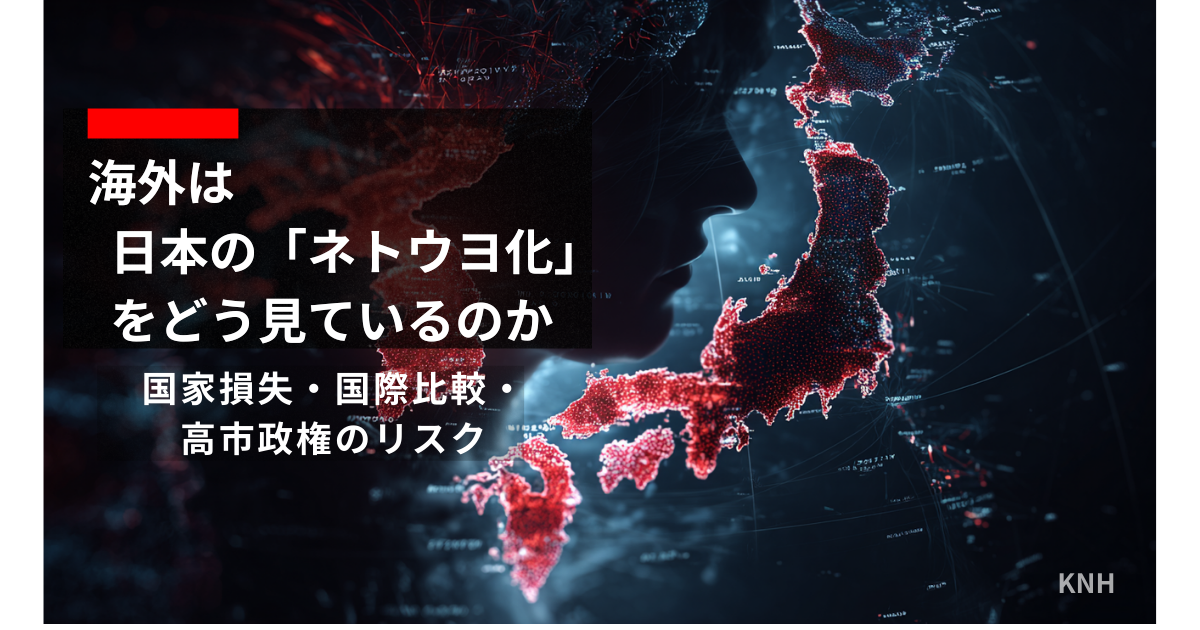
海外は日本の「ネトウヨ化」をどう見ているのか
――国家損失・他国比較・高市政権をめぐる危機の全体像
はじめに:静かに進む“国力の目減り”
日本のネット空間を見慣れていると、「ネトウヨ」は単なるネット上のノイズのように映るかもしれない。
だが、海外の研究者や外交官、国際メディアは、もはやそうは見ていない。
彼らが示し始めているのは、より冷徹な危機感だ。
「日本は、オンライン右翼の感情に政治が引きずられる国になりつつある」
「その結果、日本の戦略性と信頼性が、静かに、しかし確実に削られている」
――おおよそ、こういったトーンの指摘が目立ち始めている。
ネトウヨ現象は、
保守 vs リベラルという国内の色分けを超えた問題として、
「国家の競争力と信頼性を侵食する構造的リスク」として語られつつある。
日本の中からは見えにくい、この「外からの視線」をたどってみたい。
第1章 海外が見る「日本のネトウヨ」の危険性
本記事では「ネット右翼」と「オンライン右翼(online far-right)」を文脈に応じて併用しているが、両者には以下のような違いがある。
● ネット右翼
日本のネット文化から生まれたローカルな概念で、匿名掲示板やSNSで排外主義・歴史修正主義的な言説を展開する層を指す。主に日本国内の文脈で使われ、社会学的には“日本特有の現象”として扱われる。
● オンライン右翼(online far-right)
国際的に通用する概念で、SNS・動画プラットフォームなどのデジタル空間で形成される右派・極右運動を包括する。アメリカのalt-right、欧州のデジタル極右、陰謀論ネットワークなども含む広い用語。
日本の「ネット右翼」は、この国際的な“オンライン極右”現象の一部として位置づけられつつあるため、本記事では比較のために両者を使い分けている。
――事実より“物語”が優先される国への変質
海外の専門家が最も懸念しているのは、
日本社会が「事実」ではなく「物語」で政治を動かし始めている兆候だ。
そのパターンは、アメリカで alt-right(オルトライト)が台頭したときと驚くほど重なる。
1-1 “データより物語”という危険な回路
海外から見た日本の右派ネット空間には、いくつかの特徴がある。
- 不都合な統計や一次資料は、見なかったことにされる
- 歴史認識の議論は、「日本は悪くない」の一言で片づけられる
- 検証されていないキャプチャ画像や匿名情報が、いつのまにか“証拠”扱いされる
- 自分の怒りと相性のいい陰謀論ほど、信じられやすい
これらは一国の内輪話で終わらない。
オンライン空間で形成された“自己正当化の物語”が、政策判断にじわじわと影響を及ぼしていくからだ。
欧米の政治学者の議論を要約すると、こんな警句に収れんしていく。
「オンライン国家主義が政策を形づくるとき、戦略的合理性は真っ先に失われる」
感情の発露そのものは否定しようがない。
問題は、それが「国家意思」の領域にまで入り込んでいることだ。
1-2 崩れ始める「一貫性」と「予測可能性」
外交の現場で何より重視されるのは、「一貫性」と「予測可能性」だ。
それがなければ、同盟も協力も長続きしない。
ところがネトウヨ化した政治は、海外から見るとこう映る。
- 国内向けには勇ましい発言で拍手を取りに行く
- 実際の交渉局面ではトーンダウンする
- 後になって、支持者向けに「本当はこうだった」と物語を上書きする
結果として、
「日本は長期戦略に基づいて動いているのか」
「それとも内政向けのパフォーマンスに外交が振り回されているのか」
という疑念が募っていく。
これは、そのまま国益の削り取りにつながる。
1-3 ネトウヨ言説が「日本人全体」の顔になる
もう一つ、海外で深刻視されているのは、“代表性の誤解”だ。
国際社会は、日本国内の政治的スペクトラムを細かく区別してはくれない。
英語圏で拡散した日本人アカウントの過激な発言は、しばしばこう読み替えられる。
「日本のネット世論は、露骨な反韓・反中ナショナリズムであふれている」
「日本はまた歴史を否定し始めた」
その結果、企業の海外展開、観光誘致、留学生、外交官…
日本とは無関係な場所で生きている普通の人々の顔に、
ネトウヨ的イメージの影が落ちていく。
ツケを払うのは、声の大きい一部のアカウントではない。
日本のパスポートを持つ人間全員だ、という冷酷な構図になりつつある。
第2章 高市政権は海外でどう見られているのか
――「オンライン右翼の言語が中枢に入り込んだ」との警戒
高市早苗政権の誕生は、海外にとって「日本の右傾化」の一コマでは終わっていない。
もっと踏み込んだラベリングが並ぶ。
- hard-right nationalist(強硬右派ナショナリスト)
- Japan’s most hawkish leader(日本で最もタカ派の指導者)
- populist conservative driven by online support(オンライン支持層に駆動される保守ポピュリスト)
彼女の政治的位置づけだけではない。
海外の識者が特に強調するのは、
「これで、日本のオンライン右翼文化は、ついに政治の中枢レベルまで昇格した」
と“見なすこともできる”、という視点だ。
トランプ政権と alt-right の関係を見てきた世界にとって、
この構図は既視感を伴う危険信号に映る。
2-1 台湾発言が映し出した“オンラインノリ”と外交の混線
その象徴として語られるのが、台湾をめぐる発言だ。
安全保障コミュニティの反応を一言でまとめるなら、
「これは熟議の果てに絞り出された国家戦略の言葉というより、ネット右翼の“イケイケなノリ”が外交の場ににじみ出てしまったものに見える」――
おおよそ、そういったトーンになる。
辛辣な専門家の中には、
「彼女の発言は、外交官というより“タイムライン上の戦士”の言葉に聞こえる、と批判されてもおかしくない」
と評する向きもある。
問題は、発言の中身そのものだけではない。
それが、
- 事前の官僚答弁とは食い違い
- 後から責任の所在を曖昧にし
- 質問を投げた側へと矛先を向ける
という形で処理されたことも含めて、
海外の目には「ネトウヨ的政治文化」の延長線上として映っている。
オンラインでの“勇ましさ”が、そのまま外交トラブルに変換される。
これは、国益の観点から見れば最も避けるべき事故だ。
第3章 ネトウヨ化がもたらす“国家損失”
――信用残高・投資・発言力の三つの崩壊
海外の分析を整理すると、日本のネトウヨ化がもたらす損失は、大きく三つのレイヤーに分かれる。
3-1 「信用残高」の目減り――いざというとき誰が助けてくれるのか
外交は、日々の振る舞いによって積み上げられる“信用残高”で動く。
- 理性的か
- 事実に基づいて議論するか
- 不都合な現実からも逃げないか
- 一貫した説明を続けているか
ネトウヨ化した政治は、海外から見ればその逆に映る。
- 事実より気合とスローガンを重視する
- 対外強硬姿勢が自己目的化する
- 不利な情報には「フェイクだ」と蓋をする
こうした振る舞いが積み重なると、
「日本は戦略国家なのか、それとも気分次第で動く国なのか」
という根本的な疑問が突きつけられる。
これは単なるイメージの問題ではない。
緊急時に、誰がどこまで日本に肩入れするか――
その判断に直結する。
3-2 投資・ビジネスへの“見えない追加コスト”
世界の投資家が嫌うのは、「予測不能な政治」だ。
- SNSの空気に合わせて政策がぶれる
- 支持者の怒りを抑えるため、急な路線変更が起きる
- 近隣国との緊張が、国内世論のガス抜きに利用される
こうした兆候は、
「この国のリスクプレミアムは、以前より高く見積もるべきだ」
という判断を引き出しかねない。
政治のネトウヨ化は、
じわじわと国全体の調達コストを押し上げる“見えない税金”のように作用しうる。
3-3 国際社会での“説得力”の崩壊
国際社会の議論には、共有されたルールがある。
- 歴史資料や一次文書
- 国際法・条約
- 検証可能なデータ
- 筋の通ったロジック
ネトウヨ的な言説は、ここにまったくフィットしない。
- 「日本は悪くない」を繰り返すだけ
- 自分に都合の悪い論点は「陰謀」として片づける
- 相手の主張を理解する前に「〇〇の手先」とレッテルを貼る
こうしたスタイルは、国際的な場ではすぐに見抜かれる。
結果として、日本は
「自ら説得力を捨てている国」
になってしまう。
説得力を失った国は、
どれだけ軍事力や経済力があっても、交渉の場で主導権を握れない。
第4章 世界の「ネトウヨ」現象はどう扱われているのか
――他国との比較で見える、日本だけの“異例さ”
日本のネトウヨ化を考えるとき、他国との比較は欠かせない。
特に重要なのは、「その国の政府がネット右翼をどう位置づけているか」だ。
4-1 アメリカ:alt-right は「国内テロの温床」
アメリカでは、ネット発の極右運動はすでに
「国内テロ」と「民主主義への脅威」として扱われている。
- FBI:白人至上主義系ネットワークを、最重大の国内テロ要因と分類
- 国土安全保障省:極右過激化は対テロ政策の中心課題
- 大学・シンクタンク:陰謀論ネットワークやフェイクニュース拡散経路を継続調査
2021年1月、議会議事堂が暴徒に襲撃された事件は、
ネット右翼を放置した場合の“終着駅”を世界に見せつけた。
4-2 ドイツ:極右ネットは「憲法秩序の敵」
ドイツは、歴史的理由から最も厳格に右派過激化を監視している国の一つだ。
- 憲法擁護庁(BfV)は、極右ネットワークを「過激主義」として監視対象に指定
- ネオナチ的な表現や歴史修正発言は、刑法による処罰の対象
- SNS企業には、違法コンテンツの速やかな削除を義務付ける法律も導入
ここでは、「言論の自由」よりも
「民主主義そのものの防衛」が優先される。
4-3 フランス:極右ネットは「暴力の引き金」
フランスでは、移民問題と絡んで極右ネット世論が台頭した。
- 内務省は、極右過激化を治安リスクとして定期的にレポート
- SNS上のヘイト表現や暴力扇動に対する削除・訴追も積極的
- ル・ペンら右派ポピュリストの支持基盤としても分析対象になっている
ここでの焦点は、
「社会の分断」と「暴力の誘発」だ。
4-4 韓国:ネット右翼は「恥ずべき行為」として扱われる
韓国にも、イルベなど日本でいうネトウヨ的なコミュニティは存在する。
ただし、社会の扱い方が日本とは違う。
- 大手メディアは、彼らを「嫌悪文化」「極端主義」として批判
- 差別的表現は、名誉毀損やヘイト関連の法規制で摘発されやすい
- 政治家があからさまに迎合すれば、一気に信用を失う
ネット右翼的な振る舞いは、
「公の場に持ち出すと自分の品位が疑われるもの」
という前提で扱われている。
4-5 そして日本:政治がネトウヨを“動員可能な資源”として見始めた国
最後に日本を見ると、構図が一変する。
- ネトウヨ的な言葉遣いが、政権与党の一部で“標準装備”になっている
- メディアは、彼らの攻撃を恐れて批判を手控える場面も多い
- ネット世論を“味方”につけるために、政治家があえて過激な言説を放つケースも目立つ
海外の研究や報道を踏まえると、
「日本は、ネトウヨを明確な国家リスクとして扱わず、むしろ政治が利用しているように見える稀有な先進国だ」
と評されても不思議ではない状況だ。
アメリカでは alt-right が政権を「乗っ取ろうとした」。
日本では、ネトウヨ文化が政権側に“吸収されている”ように見える――
という評価すら出始めている。
第5章 なぜ日本だけが“異常な例外”に近づいていると言われるのか
他国との比較で浮かび上がるのは、日本の際立った例外性だ。
| 国 | ネット右翼の扱い | 国家の姿勢 | 最重視されるリスク |
|---|---|---|---|
| アメリカ | テロの温床 / alt-right | 国家安全保障として監視 | 国内テロ・民主主義崩壊 |
| ドイツ | 憲法の敵 / 過激派 | 法的規制・監視 | 反民主主義の再興 |
| フランス | 社会不安の源 | 治安管理・監視 | 暴力・移民対立 |
| 韓国 | 過激派として批判 | 強い社会的圧力 | 嫌悪文化・分断 |
| 日本 | “ネットの声”として政治が利用 | 放置・迎合 | 国家戦略の劣化・信頼の崩壊 |
先進国の多くは、ネット右翼を
「民主主義と治安を脅かすリスク」
として警戒し、さまざまな形で距離を取っている。
その一方で、日本は、
「政治が動員し、時に依存しうる“資源”」
として扱っているように見える。
この構造こそが、海外の専門家にとって最大の懸念材料になっている。
結論:ネトウヨ化は“思想の自由”では済まない
――問われているのは、日本という国家の「格」だ
海外の視点を踏まえて、あえて結論を一行でまとめるなら、こうなる。
ネトウヨ化とは、日本の国力・外交力・国際的信頼を目減りさせる“国家レベルの損失”である。
しかも、その損失の多くは、
ネトウヨ本人ではなく「普通の日本人」が支払うことになる。
高市政権をめぐる海外報道が、これほど強い警戒を帯びているのは、
単に一人の政治家のタカ派ぶりが問題なのではない。
オンライン右翼文化が、日本の政治そのものを変質させ始めているのではないか――。
世界が見ているのは、その点だ。
日本は今、
“ネットの怒り”に政治が飲み込まれる国になるのか。
それとも、感情の波がどれだけ荒れようとも、
最後は事実と合理性で判断する国であり続けるのか。
問われているのは、
イデオロギーの選択ではなく、
この国が「大人の民主主義国家」であり続ける意思があるかどうか――
その一点なのだ。
How the World Sees Japan’s “Netouyo-ization”
― National Costs, International Comparisons, and the Risks Encircling the Takaichi Administration
Introduction: A Quiet Erosion of National Power
For those accustomed to Japan’s online space, “netouyo” (ネット右翼) may look like nothing more than background noise on the internet.
But foreign researchers, diplomats, and international media no longer see it that way.
What they are beginning to express is a much colder sense of alarm.
“Japan is becoming a country whose politics are dragged around by the emotions of its online right wing.”
“As a result, Japan’s strategic capacity and credibility are being quietly but steadily eroded.”
These are, in essence, the kinds of observations that are becoming more common.
The netouyo phenomenon is increasingly described not simply as a domestic tussle between conservatives and liberals, but as
a “structural risk that undermines Japan’s economic competitiveness and international trust.”
This article traces that external vantage point ― a view that is hard to see from inside Japan.
Chapter 1 – Why Foreign Observers See Japan’s Netouyo as Dangerous
In this article, the Japanese term “netouyo” and the broader concept of the “online far right” are used side by side, depending on context. They are related but not identical.
● Netouyo
A Japan-specific term that emerged from the country’s internet culture, referring to users on anonymous forums and social media who promote xenophobic, revisionist, or ultra-nationalist narratives. It is largely used within the Japanese context and treated in sociology as a “distinctly Japanese online phenomenon.”
● Online far right (online far-right movements)
A more global concept that covers digitally networked right-wing and far-right movements on social media and video platforms. This includes the U.S. alt-right, European digital far-right networks, and various conspiracy-driven communities.
Japan’s “netouyo” are increasingly analyzed abroad as one specific instance of this wider global “online far-right” trend. For that reason, this article deliberately switches between the terms when drawing international comparisons.
― From Facts to “Narratives”: A Country in Transition
What worries many foreign experts most is the sign that Japanese politics is beginning to move less on the basis of “facts” and more on the basis of “narratives.”
The pattern looks strikingly similar to the period when the alt-right rose in the United States.
1-1. The Dangerous Circuit of “Narratives Over Data”
Seen from abroad, Japan’s online right-wing space appears to have several recurring traits:
- Inconvenient statistics and primary sources are simply ignored.
- Debates about historical responsibility are closed off with a single line: “Japan did nothing wrong.”
- Unverified screenshots and anonymous posts are quietly elevated to the status of “evidence.”
- Conspiracy theories that resonate with one’s own anger are especially likely to be believed.
None of this stops at being a kind of domestic in-joke.
Narratives of self-justification forged online can gradually seep into policy decisions.
Summarizing the arguments of Western political scientists, one often arrives at a warning like this:
“Once online nationalism begins to shape policy, strategic rationality is the first casualty.”
Emotional expression per se cannot be outlawed.
The problem is that it has begun to intrude into the realm of “state decision-making.”
1-2. The Erosion of “Consistency” and “Predictability”
In diplomacy, what matters above all is consistency and predictability.
Without these, alliances and cooperative frameworks do not endure.
Yet to many foreign observers, a politics influenced by netouyo looks like this:
- Tough, chest-thumping rhetoric for domestic applause.
- Noticeable toning down when it comes to actual negotiation tables.
- Later, the story is rewritten for supporters: “What really happened was this…”
The result is a set of nagging questions:
“Is Japan acting on the basis of a long-term strategy?”
“Or is its diplomacy being tossed around by the need to play to domestic audiences?”
These doubts, in turn, translate directly into an erosion of national interest.
1-3. When Netouyo Discourse Becomes “the Face of the Japanese”
There is another concern frequently voiced abroad: a misunderstanding of representation.
International audiences do not finely distinguish between every shade of political opinion inside Japan.
Extreme English-language posts by self-identified Japanese users are often read as:
“Japanese online opinion is awash with anti-Korean and anti-Chinese nationalism.”
“Japan is once again denying its wartime history.”
The consequences then spill over into corporate expansion, tourism, international education, and diplomacy.
Netouyo-style discourse casts a shadow over the faces of ordinary Japanese people living and working far from politics.
The bill is not paid by a handful of loud anonymous accounts.
It is paid by everyone holding a Japanese passport ― a harsh reality that is slowly taking shape.
Chapter 2 – How the Takaichi Administration Is Viewed Abroad
― Alarm Over the “Language of the Online Right” Entering the Political Core
The rise of Prime Minister Sanae Takaichi is not, for foreign observers, just another turn in Japan’s rightward drift.
They often go further, giving her labels such as:
- hard-right nationalist
- Japan’s most hawkish leader
- a populist conservative driven by online support
The focus is not solely on where she sits on the political spectrum.
What many analysts emphasize is this:
“With her, Japan’s online right-wing culture has effectively been elevated into the country’s political core.”
This is, they argue, a plausible reading of what has happened.
For people who watched the relationship between the Trump administration and the U.S. alt-right up close,
the structure feels eerily familiar ― and dangerous.
2-1. The Taiwan Remark: When “Timeline Tone” Bleeds into Diplomacy
The emblematic case, often cited abroad, is her remark on Taiwan.
In the security policy community, reactions can be summarized like this:
“Rather than a carefully weighed expression of national strategy, it sounded more like the ‘let’s go all in’ tone of online warriors spilling over into diplomacy.”
Some particularly sharp critics have commented along these lines:
“Her words sounded less like a seasoned statesperson and more like the rhetoric of a ‘fighter on the timeline.’”
The issue is not the content of the remark alone.
It is also the way it was subsequently handled:
- It diverged from the bureaucrats’ prepared answer.
- Responsibility for the wording was blurred in retrospect.
- Blame was partially shifted toward the questioner.
Taken together, these dynamics look, from abroad, like an extension of “netouyo-style political culture.”
Online bravado, in other words, is being converted directly into diplomatic trouble.
From the perspective of national interest, this is precisely the kind of accident a country should avoid at all costs.
Chapter 3 – The “National Losses” Triggered by Netouyo-ization
― The Collapse of Credit, Investment, and Persuasive Power
When foreign analyses are mapped out, the costs of Japan’s netouyo-ization tend to fall into three broad layers.
3-1. The Shrinking “Credit Balance” ― Who Will Rescue You in a Crisis?
Diplomacy runs on a “credit balance” built up by everyday behavior.
- Is the country seen as rational?
- Does it argue on the basis of facts?
- Does it face uncomfortable realities instead of running from them?
- Does it maintain consistent explanations over time?
From abroad, a politics shaped by netouyo appears to do the opposite:
- It prioritizes slogans and willpower over reality.
- Hardline stances toward other countries become ends in themselves.
- Unfavorable information is dismissed as “fake” and buried.
As these patterns accumulate, a fundamental question arises:
“Is Japan a strategic state ― or a country that moves according to mood?”
This is not merely an image problem.
In a crisis, it directly affects who will support Japan, and to what extent.
3-2. “Invisible Extra Costs” for Investment and Business
Global investors dislike one thing above all: unpredictable politics.
- Policies that sway with the atmosphere on social media.
- Sudden shifts in course to mollify angry supporters.
- Tensions with neighboring countries used as a valve to vent domestic frustration.
Signs like these encourage a conclusion:
“The political risk premium on this country needs to be revised upward.”
Netouyo-driven politics can quietly raise funding and transaction costs for the entire nation ―
functioning like an “invisible tax” on the Japanese economy.
3-3. The Collapse of Persuasive Power in International Arenas
Debate in international forums is governed by shared rules:
- Historical documents and primary sources
- International law and treaties
- Verifiable data
- Logically coherent argumentation
Netouyo-style claims fit almost none of these.
- They repeat “Japan did nothing wrong” in lieu of argument.
- They label inconvenient points as “conspiracies.”
- They brand critics as “someone’s agents” before even engaging with their claims.
Such tactics are quickly spotted and dismissed in international settings.
The result is that Japan comes to be seen as
“a country that has voluntarily abandoned its own persuasive power.”
Once a state loses persuasiveness, no amount of military or economic weight is enough to secure the initiative at the negotiating table.
Chapter 4 – How Other Countries Treat Their “Online Far Right”
― A Comparative Lens Reveals Japan’s Unusual Position
To understand Japan’s netouyo-ization, comparison with other countries is essential.
What matters in particular is how each state positions its own online far right.
4-1. United States: The Alt-Right as a “Breeding Ground for Domestic Terror”
In the United States, internet-born far-right movements are now treated as a matter of
“domestic terrorism” and “a threat to democracy.”
- The FBI classifies certain white supremacist networks as top-tier domestic terror threats.
- The Department of Homeland Security frames far-right extremism as a central challenge in counterterrorism policy.
- Universities and think tanks continually research conspiracy networks and disinformation channels.
The 6 January 2021 attack on the U.S. Capitol symbolized for the world what can happen if such movements are left unchecked ― the end point of “letting online extremism run its course.”
4-2. Germany: Far-Right Networks as “Enemies of Constitutional Order”
Germany, for historical reasons, is one of the strictest countries in monitoring far-right extremism.
- The Federal Office for the Protection of the Constitution (BfV) designates far-right networks as “extremist” and monitors them.
- Neo-Nazi expressions and certain forms of historical revisionism are punishable under criminal law.
- Social media companies are legally obliged to swiftly remove illegal content.
Here, “freedom of expression” is balanced against, and often outweighed by,
the imperative to defend democracy itself.
4-3. France: Far-Right Online Spaces as “Triggers for Violence”
In France, far-right online opinion has surged, intertwined with debates over immigration.
- The Interior Ministry regularly reports on far-right radicalization as a public security risk.
- Authorities actively demand the removal and prosecution of online hate speech and incitement to violence.
- Far-right online spaces are analyzed as key support bases for politicians like Marine Le Pen.
The core concern here is
“social fragmentation and the risk of political violence.”
4-4. South Korea: Online Far Right as “Shameful Behavior”
South Korea also has communities comparable to Japan’s netouyo, such as Ilbe.
But the way society treats them is markedly different.
- Major media outlets routinely criticize them as expressions of “hate culture” and “extremism.”
- Hate speech is more frequently targeted through defamation and hate-related laws.
- Politicians who openly pander to such views risk an immediate loss of credibility.
Online far-right behavior is largely seen as something that
“taints one’s own dignity if brought into public life.”
4-5. And Japan: A State Beginning to See Netouyo as a “Mobilizable Resource”
Against this backdrop, Japan stands out.
- Netouyo-style language has become “standard equipment” for some ruling party politicians.
- Media organizations sometimes appear to hold back criticism out of fear of online backlash.
- Some politicians deliberately deploy provocative rhetoric to “activate” online supporters.
Based on existing research and reporting, it is not hard to see why some analysts say:
“Japan appears to be a rare advanced democracy where the online far right is not clearly treated as a national risk but instead as a political asset.”
In the United States, the alt-right attempted to “capture” the state.
In Japan, by contrast, netouyo culture appears to be
absorbed into the governing side itself ―
this is the emerging line of critique.
Chapter 5 – Why Japan Is Being Branded an “Outlier”
Viewed through international comparison, Japan’s exceptional position comes into focus.
| Country | Treatment of online far right | State’s stance | Primary perceived risk |
|---|---|---|---|
| United States | Breeding ground for domestic terror / alt-right | Monitored as a national security issue | Domestic terrorism and democratic backsliding |
| Germany | Enemies of the constitution / extremists | Legal regulation and surveillance | Resurgence of anti-democratic forces |
| France | Source of social unrest | Policing and public order management | Violence and immigration-related conflict |
| South Korea | Condemned as extremist fringe | Strong social pushback | Hate culture and social division |
| Japan | Used as “the voice of the internet” for politics | Neglect and accommodation | Erosion of national strategy and trust |
Most advanced democracies treat their online far right as
“a risk to democracy and public order”
and deliberately maintain a certain distance.
Japan, by contrast, increasingly looks like a state that
“mobilizes, and at times depends on, its online far right as a political resource.”
This structure is what worries many foreign experts most.
Conclusion – Netouyo-ization Is Not Just “Freedom of Opinion”
― What Is Being Tested Is Japan’s Democratic Maturity
Taking these external perspectives into account, one could boil the argument down to a single line:
Netouyo-ization is a process that diminishes Japan’s national power, diplomatic leverage, and international credibility ― a loss at the level of the state itself.
Crucially, most of that loss is not borne by the netouyo themselves.
It is borne by “ordinary Japanese people” who had no part in the online battles.
The intensity of foreign concern over the Takaichi administration is not simply about one politician’s hawkish views.
Rather, it reflects a deeper fear:
Has online right-wing culture begun to change the character of Japan’s political system itself?
That is the question the world is now asking.
Japan faces a choice:
Will it become a country whose politics are swallowed by “online anger”?
Or will it remain a country that, no matter how rough the waves of emotion, ultimately decides on the basis of facts and reason?
What is being tested is not the choice of ideology.
It is whether Japan still intends to behave as a “mature democratic state” ―
that single point is now under scrutiny.
参考文献 / References
【日本語文献】
-
樋口直人ほか『ネット右翼とは何か』(青弓社, 2019)
Amazonで見る -
安田浩一『ネットと愛国 』(講談社+α文庫)
Amazonで見る -
辻田真佐憲『ルポ 国威発揚 「再プロパガンダ化」する世界を歩く』(中央公論新社, 2023)
Amazonで見る -
角南圭祐『ヘイトスピーチと対抗報道』(集英社新書, 2021)
Amazonで見る -
板垣竜太・木村草太(編)『ヘイトスピーチはどこまで規制できるか』(影書房, 2016)
Amazonで見る -
本田浩邦『アメリカ 危機の省察』(大月書店, 2025)
Amazonで見る
【英語文献(学術・専門書)】
-
Mudde, Cas. The Far Right Today. Polity Press, 2019.
Amazonで見る -
Nagle, Angela. Kill All Normies. Zero Books, 2017.
Amazonで見る -
Davey, Jacob & Ebner, Julia (ISD).
The Great Replacement: The Violent Consequences of Mainstreamed Extremism (ISD, 2020).
-
RAND Corporation. Online Extremism: Research Trends(2013–2022)
【公的文書(政府・国際機関)】
- U.S. Department of Homeland Security (DHS). Homeland Threat Assessment, 2020.
- Federal Bureau of Investigation (FBI). White Supremacist Extremism: Intelligence Assessment, 2020.
- European Commission. EU Internet Forum: Tackling Online Radicalisation, 2019.
- United Nations Office of Counter-Terrorism (UNOCT). Extremism in the Digital Era, UN Report, 2021.
- OSCE (Organization for Security and Co-operation in Europe). Understanding Online Hate Speech, OSCE Report, 2018.
- United Nations Human Rights Council (UNHRC). Report on Hate Speech and Digital Platforms, 2019.
参考文献・海外報道(International Sources)
-
Australia Institute of International Affairs – “Japan’s Iron Lady: Is Japan Taking a Hard Right?”
高市政権を「ハード右派」と位置づけ、日本の右傾化とオンライン右派文化の影響を分析。 -
Eurasia Review – “Takaichi’s Japan: Risks And Reality (OpEd)”
高市政権のリスク、ナショナリズムの強まり、外交・安全保障への影響を論じる国際論説。 -
Reuters – “China says Japan is ‘threatening us militarily’ …”
高市政権発言が中国外交に波紋を広げ、地域安全保障問題として扱われていることを示す主要報道。 -
Times of India – “Sanae Takaichi vs Xi Jinping: Inside Japan’s high-stakes clash with China over Taiwan”
台湾問題に関する高市発言が国際的にどう受け止められているか、アジア視点で分析。 -
Japan Forward – “What the Foreign Media Gets Wrong About Sanae Takaichi”
海外報道の内容を整理する英語圏の“メタ記事”。海外の視点がどのように形成されているかを知る手掛かり。
※本記事の分析パートは、海外報道・学術研究・公開データを基に編集部が独自に再構成したものです。
※The analytical sections in this article are independently compiled by the Editorial Desk based on international reporting, academic research, and publicly available data.

海外ニュースを多言語で読み比べ、「同じニュースが、言語や読者層によってどう書き換わるのか」 を分析しています。
日本の報道だけでは見えにくい 国際政治・情報戦・背景文脈 を、静かで冷静な筆致で読み解きます。
Calm insight from Tokyo.


コメント
コメント一覧 (4件)
戦争をしてる
日弁連とか中露北韓
報道とかサヨクは抗日歴史で暴れてるけど(大賠償は?)
戦争をしているかしてないかの差
第二次世界大戦後に
戦争をしてないのは日本だけ
コメントありがとうございます。
この記事で扱っているのは、「日本が戦争をしている/していない」という是非ではありません。
海外から見たときに、日本の
・歴史認識
・国内言説のトーン
・政治的動き
が、どのように「リスク」として受け取られているかを分析しています。
戦争の定義や日中・日韓関係の評価とは論点が異なるため、今回はそこには踏み込みません。
私は20代半ばの若者ですが、高市政権になってから日常の会話で高市首相を支持するという話がされるようになりました(それでもそこまで頻繁にではないですが)。これまで職場では政治の話など暗黙の了解でタブーとされていたにも関わらず、この記事の執筆者のいうところの「普通の日本人」が政府の政策や首相の言動に表立って首肯しているわけです。
よく左派は「ネトウヨ」などとレッテルを貼りますが、内閣支持率が高止まりしていることからも分かるように、世論は高市政権への支持を示しています。
また、実態は明らかにこの記事とは真逆で、欧米諸国に比して極右政党の主張が穏健である(かつ議席も国会においてそう多くない)ことから、極端に過激な主張が通りにくいのが日本の特徴だと感じます。
政権担当政党がコロコロ変わり混迷をきわめる欧米に比して、左右に幅広いウイングを持つ自民党におけるいわば疑似政権交代によって、ここ十数年、バランスが取れた安定的な政治体制が維持されているのだろうと思います。
コメントありがとうございます。
若い世代の実感としてのご意見、とても参考になります。
ご指摘の通り、日本では欧米諸国に比べて極端な政治的振れ幅が起きにくく、結果として制度的な安定が保たれている、という見方は成り立つと思います。
ただ、今回の記事で私が焦点を当てたのは「日本社会がどう感じているか」ではなく、
海外の政府関係者・投資家・研究者などが、日本の政治や言論環境をどう評価しているかという点でした。
外部からは、
・政策議論が国内向けに閉じやすい
・批判や異論が制度に反映されにくい
・結果として意思決定の予測可能性が下がる
といったリスクとして受け取られることがあります。
国内的な「安定」と、国際社会から見た「透明性・説明責任」は必ずしも一致しません。
そのズレこそが、この記事で提示したかった問題意識です。
貴重な視点を共有していただき、ありがとうございました。