米国が国際秩序を降りるとき、日本は何を失うのか
――「主権」と「孤立」を取り違える危うさ
米国が、66の国際機関からの離脱を表明した。
これを受けて、日本のSNSでは「日本も追随して脱退すべきだ」という論調が散見され、しかも相当数の「いいね」を集めている。
正直に言えば、強い違和感を覚える。
これは本気で国家の話をしている言説なのだろうか。
本稿は、米国の国際機関離脱を賛否や政権評価の問題として扱わない。
問うのはただ一つ、国際秩序の設計が変わるとき、日本はどこに立たされるのかだ。
主権とは何か。
国際機関とは、誰のための装置だったのか。
そして、秩序を管理してきた国が一段後退するとき、日本が依存してきた前提は、どこから崩れるのか。
この記事は、「強い言葉」や「独立幻想」では覆い隠されがちな
日本の立ち位置そのものを、構造から切り出す。

米国は「米国の利益に資さない」として、66の国際機関からの離脱を命じた。
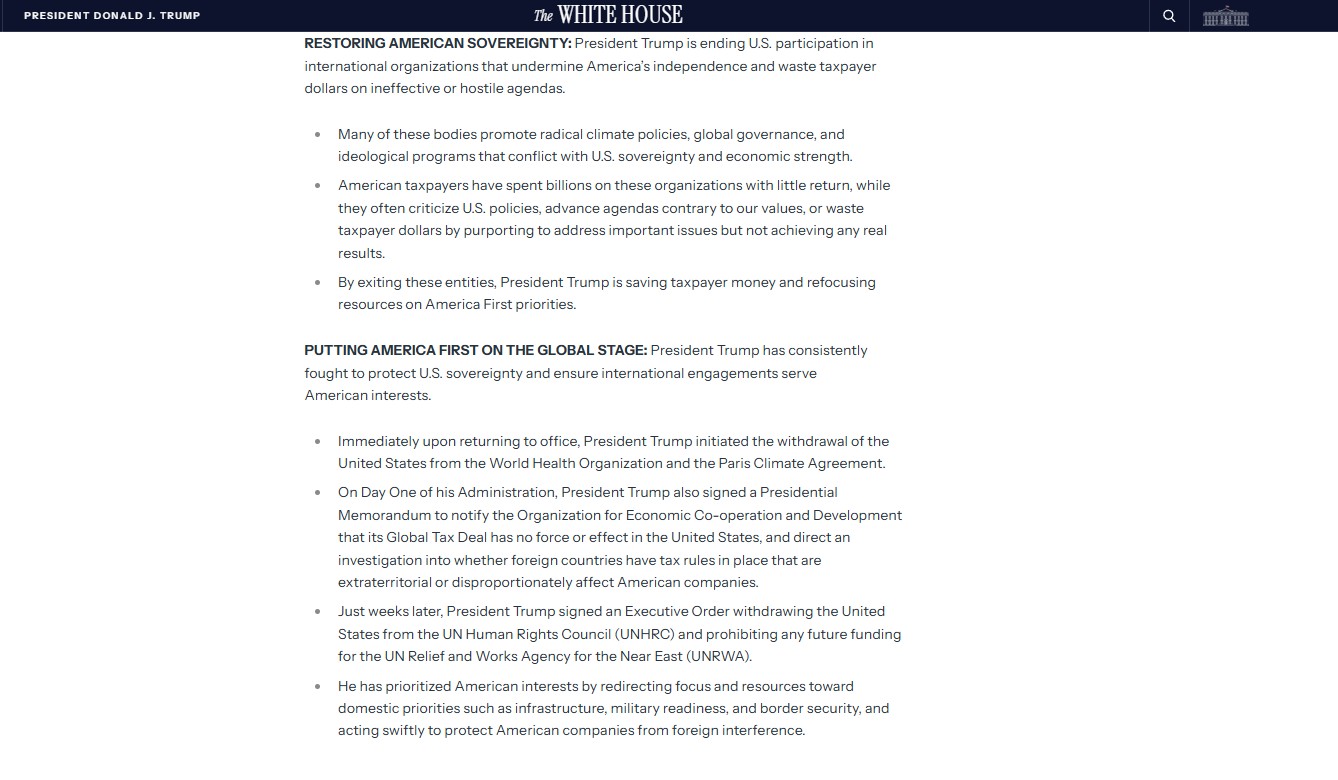
「主権」「America First」を理由に、WHO・パリ協定・国連人権理事会などからの離脱を正当化している。
参考:
米ホワイトハウス公式発表(2026年1月7日)
Fact Sheet: President Donald J. Trump Withdraws the United States from International Organizations that Are Contrary to the Interests of the United States
「主権」と「孤立」を混同する危険
「国際機関から抜ける=主権が強くなる」
この発想は、一見すると威勢がいい。
だが実態は、主権と孤立を取り違えているだけだ。
主権とは、一人で立つことではない。
主権とは、交渉とルールの中で、自国の選択肢を確保し続ける力である。
国際機関は、理想主義の集まりではない。
それは、
- ルールを作る場
- 利害を調整する場
- 力の弱い国が踏みとどまるための装置
だ。
そこから離脱した国は、自由になるのではない。
ルールを作る側から、ルールを与えられる側に回る。
なぜ「脱退=主権回復」が成立しないのか
国際機関を離脱すれば、形式上の義務は減るかもしれない。
だが同時に失うのは、単なる「席」ではない。
交渉力そのものだ。
まず、発言権を失う。
これは「意見が言えない」という話ではない。
議題の設定、文言の修正、例外規定の挿入――
ルールの中身を左右する工程から外れるということだ。
次に、事前交渉の機会を失う。
国際ルールは会議の場で突然決まるのではない。
非公式協議、作業部会、専門家会合、事務局との調整を経て、
「ほぼ決まったもの」が本会議に上がってくる。
そこに居ない国は、最初から手遅れになりやすい。
さらに、同盟国との調整を失う。
多国間の場は、同盟国同士が足並みをそろえ、
「こちら側の最適解」を作るためのインフラでもある。
離脱とは、そのインフラを自分から壊す行為だ。
それでも世界のルールは止まらない。
止まらないどころか、他国は「日本がいない前提」で設計し直す。
そして日本は、後からそのルールを
輸出入・投資・規制・安全保障の現場で事実上受け入れさせられる。
実務例①:WHO(医療・保健)
WHOは「理念」の組織ではない。
感染症情報の共有、国際的な警戒レベル、医薬品やワクチンをめぐる優先順位――
現場の判断に直結する実務のハブだ。
ここから距離を取るということは、
「自由になる」ことではない。
情報の初動や調整の輪から外れるという意味を持つ。
感染症は国境を選ばない。
それでも対応の順番や情報の深さには差が出る。
その差は、政治的主張ではなく、制度への関与度で決まる。
実務例②:気候(規制と市場)
気候変動をめぐる枠組みは、環境運動ではない。
排出基準、サプライチェーン要件、認証制度――
国際市場の参加条件を定める仕組みだ。
日本がその場にいなくても、ルールは作られる。
そして日本企業は、輸出や投資の現場で
そのルールに従わされる。
関与しないことで逃げられるのは、義務ではない。
交渉の余地だけだ。
実務例③:税制(国際課税・グローバルルール)
国際税制は、主権の最たる領域に見える。
だが実際には、多国籍企業の活動が前提となり、
一国だけで完結しない。
税制の国際協調から外れれば、
日本は「自由」になるのではなく、
他国が決めた枠組みに後から適応させられる側になる。
それは主権の回復ではない。
調整権の放棄だ。
義務だけが減って、制約が消えるわけではない。
日本の場合、起きるのは――
「制約は残り、交渉だけが消える」という事態である。
だからこれは、主権の強化ではない。
影響力の放棄なのだ。
米国と日本は、同じことをしていない
ここで決定的に見落とされがちな点がある。
米国が国際機関を離脱するのと、日本が離脱するのは、意味が真逆だ。
- 米国:秩序を壊す側に回っても生き残れる
- 日本:秩序が壊れた瞬間に、真っ先に危うくなる側だ
これは「好き嫌い」や「姿勢」の問題ではない。
交渉のカードと代替手段の差の問題である。
米国には、
- 軍事力(同盟の最終保証)
- 経済規模(市場そのものが圧力になる)
- ドル基軸(決済と金融制裁の支配力)
- 制裁能力(ルール外から相手を動かせる力)
がある。
重要なのは、米国がこれらを使って「国際機関の外側」からでも秩序を動かせるという点だ。
多国間を離れても、米国には二国間交渉、関税、制裁、同盟再編といった代替の統治手段が残る。
だが日本には、そのカードがない。
日本は、制裁を単独で貫徹できる国でも、金融決済を握る国でも、巨大市場で相手を屈服させる国でもない。
日本の強みは、威嚇ではなく、ルールの内側で利益を積み上げる能力だった。
「秩序が壊れる」とは、何が壊れることか
秩序が壊れるとは、単に国際会議が荒れることではない。
壊れるのは、次のような現場のインフラだ。
- 貿易:関税・規格・認証が政治化し、突然「参加条件」が変わる
- 金融:決済・送金・保険が政治の道具となり、取引が止められる
- 安全保障:同盟が「価値」ではなく「取引」になり、条件が毎回変わる
- 情報:共有されるはずのデータや警戒情報が、優先順位で差がつく
米国は、この混乱を力と通貨で管理できる。
しかし日本は、その混乱を管理する手段が乏しい。
だから日本は、秩序が機能している間は強いが、秩序が壊れた瞬間に弱くなる。
日本は「席を立てない国」だった
秩序が機能しているからこそ、日本は核を持たず、資源も乏しく、人口が減少する中でも国家として存続してきた。
言い換えれば、日本は秩序の内側にいることでしか強くなれない国だった。
だから、国際機関から離脱するという選択は、
「自由になる」ことではない。
交渉の席を捨て、保護を捨て、調整を捨てることに近い。
秩序の崩壊は、日本にとって自由ではなく「裸になること」だ。
その意味で、日本が米国の真似をするのは、戦略ではない。
ただの自己弱体化である。
66の国際機関とは何か――予想できる内訳
米国政府は、66機関の詳細をすべて公表していない。
だが、どのタイプが含まれるかは、かなり予測できる。
① 国連・国連関連機関(約30前後)
人権、難民、教育、文化、開発援助。
「普遍的価値」や「国際規範」を掲げ、
短期的な国益に直結しにくい分野が中心だ。
② 気候変動・環境関連枠組み
気候変動対策、持続可能性、環境規制。
国内産業への制約を伴うため、
米国右派にとって最も「割に合わない」と見なされやすい領域である。
③ 開発援助・技術支援・能力構築
短期的な「見返り」が見えにくい分野。
トランプ流の国家観では、
真っ先に「成果が曖昧」と判断され、切られる。
④ グローバル・ガバナンス系ネットワーク
多国間調整、共通基準づくり。
「一国一票」に埋没するこの仕組みは、
America Firstと最も正面から衝突する。
これらは、無能だから切られたのではない。
米国が「国際秩序を管理するコスト」を、もはや引き受けないと決めた、という意味を持つ。
米国はどうなるのか
短期的には、「節約」「主権回復」が強調される。
だが現実には、これは「撤退」ではない。
国際秩序を、制度ではなく取引で扱う方向への転換だ。
まず増えるのは、二国間交渉だ。
多国間の場で一括調整していたものが、案件ごとに「個別交渉」へ戻る。
それは自由ではなく、交渉コストの増加である。
- 二国間交渉の増加(案件が分割される)
- 外交コストの上昇(交渉・調整・報復の応酬)
- 同盟国との摩擦(「価値」より「条件」が前に出る)
短期:国内向けには「勝利」に見える
短期では、国内政治的には「成果」に見えやすい。
「無駄な拠出を止めた」「米国第一を貫いた」という物語が作りやすいからだ。
だが、ここで削れるのは主に予算であり、削れないのは世界の課題である。
中期:同盟国が「不確実性コスト」を負う
中期に効いてくるのは、同盟国側の不安定化だ。
多国間ルールが弱まるほど、同盟は「制度」ではなく「取引」になる。
取引になれば、条件が固定されず、毎回変わる。
同盟国は、軍事・経済・エネルギー・規制のあらゆる領域で、不確実性コストを上乗せされる。
その結果、同盟国は二つの動きを同時に進める。
米国との関係維持と、米国抜きで回る仕組みの構築だ。
皮肉だが、米国の「離脱」は、同盟国に米国依存の分散を促す。
長期:信頼の摩耗は、米国の「価格」を上げる
長期で一番効くのは、信頼の摩耗だ。
これは道徳の話ではない。
米国と組むコストが上がるという話である。
国際機関は、米国にとっても「安く世界を管理する装置」だった。
そこを弱めれば、管理はより直接的になり、より高くつく。
軍事・制裁・関税・補助金――
力で押し切るほど、相手の対抗も強まり、米国の負担は増える。
米国は、それでも生き残れる。
だが、制度で秩序を動かす国から、力で秩序を動かす国へ傾くほど、
信頼と正当性は、確実に摩耗する。
世界はどうなるのか
米国が抜けた空白は、放置されない。
だが、その空白は「同じ秩序」で埋まるわけではない。
埋まるのは秩序ではなく、勢力ごとの都合だ。
結果として世界は、単一の国際秩序ではなく、
分断された秩序の集合体へと向かう。
中国:制度の「看板」は残し、中身を書き換える
中国が目指すのは、国際機関を壊すことではない。
むしろ制度の枠組みや看板は維持したまま、
議題設定、用語、基準、運用を通じて、中身を自国に有利な方向へ寄せることだ。
米国が距離を取るほど、空席は生まれる。
その空席に人を送り込み、議論の流れを握り、
一度形成された人脈と慣行を既成事実にする。
制度は残るが、性格は変わる。
それが、中国型の「秩序の書き換え」だ。
欧州:規範で埋めるが、摩擦も同時に生む
欧州は、秩序が揺らぐ局面ほど「規範」で踏ん張ろうとする。
環境、人権、サプライチェーン、データ保護。
欧州の強みは軍事ではなく、市場ルールの設計にある。
規範を通じて標準を握ることで、
自国の価値観を市場の参加条件に変える。
だがその一方で、規範は各国の国内政治と衝突しやすい。
秩序を作る力と、反発を生む力は、常に表裏一体だ。
中堅国:世界は「分野別のミニ秩序」へ
米国が主導しない世界で、中堅国は二択を迫られる。
強国に追随するか、自ら束ねるか。
その結果、増えるのは包括的な秩序ではない。
半導体、エネルギー、海運、感染症、税制、安全保障。
分野ごとの小さな連合が乱立していく。
世界は一つのルールで動くのではなく、
分野ごとに異なるルールが併存する状態になる。
「分断された秩序」は現場でこう現れる
- 基準が割れる:規格や認証が陣営ごとに異なる
- コストが増える:市場ごとに作り分けが必要になる
- 例外が増える:ルールより政治判断が優先される
- 弱い国が落ちる:選べない国ほど外側に押し出される
秩序が分断されるほど、
予測可能性は下がり、取引コストは上がる。
特に打撃を受ける領域:「止めると人が死ぬ分野」
最も深刻な影響を受けるのは、
人道支援、難民、保健、感染症対策といった分野だ。
これらは政治闘争の対象になりやすい一方、
止めれば即座に被害が出る。
秩序が分断されるほど、支援は遅れ、現場は詰む。
米国の離脱は、世界を一気に壊すわけではない。
だが、世界を静かに弱くする。
それは、救えるはずの命が救われなくなる形で現れる。
なぜ日本の右派ほど、この危険を理解していないのか
日本の右派言説は、国際政治を「姿勢」「覚悟」「威勢」の問題として語りがちだ。
だが外交は、感情ではなく、力関係と制度の設計で決まる。
危険が見えにくいのは、戦後日本が長く
「米国が秩序を管理してくれる」前提で生きてきたからだ。
日本は、自力で秩序を作る側ではなく、秩序に守られる側として最適化されてきた。
その結果、次の感覚が社会に染みついた。
- ルールは「外から与えられるもの」で、交渉で形を変えられるものだという実感が薄い
- 制度を維持するにはコストがかかり、誰かが引き受けているという認識が薄い
- 秩序が壊れた場合の代替手段(制裁・市場・通貨・軍事)を日本は持たないという自覚が薄い
つまり、日本の右派が強調する「主権」や「独立」は、しばしば
制度の内側に居続ける技術ではなく、気分の言い換えになってしまう。
そしてもう一つ大きいのは、言葉の誤作動だ。
「主権」という言葉が、現実の交渉力ではなく、
批判されない権利/反論されない正しさの意味で使われてしまう。
その瞬間、外交は設計ではなく、信仰になる。
高市路線が「戦争抑止」にならない理由
抑止とは、相手に「やらない方が合理的だ」と思わせることだ。
抑止が成立するには、最低限、
- 能力(実際にやれる力)
- 意思(やる覚悟)
- 伝達(相手がそれを信じる情報設計)
- 持続性(一時の発言ではなく継続できる制度)
が揃わなければならない。
だが、強い言葉や敵味方の単純化は、この条件を満たさない。
むしろ逆に、相手に「日本は引けない」と誤認させ、
相手国内の強硬派に正当性と燃料を与える。
抑止は、相手の計算を変える技術だ。
だが、強硬レトリックは、相手の感情と国内政治を刺激するだけで、
計算を変えない。
さらに致命的なのは、カードの非対称だ。
強硬姿勢は、裏側に「交渉のカード」と「出口」があって初めて機能する。
だが日本には、米国のような通貨覇権も、制裁の貫徹力も、巨大市場もない。
カードが薄い国がレトリックだけ強めれば、残るのは拘束だ。
それは抑止ではない。
エスカレーションの補助である。
日本が取るべき現実的な生存戦略
日本に必要なのは、勇ましさでも、脱退競争でもない。
必要なのは、秩序が揺らぐ世界で「損を小さくし、選択肢を残す」ための設計だ。
① 国際ルールを「使う側」に居続ける
国際機関は、理想を語る場所である以前に、交渉のインフラだ。
席を立てば、義務が減るのではない。
交渉の余地が減る。
日本がやるべきことは、離脱ではなく「居残り」だ。
議題設定、文言調整、例外規定、技術基準。
地味だが、ここでしか守れない国益がある。
② 同盟を単線化せず、分散させる
同盟は重要だ。だが、同盟だけに全てを預けることは危険だ。
米国が「制度」より「取引」に傾くほど、条件は固定されなくなる。
だから日本は、米国との同盟を軸にしつつ、支点を増やす必要がある。
欧州、豪州、カナダ、韓国、東南アジア。
分野別に連携を組み替え、「一枚のカード」に依存しない。
これは反米ではない。保険である。
③ 標準・制度・供給網を押さえ、弱点を減らす
秩序が分断されるほど、強い国は軍事でなく標準で支配する。
環境、データ、税制、認証、サプライチェーン。
ここで「参加条件」が変われば、日本企業は現場で従わされる。
だから日本は、標準を受け取る側ではなく、標準を作る側に関与し続ける必要がある。
同時に、医薬品原料、重要鉱物、半導体材料、海運。
止まると致命傷になる領域の供給網は、政治ではなく実務で分散させる。
④ 「強い言葉」ではなく、一貫性と予測可能性を積み上げる
外交の信用は、格好いいスローガンからは生まれない。
日々の発言、投票行動、拠出、協定遵守。
小さな積み重ねが、危機のときの発言力になる。
日本の最大の資源は、軍事力でも人口でもない。
信用と制度適応力だ。
私自身の立ち位置として
私は、日本が「弱い国」だとは思っていない。 だが、「壊れた秩序の中で強く振る舞える国」だとも思っていない。
だからこそ、国際機関からの離脱を、 主権や独立の象徴として語る言葉に、強い違和感を覚える。
それは覚悟ではない。 代替手段のないまま、退路を消していく選択に見える。
私は、日本がもう一度、 声を荒げる国ではなく、場を捨てない国であってほしいと思っている。
結論
「国際機関から抜ければ主権が強くなる」
それは気持ちのいい幻想にすぎない。
主権とは、孤立する権利ではない。
交渉の場に居続け、選択肢を確保し続ける力である。
秩序が揺らぐ世界で、日本に必要なのは「威勢」ではない。
場を捨てず、カードを増やし、弱点を減らすことだ。
その違いを見誤った政治は、国を守らない。
戦争を呼び込む。
What Japan Loses When the U.S. Steps Down from the International Order
— The danger of confusing “sovereignty” with “isolation”
The United States has announced its withdrawal from 66 international organizations.
In Japan, I’m already seeing a familiar pattern on social media: “Japan should follow and withdraw as well”—and those posts are collecting a surprising number of likes.
To be frank, it feels deeply unsettling.
Are we really talking about national strategy here?
This piece is not about whether the U.S. withdrawal is “right” or “wrong,” nor is it a simple scorecard of the Trump administration.
The question is more basic:
when the architecture of the international order shifts, where does Japan end up?
- What does “sovereignty” actually mean?
- Who were international institutions designed to protect?
- And when the country that used to manage the order steps back, what happens to Japan’s room for maneuver?
This is not a debate that can be settled by “strong words” or “independence rhetoric.”
It is about Japan’s position itself—cut out from the structure.
Source: White House Fact Sheet (Jan 7, 2026)
Fact Sheet: President Donald J. Trump Withdraws the United States from International Organizations that Are Contrary to the Interests of the United States
Confusing “Sovereignty” with “Isolation”
“Leaving international organizations will make our sovereignty stronger.”
At first glance, this sounds bold.
But in reality, it is simply a confusion between sovereignty and isolation.
Sovereignty does not mean “standing alone.”
Sovereignty is the capacity to keep options open through negotiation and rules.
International institutions are not gatherings of idealists.
They are also:
- places where rules are written
- places where interests are coordinated
- devices that allow weaker states to keep a foothold
A country that leaves does not become “free.”
It moves from rule-maker to rule-taker.
Why “Withdrawal = Sovereignty Restored” Doesn’t Work
Yes, leaving may reduce formal obligations on paper.
But what you lose is not “paperwork.” It is negotiating power.
First, you lose a voice.
Not the right to complain after the fact—but the ability to shape the draft before it becomes the rule.
Second, you lose the pre-negotiation layer.
Global rules are rarely decided in one plenary meeting. They are shaped through working groups, expert panels, side talks, and informal coordination.
A country that leaves is more likely to be confronted with a finished product.
Third, you lose coordination with allies.
Multilateral frameworks are often where allies align positions, share burdens, and build common leverage.
And the world’s rules do not stop.
They simply move forward—without Japan in the room.
That is not stronger sovereignty.
It is the abandonment of influence.
Practical Example 1: WHO (Health & Medicine)
The WHO is not “just politics.”
It is an operational layer: surveillance of outbreaks, risk assessment, guidance for medical systems, and coordination of vaccine and medicine priorities.
Stepping away from that system does not make a country “free.”
It means stepping away from information flows and early coordination.
Outbreaks do not wait for politics.
When the channel is gone, the cost shows up in delays, confusion, and avoidable damage—decided not by slogans, but by lost time.
Practical Example 2: Climate (Rules & Markets)
Climate frameworks are not only about “the environment.”
They also shape market rules: emissions standards, supply-chain requirements, reporting obligations, and conditions of access.
Even if Japan were absent, global rules would still be written.
The difference is that Japanese firms would be forced to comply from the outside.
Leaving is not “escaping constraints.”
It is losing the ability to negotiate the constraints.
Practical Example 3: Tax (International Coordination / Global Rules)
Tax coordination is often framed as “constraints on sovereignty.”
In reality, it is a mechanism for coordinating cross-border rules that cannot be enforced unilaterally.
If Japan steps away from global tax coordination, it does not become “free.”
It becomes the country that must accept what others agree on—after the fact.
When constraints disappear, the vacuum is filled by others’ rules.
For Japan, “less coordination” can mean less negotiating space, not more sovereignty.
The United States and Japan Are Not Doing the Same Thing
This is the most critical point that is often overlooked.
When the United States withdraws from international institutions, and when Japan does the same, the meaning is fundamentally different.
- The United States can survive even by positioning itself as a disruptor of the existing order.
- Japan becomes vulnerable the moment that order begins to collapse.
This is not a question of ideology or attitude.
It is a question of bargaining power and available alternatives.
The United States possesses cards that Japan does not:
- Overwhelming military capability
- Economic scale that itself exerts pressure
- The U.S. dollar as the global reserve currency
- The ability to enforce rules from outside the system
Japan does not have these cards.
Japan’s strength has never been about domination.
It has been about increasing its influence within the rules.
What Does It Mean When “Order Collapses”?
The collapse of international order does not mean that institutions simply disappear.
What collapses are the conditions that make predictability possible:
- Trade, sanctions, and investment rules that define access and costs
- Financial and payment systems that allow transactions to function
- Security coordination that turns “trust” into stability
- Information-sharing frameworks that enable early response
The United States can manage chaos by converting power into control.
Japan cannot.
That is why Japan becomes more exposed as disorder expands.
Japan Was a Country That Could Not Leave the Table
Japan survived because the international order functioned.
With limited resources, no nuclear deterrent, and a shrinking population, Japan remained viable precisely because it stayed embedded within rules.
Japan was never a country that dominated from outside.
It was a country that negotiated, adjusted, and endured from within.
That is why withdrawal is not “freedom” for Japan.
It is the abandonment of the very space that made survival possible.
What “Order Collapse” Actually Means
Order collapse does not simply mean “international meetings become chaotic.”
It means concrete fractures that hit the real economy and security:
- Trade: tariffs, sanctions, and “conditions of access” shift abruptly
- Finance: settlement, remittance, and payment rails face political risk
- Security: “credibility” turns into “uncertainty”
- Information: data flows and intelligence sharing become more selective
The U.S. can manage chaos with power.
Japan finds it far harder to manage chaos without the order itself.
What Are the 66 Organizations Likely to Include?
The U.S. government has not published a full list of all 66 bodies.
Still, the categories are highly predictable.
1) UN and UN-Associated Bodies (around 30)
Human rights, refugees, education, culture, development assistance—domains framed as “universal values” and “international norms,” often seen as distant from short-term national interest.
2) Climate & Environment Frameworks
Climate policy, sustainability, environmental regulation—areas often perceived as imposing domestic industrial constraints, and therefore politically targeted by the U.S. right.
3) Development Aid / Technical Assistance / Capacity Building
Fields where short-term “returns” are hard to see—often first to be cut under transactional statecraft.
4) Global Governance Networks
Multilateral coordination and common standards—systems that conflict most directly with “America First” logic, especially when outcomes are shaped by “one country, one vote.”
These were not cut because they are “useless.”
They were cut because the U.S. is stepping back from paying the management cost of the international order.
What Happens to the U.S.?
In the short term, the message will be framed as “savings” and “sovereignty restored.”
But this is not simply “withdrawal.” It is a shift toward running global politics through deals rather than institutions.
Short term: it looks like a “win” domestically
It is politically easy to claim: “We stopped wasting money.”
But cutting budgets does not cut global problems.
Mid term: allies pay the “uncertainty cost”
As rules weaken, alliances become more transactional. Conditions shift more often.
Allies then build two things at once: continued U.S. ties and backup mechanisms that can function without U.S. leadership.
Long term: erosion of trust raises the “price” of the U.S.
This is not morality. It is cost.
The more the U.S. relies on power and coercion to manage outcomes, the more resistance grows—and the more expensive management becomes.
The U.S. can still survive.
But the more it shifts from institutions to force, the more its legitimacy and trust are worn down.
What Happens to the World?
The vacuum will not remain empty.
But it will not be filled by a single order. It will be filled by competing logics.
China: keeps the “signboard,” rewrites the contents
China’s goal is not to destroy institutions, but to reshape agendas, language, standards, and operations from within—locking in new defaults through personnel and procedure.
Europe: fills the gap with norms—while creating friction
Europe’s strength is regulatory power: environment, human rights, supply chains, data protection.
Norms can stabilize order, but they also trigger backlash when they collide with domestic politics elsewhere.
Middle powers: a world of “mini-orders” by sector
Instead of one unified system, we get sector-by-sector coalitions: chips, energy, shipping, health, taxation, security—each with different rules and different memberships.
Fragmented order shows up on the ground like this
- Standards split: certifications and rules diverge by bloc
- Costs rise: firms must build multiple compliance paths
- Exceptions grow: politics overrides rules more often
- Weaker states fall off: those who cannot choose are pushed out
Hardest hit: “areas where people die if you stop”
The most dangerous impact is on humanitarian aid, refugees, public health, and infectious disease response.
When coordination becomes a battleground, delays translate directly into preventable harm.
Why Japan’s Right Wing Often Misses This Risk
Japan’s right-wing discourse tends to treat international politics as a question of “attitude,” “resolve,” and “boldness.”
But diplomacy is designed through power relations and institutions—not emotions.
Postwar Japan lived under the assumption that “the U.S. will manage the order.”
As a result, Japan was optimized as a country protected by rules, not a country writing them.
- Rules are perceived as “given,” not negotiated
- The maintenance cost of order is underestimated
- Japan’s limited substitute tools (sanctions, currency leverage, coercive capacity) are under-recognized
That is why “sovereignty” sometimes becomes a mood—a desire to be beyond criticism—rather than the technical capacity to remain inside negotiation frameworks.
Why the Takaiichi Line Does Not Create Deterrence
Deterrence means making the other side conclude: “It is rational not to act.”
For deterrence to work, at minimum, you need:
- Capability (the power to act)
- Intent (the resolve to act)
- Communication (credible signaling)
- Sustainability (institutions that make it durable)
But strong words and simplistic enemy narratives do not change the other side’s calculations.
They often empower the other side’s hardliners and accelerate escalation.
Deterrence requires cards and exits—leverage and off-ramps.
If a country with limited cards escalates rhetoric, what remains is self-binding.
That is not deterrence.
It is assistance to escalation.
Japan’s Realistic Survival Strategy
Japan does not need louder slogans, nor a competition to “withdraw.”
What Japan needs is a design that keeps options alive in a fragmented world.
1) Stay on the inside of rule-making
International institutions are negotiation infrastructure.
Leaving does not reduce constraints; it reduces negotiating space.
2) Diversify alliances instead of making them single-track
Keep the U.S. alliance as the axis—but add supports.
This is not anti-American. It is insurance.
3) Control standards, institutions, and supply chains—reduce vulnerabilities
In a fragmented order, domination often comes through standards and compliance conditions.
Japan must stay involved where those conditions are written—and operationally diversify critical supply chains where failure is catastrophic.
4) Not “strong words,” but consistency and predictability
Diplomatic credibility is not built by slogans.
It is built by daily signals: statements, votes, funding choices, commitments kept.
Small accumulations become leverage in crisis.
Japan’s greatest resource is not military power or population size.
It is credibility and institutional adaptability.
My stance, personally
I do not believe Japan is a “weak country.”
But I also do not believe Japan can “act strong” inside a collapsed order.
That is why I feel a deep unease when withdrawal from international institutions is framed as a symbol of sovereignty or independence.
That is not resolve.
It looks like a choice that eliminates exit routes while lacking real alternatives.
I want Japan to become, once again, not a country that raises its voice—but a country that does not abandon the table.
Conclusion
“Leaving international institutions will make a nation stronger.”
That idea sounds comforting.
But it is nothing more than a pleasant illusion.
Sovereignty is not the right to stand alone.
It is the capacity to remain at the negotiating table and to keep one’s options open.
In a world where the international order is weakening, what Japan needs is not “toughness.”
What it needs is to stay present—to accumulate cards, reduce vulnerabilities, and preserve room to maneuver.
A politics that mistakes isolation for sovereignty does not protect a country.
It invites conflict.
参考文献・参考資料
一次資料(公式発表・原文)
-
The White House
Fact Sheet: President Donald J. Trump Withdraws the United States from International Organizations that Are Contrary to the Interests of the United States
January 7, 2026 -
The White House
Presidential Memorandum on Withdrawing from Certain International Organizations
January 2026 -
United Nations (UN)
Official documents and institutional frameworks
https://www.un.org/
国際機関・制度関連
-
World Health Organization (WHO)
International Health Regulations (IHR)
https://www.who.int/ -
OECD
OECD/G20 Inclusive Framework on BEPS
https://www.oecd.org/tax/beps/ -
UNFCCC
United Nations Framework Convention on Climate Change
https://unfccc.int/ -
IMF
Global Financial Stability Reports
https://www.imf.org/
分析・報道(英語)
- Reuters(米国の国際機関離脱・多国間外交に関する報道)
- The Financial Times(国際秩序・制度・米国外交に関する分析)
- Foreign Affairs(国際秩序・主権・多国間主義に関する論考)
- The New York Times(米国の対外政策・国際制度への関与に関する報道)
分析・報道(日本語)
- 日本経済新聞(国際機関・米国外交・国際秩序に関する解説)
-
外務省(日本)
国際機関・多国間外交に関する公式資料
https://www.mofa.go.jp/
補足(本稿の位置づけ)
本稿は、米国の国際機関離脱を是非や政権評価として論じるものではない。
国際秩序の設計が変化する中で、日本がどの立場に置かれ、何を失い得るのかを構造的に検討するための分析である。
※ 本稿は、公開情報および国際機関の公式資料に基づいて執筆している。
This article is based on publicly available information and reflects the author’s independent analysis.

海外ニュースを多言語で読み比べ、「同じニュースが、言語や読者層によってどう書き換わるのか」 を分析しています。
日本の報道だけでは見えにくい 国際政治・情報戦・背景文脈 を、静かで冷静な筆致で読み解きます。
Calm insight from Tokyo.