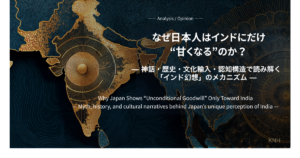
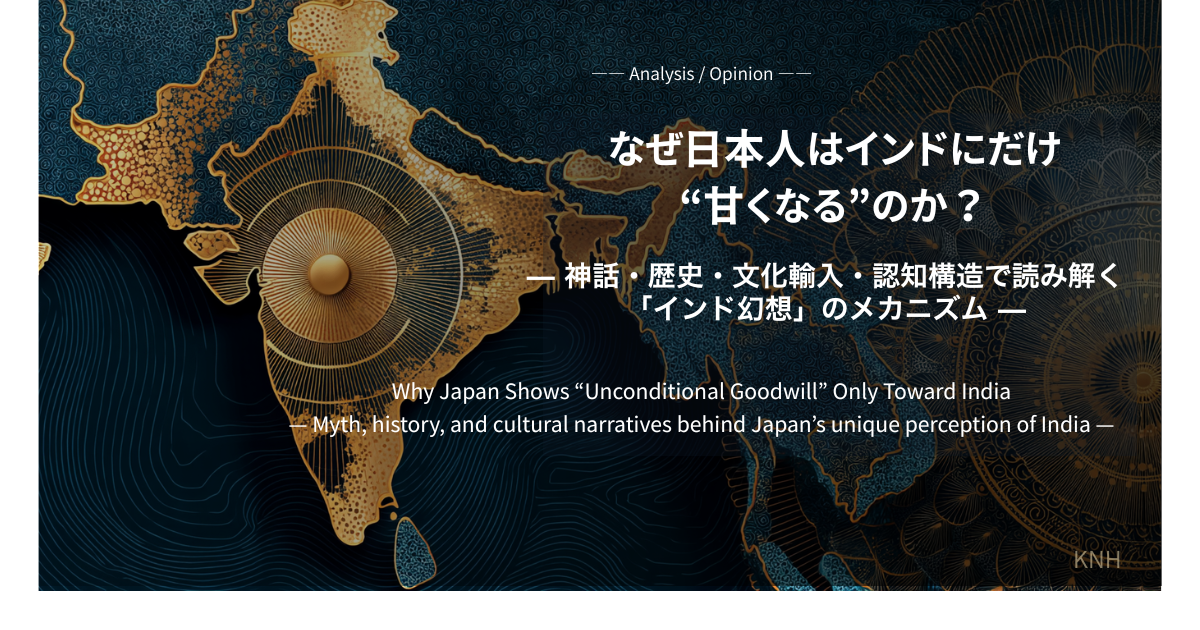
日本人がインドにだけ“無条件の好意”を抱きやすい理由
日本人がインドに“無条件の好意”を抱くのは、インドが特別だからではありません。
特別なのは、日本人の「物語を信じやすい情報構造」のほうです。
——美談・文化・歴史・構造が生み出した「インド幻想」と、日本人の認知のクセ
日本人は、外国に対する感情の振れ幅が極端だ。ある国には過剰な親しみを抱き、ある国には過剰な不信感を抱く。その評価は、かならずしも「事実」や「利害」だけで決まっているわけではない。
その中でも、かなり特異な現象がある。インドに対する、ほぼ“無条件の好意”だ。
インドが日本に特別優しいわけではない。外交は自国の国益を最優先するリアリスト国家であり、日本への態度も他国と同じく「利害」で動く。それなのに、日本社会ではインドに批判的な視線がほとんど向かない。
この「インドだけ例外的に甘い」現象は、インドの側に原因があるというより、日本側の認知構造の問題として見た方が筋が通る。
1)日本に“良い話だけ”が輸入された結果としての「美談ストーリー」
まず、日本で語られてきたインド関連の物語は、美談の割合がやたら高い。
- 戦後の極東国際軍事裁判で日本に同情的だったとされるパール判事
- マハトマ・ガンジーに代表される「精神性の高い国」というイメージ
- 「親日的な国」としてのインド像
- 象のハナコや、日本との友情エピソード
これらはすべて、広大で複雑なインド史のごく一部に過ぎない。しかし日本では、こうした「わかりやすく好意的な話」だけが切り取られ、拡大され、インドそのもののイメージとして独り歩きしてきた。
物語を重視する日本社会の気質と合わさることで、「インドは日本に優しい友好国だ」という印象が、ほぼ疑われることなく広まってしまったのである。
2)メディアがインドを「安全・文化枠」で固定してきた
日本のメディアは、国ごとに扱う「文脈」がある程度決まってしまっている。
- 中国・韓国 → 歴史問題・外交摩擦・安全保障
- 中東 → テロ・紛争・治安不安
- 欧州 → 社会問題・移民・経済危機
- 東南アジア → 低賃金労働・移民・観光
ところがインドの場合は、扱われる文脈がかなり偏っている。
- カレー、ナン、スパイスなどの食文化
- ヨガや瞑想、精神世界
- IT大国としての技術・人材
- どこか「親日的」で穏やかなイメージ
つまりインドは、日本のメディアの中で「安全で、文化的で、安心して好意を向けられる国」として固定されてしまっている。
インドが抱える現実の課題や摩擦はほとんど報じられない。その結果、日本人はインドに対して批判的な材料も、懐疑的な視点も持ちにくい構造になっている。
3)「南アジア=全部インド」という雑な認知
日本中どこの地方に行っても、「インド料理店」は必ずあると言っていい。しかし実際のところ、その多くはネパール人経営だったり、バングラデシュ出身だったりする。
それでも日本人の多くは、それを深く気にしないまま「インド料理」として受け入れている。ここには、
南アジアの多様な国や民族を、ざっくりと“インド”としてひとまとめにしてしまう
という、かなり大雑把な認知がある。
つまり日本人が向けている好意は、厳密な意味で「インド」に向けられたものというより、曖昧な南アジア像への好意になっているケースが少なくない。
4)欧米でのインド評価を“そのまま輸入”している側面
欧米のIT業界や医療、金融などでインド系人材が活躍していることは、たびたびニュースになる。
- シリコンバレーのインド系CEO
- イギリスやアメリカのインド系エリート層
こうした報道を通じて、
「欧米で評価されているインド」=「日本も高く評価すべきインド」
という、典型的な「白人評価の輸入」が起きている。
日本人は「欧米が褒めているもの」に弱い。インドへの好意の一部は、日本独自の観察ではなく、“欧米フィルター越し”の評価に頼っている側面がある。
5)インドにも深刻な人権問題は存在する —— ただし日本ではほとんど報じられない
ここまでインドを「美談枠」で語ってきたが、もちろんインドにも深刻な課題は存在する。国際人権団体や国連機関は、長年にわたって次のような問題を指摘し続けている。
- カースト差別:制度的には禁止されていても、現実には暴力や排除が続いている。
- 女性への暴力や性犯罪:国際比較でも深刻な水準にあり、国内外で大きな議論を呼んでいる。
- 宗教間暴力:とくにヒンドゥー教徒とムスリムの対立は各地で衝突を生んでいる。
- 報道・表現の自由への圧力:メディアやジャーナリストへの締め付けが強まっているとの指摘も多い。
- 少数民族・地域問題:カシミールなど、長年火種を抱えた地域が複数存在する。
他の国であれば、「危険な国」「問題の多い国」として大きく報じられるようなテーマである。
ところが日本のメディアでは、インドに関してこうした問題がほとんど取り上げられない。その結果、
「インド=問題が少ない国」「インド=善意の国」
という、かなり歪んだイメージだけが残ってしまう。
6)メディアの文脈選択ひとつで、国民感情はここまで左右される
インドに対する日本人の好意のかなりの部分は、インドの現実をよく知ったうえでの評価ではなく、
「日本のメディアが与えてきた“好意的な物語”の積み重ね」
によって形成されている。
ここには、非常に重要なポイントがある。
メディアがある国を「文化」「美談」「親日」といった枠でだけ紹介すれば、国民感情はその方向に大きく引き寄せられる。逆に、事件・不祥事・対立といった文脈ばかりが強調されれば、その国に対する印象は簡単に悪化する。
つまり、
メディアの取り上げ方ひとつで、国民感情はこれほどまでに左右される。
そしてその「取り上げ方」自体が、どこまでメディアの自主判断なのか、それとも政府方針や外交上の配慮なのか——という問題は、また別の大きな論点として残る。
7)日本人は「事実や利害」より「感情の物語」で国を判断しがちな民族
もちろん、日本人全員がそうだと言うつもりはない。ただ、社会全体の傾向として、次のようなパターンは否定しがたい。
- 複雑な現実より、「わかりやすい美談」を信じたがる
- 国益や利害より、「好感が持てるかどうか」で国を評価しがち
- 一面的なストーリーを、その国全体のイメージとして受け入れてしまう
インドに向けられている過剰な好意は、この「物語で世界を見てしまう日本人のクセ」が、他国よりも極端な形で現れている例だと言えるだろう。
8)他国ではインドはどう見られているのか?——日本の「無条件好意」はむしろ例外
では、日本以外の国々では、インドはどのように扱われているのだろうか。
世界価値観調査(World Values Survey 2020–22)によれば、主要国の中でも、日本は「インドに好意的な印象を持つ人の割合」が比較的高い一方で、欧米諸国ではインドを「信頼できる」とみなす割合が必ずしも高くはない。
つまり、「インド=好意的」という感情は、国際的に見ればむしろ日本が例外的に強い傾向だと言える。ここから、なぜ日本にだけインドへの“好ましい物語”が広がったのかを、あらためて説明する必要が出てくる。
結論から言うと、日本のように「ほぼ美談一色で、無条件の好意を向ける国」はあまり多くない。
- 欧米:IT人材やエリート層に対する高い評価がある一方で、移民問題、宗教対立、ビザ不正や差別問題など、現実的な摩擦も多く語られる。
- 中東:多くのインド系・南アジア系労働者を受け入れているため、経済的には不可欠な存在だが、労働環境や権利問題をめぐる緊張も絶えない。
- アフリカ:インド企業の進出が進む地域では、経済的協力と同時に摩擦や反発も起きている。
- アジア諸国:中国からはライバル視され、東南アジアでもインド系コミュニティは「重要な存在」であると同時に、「移民問題」の一部として語られることも多い。
つまり世界では、インドは「好意・警戒・競争・摩擦が混ざった対象」として、比較的リアリズムに評価されている。日本のように「ほぼポジティブ一色」で描かれる国は珍しい。
補足①:インド式掛け算という「象徴の誤読」—— 世界中にある計算法が、なぜ“インドの特技”になったのか
もう一つ、日本で「インド=頭が良い国」というイメージが強まった背景に、インド式掛け算(いわゆるヴェーダ数学)が一時的にブームになったことがある。
桁の多い計算を一瞬で解くあの手法は、学習教材やテレビ番組でも取り上げられ、日本人の間で「インド人は数学が得意」という印象をさらに強めた。
しかし実際には、あの手の“スピード計算テクニック”はインド固有のものではない。 世界中の文化や地域に存在する、民間算術・暗算法の一種であり、インド式はその一体系にすぎない。
ところが日本では、なぜかそれが「インド人は生まれつき数学に強い」というイメージを象徴する存在として独り歩きしてしまった。
つまり、日本人の中では「計算の速さ」という単純でポジティブな特徴が、インド全体の知性や論理性の象徴として拡大され、インドへの好意的ステレオタイプをさらに強化する素材になった側面がある。
現実のインド社会は地域差も教育格差も大きいが、こうした“わかりやすい象徴”が日本で広まると、それだけで国家イメージが上書きされやすいのだ。
補足②:『0(ゼロ)』をめぐる誤解 —— 日本で語られる「インド=数学大国」イメージのもうひとつの源
もうひとつ、日本で広まっているのが「インドはゼロを発明した国である」という認識である。
この語りはしばしば、「インドは数学に強い国家である」というイメージを補強する象徴的な材料として使われてきた。
しかし、学術的に見れば、この物語は単純化されすぎている。
まず事実として、インドの数学者たちがゼロを記号化し、位取り記数法に統合したことは、数学史における大きな貢献である。これは疑いようがない。
だが一方で、「ゼロの概念そのもの」は複数の古代文明で独立して発生しており、インドのみで生まれた思想ではない。
- 「無」や「空(プレースホルダー)」の概念は、早期の諸文明で並行して存在していた
- インドはそれを数学体系として完成させたが、「最初に思いついた」わけではない
にもかかわらず日本では、
「インドがゼロを発明した → インド人は数学に強い」
という分かりやすい物語として流通してきた。
こうした「単純で心地よい説明」は、インドに対する肯定的ステレオタイプをさらに強固にしていく。
- インド式掛け算
- ゼロの物語
- 「数学に強い民族」というイメージ
これらが積み重なることで、日本の中で「インド=数学の国」という特別視が形成されていったという構図である。
9)インド系が世界で「馴染みやすい」と言われる理由——文化性格ではなく構造的強み
インド系の人々は、世界各地にコミュニティを形成している。いわゆるディアスポラ(離散した共同体)として、歴史的にも非常に大きな存在だ。
彼らが「現地社会に馴染みやすい」「成功しやすい」と言われる背景には、いくつかの構造的な要因がある。
- 英語力:旧イギリス植民地という歴史から、高い英語運用能力を持つ層が多い。
- 専門スキル:IT、医療、金融など、先進国が求める分野に強い人材が多い。
- 強固なコミュニティ:宗教・出身地域ごとのネットワークが強く、移住先での相互扶助が機能している。
- 政治参加の積極性:欧米やアジア各国でインド系政治家が多数活躍しており、発言権を持ちやすい。
つまり、「インド系は性格が温厚だから馴染みやすい」という話ではなく、歴史的・構造的な強みが揃っているため、成功しやすい条件を持っていると言える。
10)欧米カルチャーが作った「神秘のインド」を日本も輸入した
もう一つ見落とせないのが、ポップカルチャーを通じて輸入された“神秘のインド像”だ。
1960〜70年代、欧米ではインド文化ブームが起きた。
- ビートルズの楽曲にシタールが導入される
- ラヴィ・シャンカールとの共演
- ヨガや瞑想、サイケデリックカルチャーの流行
- 「東洋の精神性」への憧れ
当時の西洋の若者やカウンターカルチャーにとって、インドは「物質主義的な西洋社会へのカウンター」であり、「精神の自由」の象徴になった。
このムーブメントは日本にも少し遅れて輸入され、当時“尖っていた”文化人や知識人、学生運動世代に大きな影響を与えた。その世代がメディアや教育界の中核にいたことを考えると、
「インド=スピリチュアルで神秘的で、どこか優れた国」
というイメージが、日本社会に長く残ったのも不思議ではない。
11)「仏教はインド発祥」という意識が生む、潜在的な親近感
日本人は宗教に無関心だと言われる一方で、葬儀や法事、寺社参拝など、生活の中には仏教文化が深く入り込んでいる。
その仏教が「インド発祥」であるという知識は、多くの日本人が何となく知っている。
そのため、
「日本文化の精神的ルーツの一部はインドにある」
という、明文化されない親近感が生まれやすい。
現代インドの宗教状況はヒンドゥー教が多数派であり、仏教はむしろ少数だが、日本側のイメージの中では、
「インド=精神性の源」「仏教の故郷」
という印象が、インドへの好意に静かに上乗せされている。
12)地理的距離が「理想化」を助けている
日本が外国をどう感じるかには、地理的距離も影響する。
- 中国・韓国 → 近すぎるがゆえに、政治摩擦や歴史認識のズレが日常的に目に入りやすい。
- 欧米 → 遠すぎて、「憧れ」と「無関係さ」が混ざった感覚になりやすい。
- 東南アジア → 観光地としての親近感と、労働・移民をめぐる現実が混在する。
その中で、インドは
- 地理的にはそこまで近くないが、完全に遠いわけでもない
- 戦後日本と直接対立した歴史的記憶がほとんどない
- ビジネスや移民の摩擦も、一般市民の目にはあまり見えてこない
という、「適度に距離があり、現実の負の側面が見えにくい位置」にいる。
実害が可視化されない相手には、人はどうしても理想を投影しがちになる。インドは、日本にとってまさにそのような「理想化しやすい距離」にいる国だと言える。
13)日本のインド観は、欧米の「オリエンタル幻想」を借りている
もう一歩踏み込むと、日本のインド観はかなりの部分が、欧米が作り上げた「オリエンタリズムとしてのインド像」を借りていると言える。
19〜20世紀の欧米において、インドはしばしば次のように描かれてきた。
- 神秘的で、精神性の高い東洋の国
- 貧しいが、どこか崇高で、悟りに近い人々
- カレーとヨガと瞑想の国
これは、あくまで「白人の側から見た、都合のいい東洋像」であって、現実のインド社会を忠実に映したものではない。
日本は戦後、この欧米的な東洋観を大量に輸入してきた。その延長線上で、「欧米が好む安全なインド像」を、そのまま自分たちのインド観として受け入れてしまった部分がある。
つまり、日本人が抱いているインド像のかなりの部分は、
「日本自身の観察から生まれたもの」ではなく、「欧米が作った絵葉書のようなインド」をなぞったもの
である可能性が高い。
最終結論:インドが特別なのではなく、日本の「物語に弱い認知構造」がインドを特別にしている
ここまで見てきたように、インドが「特別に優れた国」だから日本人が好意を抱いている、というよりは、
- インドに関する美談だけが強調されてきたこと
- 人権問題や宗教対立などの負の側面がほとんど報じられてこなかったこと
- 欧米カルチャーやポップミュージックが作った「神秘のインド」像が輸入されたこと
- 仏教発祥の地としての文化的な親近感
- 地理的距離ゆえに現実の摩擦が見えにくいこと
- 欧米のオリエンタリズムとしてのインド像を、そのまま受け入れてきたこと
- そして何より、日本人が「物語で世界を見がちな民族」であること
こうした複数の要因が折り重なった結果として、「インドだけ例外的に甘く評価される」という現象が生まれている。
インドへの友情や好意を否定する必要はない。ただし、その好意が現実の多面性を理解したうえでの判断なのか、それとも心地よくできあがった物語を信じているだけなのかは、一度冷静に立ち止まって考える価値がある。
日本人が本当に取り戻すべきなのは、インドへの過剰な理想化ではない。むしろ、
どの国に対しても、“物語ではなく現実”を、多面的に見る視点そのもの
なのだと思う。
では、これからの日本はどの国をどのように見つめるべきだろうか。私たちはどの「物語」から自由になり、何を基準に世界を理解していくべきなのか。
インドを過度に美化することでも、過度に貶めることでもなく、「実態を見て、事実から考える」という姿勢そのものが、いま日本社会に問われているのだと思う。
日本がインドを見る目をアップデートすることは、同時に、日本自身の「認知の枠組み」をアップデートすることでもある。この記事が、その最初の一歩を考えるきっかけになれば幸いだ。
Why Japanese People Tend to Show “Unconditional Goodwill” Only Toward India
Japan’s unusually warm feelings toward India say less about “what India really is,” and far more about how Japanese society is structured to see the world through comforting stories.
— How Myths, Culture, History and Structure Shaped an “India Fantasy,” and What It Reveals About Japan’s Way of Seeing the World
Japanese attitudes toward foreign countries tend to swing to extremes. Some countries are treated with excessive affection, others with excessive distrust. And that judgment is often not based purely on “facts” or “national interest.”
One of the most peculiar examples of this is Japan’s almost unconditional goodwill toward India.
It is not as if India is especially “kind” to Japan. Like any other major power, India pursues its own national interests with a realist foreign policy. Its stance toward Japan is also driven by calculation and interests, not by sentimentality.
And yet in Japan, India is rarely the target of serious criticism. This “exceptional softness” toward India says less about India itself, and far more about how Japanese society is structured to perceive other nations.
1) The “Good Story Only” Filter: How a Handful of Anecdotes Became “India Itself”
The India that circulates in Japanese discourse is strangely dominated by “good stories.”
- The episode of Judge Radhabinod Pal at the Tokyo Tribunal
- The image of Mahatma Gandhi and India as a “spiritually elevated” country
- The vague notion of India as a “pro-Japan” nation
- Stories of elephants, friendship, and symbolic episodes like the elephant Hanako
These are, of course, only tiny fragments of a vast and complex history. Yet in Japan, such “easy-to-digest, positive stories” have been repeatedly selected, amplified, and eventually came to stand in for India as a whole.
In a society that loves narratives, it is not surprising that these stories solidified into the impression that “India is a country that has always been kind and friendly to Japan.”
2) How Japanese Media Locked India Into a “Safe Cultural Frame”
Japanese media tend to frame each country in particular ways:
- China and South Korea → history disputes, diplomatic friction, security issues
- The Middle East → terrorism, conflict, instability
- Europe → social problems, migration, economic crises
- Southeast Asia → tourism, cheap labor, foreign workers
India, however, is treated in a much narrower frame:
- Curry, naan and spice-centered food culture
- Yoga, meditation and spirituality
- “IT powerhouse” and tech talent
- Somehow “gentle” and “friendly to Japan”
In other words, Japanese media have effectively fixed India into the category of
“safe, cultural, and easy to like.”
The hard, uncomfortable realities of India are rarely covered. As a result, Japanese audiences are structurally deprived of both critical information and skeptical perspectives on India.
3) The Crude Shortcut: “All of South Asia = India”
Walk around almost any town in Japan and you will find an “Indian restaurant.” In reality, many of these are run by Nepalese or Bangladeshi owners and staff.
Yet most Japanese patrons don’t notice—or care. This reflects a deeper cognitive shortcut:
the tendency to lump the entire South Asian region together and label it “India.”
In that sense, the goodwill that appears to be directed toward “India” is, in many cases, actually directed toward a vague, undifferentiated image of “South Asia.”
4) Importing Western Praise: “If the West Likes It, Japan Will Too”
In Silicon Valley and in Western medicine and finance, Indian-origin professionals are often highlighted as success stories:
- Indian CEOs of global tech firms
- Indian elites in politics, business and academia
Such coverage easily translates, in Japan, into the narrative that:
“India is praised by the West, therefore we should also regard India as a successful and admirable country.”
This is a classic pattern: Japan importing Western evaluations rather than forming its own. Part of Japan’s positive view of India is filtered through this “as seen from the West” lens.
5) India’s Serious Human Rights Problems — Mostly Invisible in Japan
None of this means that India is uniquely bad. But it does mean that, like any large country, India has serious human rights issues and deep social problems that require scrutiny.
International organizations and human rights NGOs have long pointed out issues such as:
- Caste-based discrimination and violence despite legal prohibitions
- Violence against women and high rates of sexual assault
- Religious violence, especially Hindu–Muslim clashes
- Restrictions on media freedom and pressure on journalists
- Minority and regional conflicts in places like Kashmir
In many other countries, these would be covered as “serious problems” or “sources of instability.”
But in Japanese media, these darker aspects of India are rarely reported. The result is a deeply skewed perception in which
“India = a country with almost no problematic side”
is quietly taken for granted.
6) A Single Editorial Choice Can Shape Public Emotion
Much of Japan’s goodwill toward India is not the result of carefully weighing India’s multi-layered reality. It is largely a product of
the selective narrative provided by Japanese media over many years.
This illustrates a broader structural issue:
public sentiment can be dramatically shaped by how media choose to frame a country.
If a nation is introduced mainly through culture, friendship and heartwarming stories, public emotion will naturally tilt that way. If, instead, the emphasis is on conflict, crime and disputes, the emotional tone shifts in the opposite direction.
Whether these editorial choices are purely the media’s own or influenced by government preferences and diplomatic considerations is a separate, important question. But in either case, the mechanism is the same: Japanese public emotion is easily steered by narrative framing.
7) A National Tendency: Judging Countries More by Narrative Than by Facts or Interests
Of course, not every Japanese person behaves this way. Still, at a societal level, certain tendencies are hard to deny:
- A preference for simple, uplifting stories over complex realities
- A habit of judging countries by emotional impressions rather than by interests or data
- A readiness to accept a single storyline as representative of an entire nation
Japan’s excessive goodwill toward India is a striking example of this broader pattern: a nation that sees the world through stories first, and only later—if ever—through facts.
8) How Is India Viewed Elsewhere? Japan’s “Unconditional Goodwill” Is Actually an Outlier
So how is India perceived in other parts of the world?
According to the World Values Survey (2020–22), Japan is among the countries where a relatively high share of respondents say they have a favorable impression of India, while in many Western countries trust in India is far more restrained.
In other words, Japan’s overwhelmingly positive view of India is not the global norm but a notable exception.
The short answer to our question is therefore this: in most regions, India is seen much more ambivalently and realistically than in Japan.
- In the West, India is praised for its talent and innovation, but also discussed in the context of migration tensions, religious conflict and bureaucratic challenges.
- In the Middle East, Indian and South Asian workers are essential to local economies, yet labor and rights issues generate constant friction.
- In Africa, Indian investment is welcomed in some sectors while provoking backlash in others.
- In other Asian countries, India may be seen as a strategic partner, a competitor, or both at once.
In most places, India is viewed as a complex actor: a mix of opportunity and risk, cooperation and conflict. Japan’s almost exclusively positive framing is, in that context, quite unusual.
Note1: “Vedic math” as a symbolic misunderstanding — A technique found worldwide, framed as uniquely Indian
Another factor that strengthened Japan’s perception of India as a “smart, logical nation” was the temporary boom of so-called “Vedic math” or rapid Indian-style multiplication.
The technique, which allows fast mental calculation of large numbers, was widely featured in educational media in Japan, reinforcing the stereotype that “Indians are naturally strong in math.”
However, these rapid-calculation methods are not unique to India. Similar techniques exist across many cultures worldwide as forms of folk arithmetic or mental math. India’s version is simply one branch within a broader global tradition.
Yet in Japan, it somehow became a symbolic example that “proved” Indian mathematical excellence, further amplifying positive stereotypes about Indian intelligence.
Even though India is a vast and diverse society with significant regional and educational disparities, such easily digestible symbols tend to overwrite real complexity and shape national images in simplified, flattering ways.
Note2: The Myth of “Zero” — How Japan Simplified a Global Mathematical History
Another widely circulated idea in Japan is that “India invented zero.” This narrative is powerful and often cited as proof that “Indians are mathematical geniuses.”
It is true that Indian mathematicians played a crucial role in formalizing the symbol “0” and integrating it into a positional number system. But academically, the story is far more complex:
- The concept of “nothingness” and placeholder symbols developed independently across several early civilizations.
- India made the decisive contribution of systematizing “0” as part of a mathematical structure.
- Thus, the idea that “only India invented zero” is an oversimplification.
Yet in Japan, these nuances rarely enter public discourse. Instead, “Zero was invented by India → India is the root of mathematics → Indians are born math geniuses” becomes a simplified cultural narrative.
This narrative chain then flows naturally into:
- “Indians are exceptionally strong at math”
- “Indians are naturally talented in IT and engineering”
- “India is a nation of elite STEM minds”
In other words, the “zero myth” is less about India itself and more about Japan’s tendency to mythologize foreign cultures by reducing them into easy, flattering symbolic stories.
9) Why Do Indian Diaspora Communities Often “Integrate Well”? It’s Structural, Not Just Personality
Indian-origin communities are among the largest diasporas in the world. Their perceived “smooth integration” into host societies is not just a matter of temperament; it reflects several structural strengths:
- English proficiency, rooted in colonial history
- High-value skills in IT, medicine, finance and engineering
- Strong community networks based on region and religion
- Active political participation, leading to real influence in host countries
This combination makes Indian diaspora communities highly visible and often successful. It is less about “national character” and more about historical and structural advantages.
10) The Beatles and the “Mystic East”: How Western Pop Culture Exported a Fantasy India
Another crucial factor behind Japan’s India fantasy is the influence of Western pop culture.
In the 1960s and 70s, the West went through a major “India boom”:
- The Beatles incorporated the sitar into their music
- Collaborations with Ravi Shankar brought Indian classical music to Western audiences
- Yoga, meditation and psychedelic culture spread as symbols of “spiritual liberation”
- “The East” was romanticized as a source of wisdom and freedom
For young people and counterculture movements of that era, India became a symbol of “freedom from Western materialism” and “deeper spiritual truth.”
Japan imported this cultural wave as well. Many of the intellectuals, artists and activists who were “edgy” at the time absorbed this Western picture of India and carried it into their later roles in media and education.
It is therefore not surprising that, for decades, Japan has preserved an image of India as
“a mystical, spiritual and somehow superior country.”
11) Buddhism as a “Spiritual Link”: Seeing India as the Source of Japan’s Inner Life
Even in a nominally secular Japan, Buddhism is deeply woven into everyday life—funerals, ancestral rites, visits to temples.
Many Japanese people are vaguely aware that Buddhism originated in India. This creates a subtle but powerful association:
“Part of Japan’s spiritual and cultural roots lie in India.”
Even though modern India is predominantly Hindu, and Buddhism is a small minority there today, the Japanese mental map still links “India” with “the birthplace of Buddhism” and “spiritual origins.”
This unspoken sense of kinship quietly reinforces Japan’s tendency to view India with particular warmth.
12) The Perfect Distance: Far Enough to Idealize, Close Enough to Feel Relevant
Geographical distance also matters.
- China and South Korea are “too close,” which makes every political clash and historical dispute feel immediate and personal.
- The West is “too far,” often framed more as aspiration or abstraction than as everyday reality.
- Southeast Asia is familiar as a tourist destination and as a source of foreign labor, leading to a mixed and sometimes conflicted image.
India, by contrast, sits at a sweet spot:
- Not so close that daily frictions are constantly visible
- Not so far that it feels entirely irrelevant
- With little direct wartime baggage in the Japanese memory
This makes India an ideal canvas for projection: a country on which Japan can easily paint its own fantasies, unconstrained by the messy immediacy that shapes perceptions of neighboring states.
13) Japan’s India Is, in Many Ways, the West’s Fantasy India
Finally, a blunt point: much of Japan’s image of India is effectively borrowed from Western “Orientalist” fantasies.
For over a century, Western literature, art and scholarship often depicted India as:
- A land of mystical wisdom
- A place of noble poverty and spiritual depth
- A country defined by curry, yoga and meditation
These are not neutral descriptions; they are projections—ways of turning a complex society into a consumable “exotic object” for Western audiences.
Postwar Japan absorbed much of this imagery along with other Western cultural imports. Without fully realizing it, Japan has often treated this “postcard India” created for Western eyes as if it were the real thing.
Final Conclusion: It’s Not India That Is Exceptional — It’s Japan’s Story-Driven Way of Seeing
When you put all of this together, a clear pattern emerges. Japan’s special affection for India is not simply a response to “what India really is.” It is largely the product of:
- The overemphasis on positive anecdotes and “good stories”
- The near absence of reporting on darker realities and human rights issues
- The importation of Western pop-cultural images of a “mystical India”
- The sense of spiritual affinity created by Buddhism’s Indian origins
- The geographic distance that makes friction and conflict less visible
- The uncritical adoption of Western Orientalist imagery
- And, above all, a national tendency to view the world through narratives rather than structures and facts
India is not uniquely “good,” nor uniquely “bad.” It is a large, complex, contradictory country like any other. What is unique here is Japan’s story-driven perception.
Japan does not need to abandon its goodwill toward India. But it does need to ask:
Is this goodwill based on a sober understanding of reality, or on a comforting set of stories?
The real task is not to idealize or to demonize any particular nation, but to recover the ability to see all countries—including India—in their full, multi-layered reality.
In that sense, what Japan most urgently needs to regain is not “love for India,” but something deeper and more fundamental:
the intellectual discipline to look beyond narratives, and to see the world as it really is.
Where, then, should Japan turn its gaze next? Which narratives do we need to step out of, and what standards should we use to understand the world?
Learning to see India as it truly is—without excessive idealization or undue hostility—would be an important first step. From there, Japan can begin to update not only its view of India, but its entire mental framework for understanding the world.
参考文献(International References)
-
United Nations Human Rights Council (UNHRC).
(2023). Report on the Human Rights Situation in India.
https://www.ohchr.org/en/countries/india -
World Values Survey Association.
(2010–2022). World Values Survey: India & Japan Comparative Data.
https://www.worldvaluessurvey.org/ -
Pew Research Center.
(2023). Global Indicators Database: Views of India.
https://www.pewresearch.org/global/ -
OECD Data.
(2024). Education, Literacy, and Social Development Indicators: India.
https://data.oecd.org/ -
United Nations Development Programme (UNDP).
(2023). Human Development Report: India Country Profile.
https://hdr.undp.org/data-center -
International Organization for Migration (IOM).
(2022). Global Migration Data: Indian Diaspora.
https://www.iom.int/global-migration-data
※上記はすべて国際機関の一次データ/公式レポートであり、本記事の分析(日本人のインド観・人権状況・価値観比較・ディアスポラ構造の説明)を裏付けるために編集部が再構成したものです。
※本記事の分析パートは、海外報道・学術研究・公開データを基に編集部が独自に再構成したものです。
※The analytical sections in this article are independently compiled by the Editorial Desk based on international reporting, academic research, and publicly available data.

海外ニュースを多言語で読み比べ、「同じニュースが、言語や読者層によってどう書き換わるのか」 を分析しています。
日本の報道だけでは見えにくい 国際政治・情報戦・背景文脈 を、静かで冷静な筆致で読み解きます。
Calm insight from Tokyo.