※報道内容の分析のため引用
大使館は「外国の主権」に準ずる空間。
そこに兵士が入る意味は、想像より重い。
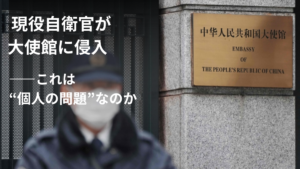
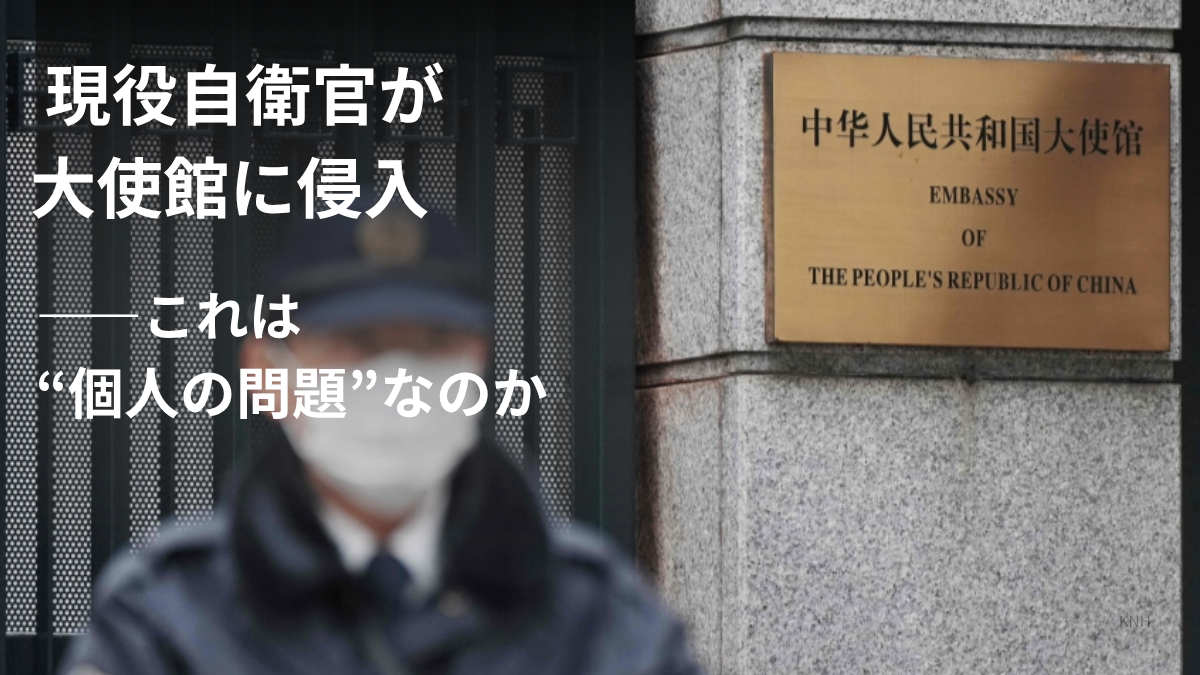
2026年3月24日、現役の自衛官が中国大使館に侵入し、現場で取り押さえられた。
容疑者は「大使に直接意見を伝えるためだった」と説明し、刃渡り約18センチの刃物を持ち込んでいたとされる。
また、要求が受け入れられなければ自決する意図があったとも供述している。
中国側はこの件について強い抗議を行っている。
日本政府はこの件について、「遺憾」とコメントした。
だが、この言葉は今回の事案に本当にふさわしいのだろうか。
「遺憾」とは、本来、思い通りにいかず残念だという意味の言葉だ。
しかし今回起きたのは、現役兵士が刃物を持って外国大使館に侵入した事件である。
しかも大使館は、単なる外国の施設ではない。
国際法上、特別に保護される空間であり、受け入れ国にはその安全を守る義務がある。
そう考えると、これを単に「残念な出来事」として処理していいのか、という疑問が生じる。
ここで一度、立ち止まる必要がある。
この出来事を「異常な個人の行動」として処理していいのか。
この事件の重さは、国内の感覚だけでは見えにくい。
国際法ではどう位置づけられるのか。海外メディアはどう報じているのか。さらに、過去に海外で起きた類似の事例は、どのように扱われてきたのか。
それらをたどっていくと、この出来事が単なる個人の事件ではなく、国家・外交・安全保障の問題として見られる理由が浮かび上がってくる。
国際法ではどう扱われるのか
この種の事件は、国際法上どのように位置づけられるのか。
ウィーン外交関係条約(1961)
外交施設の扱いについては、「ウィーン外交関係条約(1961年)」が国際的な基準となっている。
この条約では、大使館は「不可侵」とされ、受け入れ国にはその安全を確保する義務があると明記されている(ウィーン外交関係条約(1961年)第22条)。
この種の事件は、国際法上どのように位置づけられるのか。
結論から言えば、これは単なる不法侵入ではない。
大使館は国際法上、「不可侵」とされる特別な空間であり、 受け入れ国にはその安全を確保する義務がある。
これは、いわゆる「ウィーン外交関係条約」によって定められている。
この条約では、
- 外交施設への侵入は許されないこと
- 受け入れ国が施設の保護責任を負うこと
が明確に規定されている。
つまり、大使館への侵入が発生した時点で、
それは単なる国内の治安問題ではなく、国家間の責任問題に直結する。
さらに今回のケースでは、
- 侵入したのが現役の兵士であること
- 刃物という武器が持ち込まれていること
が加わっている。
これにより、この行為は
国家の武装組織に関わる事案として解釈される余地を持つ。
たとえ個人の行動であったとしても、 国際的には「統制の問題」「管理の問題」として見られる。
ここで問われるのは、
- なぜ侵入を防げなかったのか
- なぜそのような行動が起きたのか
- 国家としての管理体制は適切だったのか
であり、個人の動機そのものではない。
つまり——
国際法の観点では、この事件はすでに「国家の責任が問われる事案」として扱われる。
海外メディアはこの事件をどう報じたか
この件を報じた海外メディアを見ると、日本国内での扱いとは視点が大きく異なる。
日本では、この事件は「異常な個人の行動」として処理されがちだ。
しかし海外では、同じ出来事がまったく別の枠組みで捉えられている。
ワシントン・ポスト(米国)
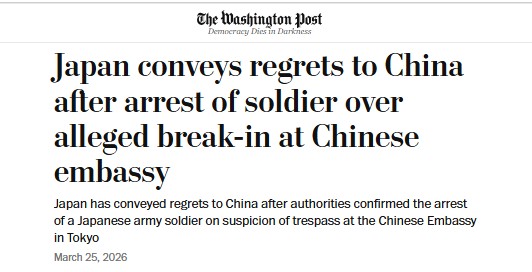
見出しの段階で、この事件が個人の問題ではなく、日本政府の対応と日中関係の中で扱われていることが分かる。
。米国では、現時点で主流メディアの中で報じたのは The Washington Post のみである。
ワシントン・ポストは、この事件を単なる侵入事件としてではなく、日本政府が中国に遺憾の意を示したこと、そして日中関係の中で起きた摩擦として位置づけている。
記事の焦点は、個人の動機ではなく、
- 日本政府の対応
- 中国側の抗議
- 日中関係の緊張
に置かれている。
ドイチェ・ヴェレ(ドイツ)
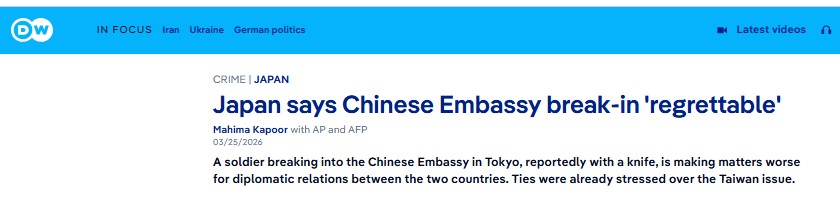
見出しの段階で、この事件が外交関係の悪化と結びつけて扱われていることが分かる。
ドイツの国際放送 Deutsche Welle は、この事件を外交関係の文脈で扱っている。
報道では、兵士による侵入と刃物の存在に触れたうえで、この出来事がすでに緊張状態にある日中関係をさらに悪化させる可能性があると指摘している。
特に重要なのは、この事件が台湾問題をめぐる対立と結びつけて語られている点だ。
つまりDWにとって、この出来事は単なる犯罪ではなく、
地政学的な緊張の中で発生した一つの事象
として位置づけられている。
インディペンデント(英国)
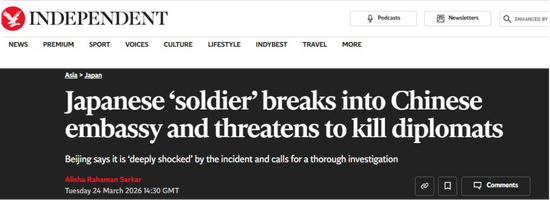
見出しの段階で、この事件が外交官への直接的な脅威として扱われていることが分かる。
英国紙 The Independent は、この事件を外交官への脅威という観点から報じている。
記事では、中国側がこの行為を「外交官への脅威」と受け止め、強い抗議と調査要求を行った点が強調されている。
つまりこの媒体では、この事件は
外交施設の安全保障に関わる問題
として扱われている。
サウスチャイナ・モーニング・ポスト(香港)
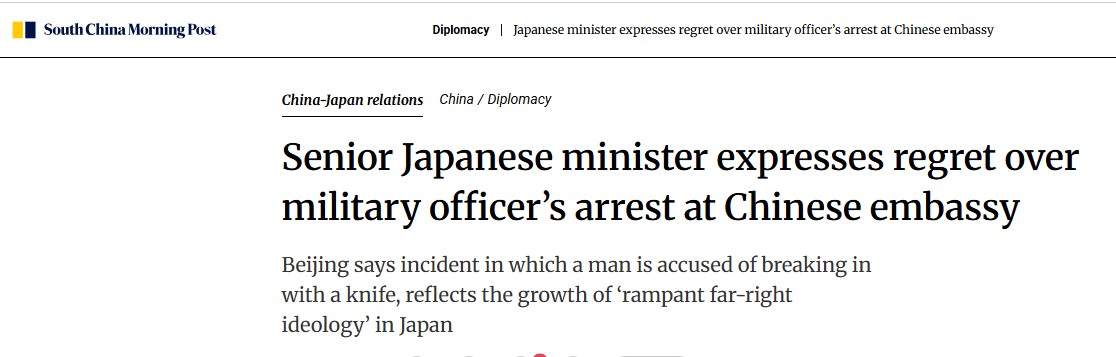
見出しから、この事件が日本政府の対応と日中関係の文脈で扱われていることが分かる。
South China Morning Post は、この出来事を日本社会の内部要因にまで踏み込んで報じている。
ここでは、この事件が日本における対中強硬姿勢や思想的な変化と結びつけて解釈されている。
もちろん、この見方には中国側の視点が強く反映されているため、そのまま事実として受け取ることはできない。
しかしそれでも、この事件が単なる個人の逸脱としてではなく、
社会や政治の文脈の中で理解されている
という点は共通している。
海外報道に共通している視点
ここまでを見ると、各メディアの焦点は異なる。
- ワシントン・ポストは「国家の対応」と「外交摩擦」
- ドイチェ・ヴェレは「地政学的緊張」
- インディペンデントは「外交官の安全」
- サウスチャイナ・モーニング・ポストは「社会・思想」
しかし、違い以上に重要なのは、その共通点である。
どの媒体も、この事件を個人の行為として報じつつも、 国家・外交の文脈の中で位置づけている。
むしろ共通して見ているのは、
- 国家の対応
- 外交関係への影響
- 組織統制の問題
- 社会・政治的背景
である。
さらに重要なのは、複数の報道がこの事件の背景として、 日中関係の悪化を明確に位置づけている点だ。
特に繰り返し言及されているのが、 高市早苗首相による台湾有事に関する発言である。
この発言は中国側の強い反発を招き、両国の関係は緊張状態にある。
つまり今回の出来事は、
突発的な個人の行動ではなく、すでに緊張していた国家関係の中で発生した事象として理解されている。
言い換えれば、海外で問われているのは、
「何が起きたか」ではなく、「なぜその状況でそれが起きたのか」である。
実際の国際事例
過去にも、大使館や外交施設への侵入は、単なる治安事件ではなく、重大な国際問題として扱われてきた。
重要なのは、そこでは常に「誰が侵入したか」だけでなく、
- 受け入れ国が安全を守れたのか
- 外交関係にどのような影響を及ぼしたのか
- その行為が国家間の対立をどう深めたのか
が問われてきたという点である。
1979年 テヘラン米国大使館人質事件
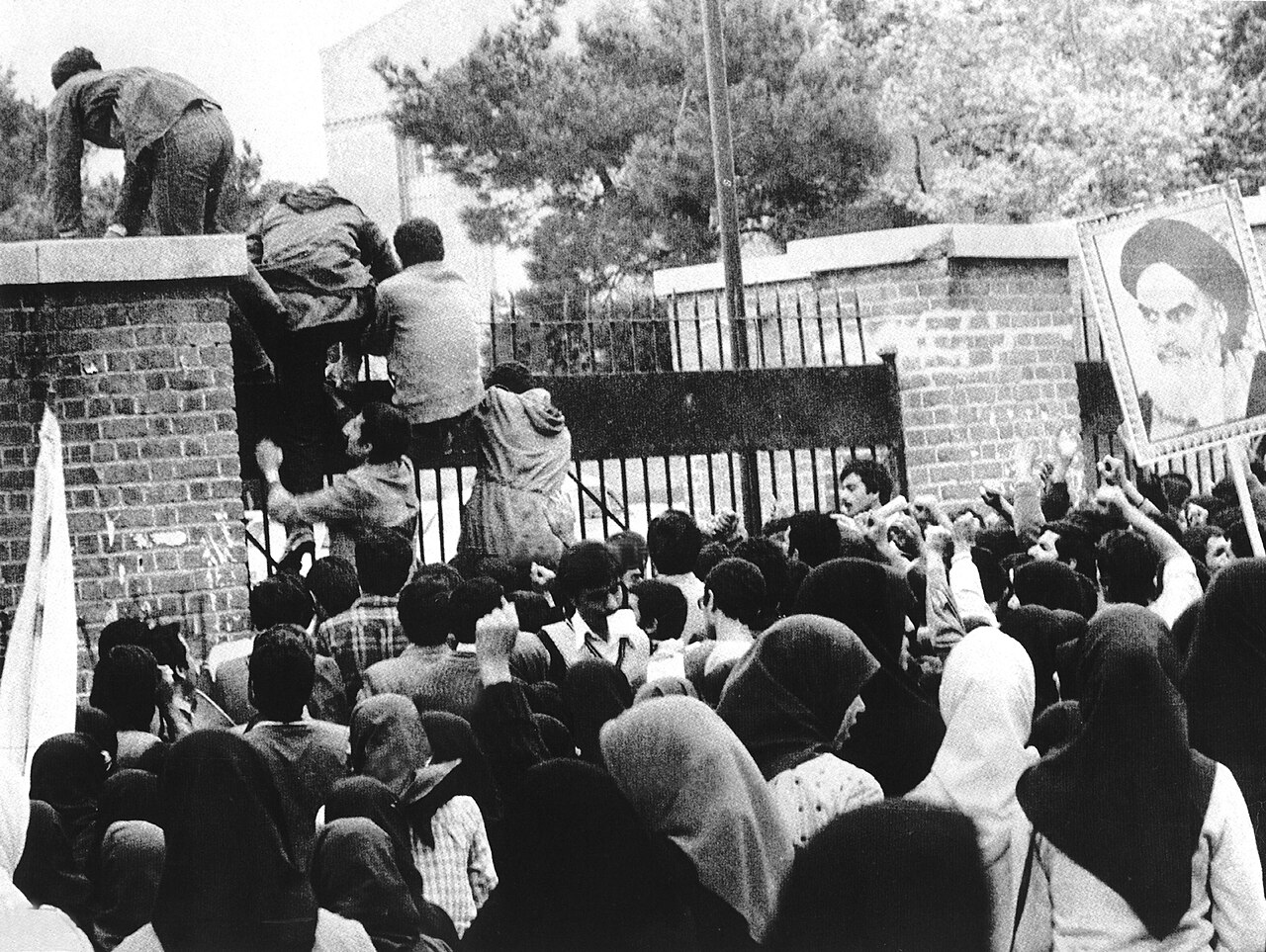
大使館への侵入が、単なる治安事件ではなく国家関係そのものを揺るがすことを示した典型例である。
1979年、イランの首都テヘランで、米国大使館が占拠され、外交官らが長期間拘束された。
この事件が国際社会に与えた衝撃は大きかった。なぜなら、大使館は本来、外交関係を維持するために特別に保護されるべき空間であり、そこへの侵入は単なる施設侵害ではなく、
国家間の最低限のルールそのものを踏み越える行為
と受け止められたからである。
結果として、この事件は米国とイランの関係を決定的に悪化させ、両国は断交に至った。
ここで問われたのは、侵入した者の個人的事情ではなく、
- 外交施設の不可侵が破られたこと
- 受け入れ国がその安全を守れなかったこと
- その結果として国家間関係が破壊されたこと
である。
つまりこの事件は、
大使館への侵入が国家関係そのものを破壊しうる行為である
ことを示した典型例だった。
1980年 ロンドンのイラン大使館占拠事件
翌1980年には、ロンドンのイラン大使館が武装勢力に占拠される事件が起きた。
この事件では、英国政府は特殊部隊を投入し、武力を用いて事態を収束させた。
ここで示されたのは、大使館侵入という行為が、場合によっては通常の警察対応を超え、
軍事・準軍事レベルの対応を必要とする問題
に発展しうるという現実である。
大使館は単なる建物ではなく、外国の主権と直結する象徴的な空間である以上、その安全が脅かされれば、事態は一気に外交危機へと変わる。
この事件もまた、単に「武装犯が立てこもった」という話では終わらなかった。
そこでは、
- 外交施設の安全確保
- 受け入れ国の責任
- 国際社会への政治的メッセージ
が同時に問われた。
小規模な侵入事件は世界中で起きている
一方で、大使館への侵入そのものは、世界的に見れば決して珍しいものではない。
活動家や抗議者がフェンスを越えて敷地内に入り、横断幕を掲げたり抗議行動を行うケースは各国で繰り返し発生している。
これらの事例の多くは、
- 民間人による行為
- 非武装
- 政治的抗議が目的
という特徴を持つ。
そのため、逮捕や外交上の抗議には発展しても、
国家関係そのものを揺るがす問題にまでは発展しにくい。
つまりそれらは、国家の問題ではなく「抗議行動」として処理可能な範囲に収まる。
中規模の事例:外交危機に発展するケース
より重大なケースでは、大使館や領事館への攻撃が外交危機に直結する。
代表的なのが、2012年のリビア・ベンガジにおける米領事館襲撃事件である。
この事件では武装勢力が施設を襲撃し、米国大使が死亡した。
この結果、
- 米国内で政治問題化
- 安全保障上の重大事案として扱われる
- 外交政策そのものに影響
といった影響が生じた。
この段階になるとすでに、
単なる事件ではなく「国家の安全保障問題」として扱われる。
では今回の事件は、この中でどこに位置づけられるのか。
結論から言えば、
「小規模な侵入」ではなく、「国家問題へ接続しうる中間領域」にある。
民間人による抗議型の侵入とは異なり、 現役兵士による行為である以上、 この時点で問題は個人の枠を超える。
これらの事例が示していること
これらの事例は性質こそ異なるが、共通している点がある。
- 大使館侵入は「普通の事件」としては扱われない
- 問題は個人ではなく、国家間関係へと直結する
- 受け入れ国の安全確保義務が厳しく問われる
そして今回の件では、そこにさらに
- 侵入したのが現役兵士であること
- 刃物が持ち込まれていたこと
が重なっている。
この二つの要素は、問題をより重くする。
なぜなら、兵士は国家の指揮命令系統に属する存在であり、 その行動はたとえ個人的なものであっても、
国家の統制や管理の問題として見られる余地を持つ
からだ。
そう考えると、今回の事件は「異常な個人の行動」で片づけられるものではない。
問題は侵入ではない。侵入した主体である。
なぜ「兵士」だと意味が変わるのか
今回の核心はここにある。
もしこれが一般人による侵入であれば、まだ「治安事件」として処理される余地がある。
しかし今回は違う。
侵入したのは現役の兵士であり、刃物という武器が持ち込まれていた。
この二つが重なった時点で、この出来事の意味は大きく変わる。
兵士とは、国家の指揮命令系統に属し、装備と権限を与えられた存在である。
つまり——
個人ではなく、「国家と接続された存在」が動いたと見なされる。
たとえ単独の行動であったとしても、
- 統制は機能しているのか
- 思想的な問題は存在しないのか
という疑念が必ず生じる。
「個人」で終わらないのはなぜか
ここで重要なのは、過去の事例である。
完全に同一のケースは少ないが、構造としては繰り返されてきた。
事例①:大使館侵入はそれ自体で国際問題になる
ロンドンのイラン大使館占拠事件では、武装勢力による侵入に対し英国は特殊部隊を投入した。
ここで重要なのは、「誰が侵入したか」以前に、
大使館への侵入そのものが外交問題になる
という点である。
事例②:国家組織が関与すると個人では処理されない
いわゆるアブ・オマル事件では、米CIAがイタリア国内で人物を拘束したことが問題となった。
結果として、
- 主権侵害として国際問題化
- CIA関係者に有罪判決
が下されている。
同盟国同士であっても、国家組織が関与した時点で、
それは個人の問題ではなく、国家責任の問題となる。
事例③:兵士が動けば国家問題になる
クリミア併合では、所属不明とされた武装兵が施設を制圧した。
ロシア側は関与を曖昧にしたが、国際社会はこれを国家行為と認定し、制裁へと発展した。
ここで示されたのは、
兵士が動いた時点で、それは国家の問題として扱われる
という現実である。
視点を変えると見えるもの
もし逆の立場だったらどうか。
中国の現役兵士が、刃物を持って日本大使館に侵入した場合、 それを「個人の問題」として受け止めるだろうか。
おそらく多くの人は、そうは考えないはずだ。
問われているのは「行為」ではなく「構造」
この種の事件は、
- 誰がやったのか
- どんな動機だったのか
だけで評価されるものではない。
むしろ問われているのは、
- 統制は機能しているのか
- どのような思想環境があるのか
- なぜそれが現実の行動として現れたのか
という「構造」である。
憲法と自衛隊の「曖昧さ」は影響するのか
ここで一つ、見落とされがちな論点がある。
日本における自衛隊の位置づけである。
日本国憲法は、戦力不保持を原則としており、自衛隊は長年「軍隊ではない」という整理のもとに運用されてきた。
このため国内では、
- 自衛隊員はあくまで個人としての行為
- 国家の行為とは切り離して考える
という認識が生まれやすい。
しかし——
国際社会はそのようには見ない。
国際的には、
- 武装しているか
- 国家の指揮命令系統に属しているか
- 公的任務を担う組織か
という観点で判断される。
その意味で、自衛隊は明確に「国家の武装組織」として扱われる。
したがって、
「自衛隊だから個人の問題として軽く扱われる」ということは、国際的には起こりえない。
むしろ逆に、
国家の統制や管理の問題として見られる可能性が高い。
ここで重要なのは、 この「国内の認識」と「国際的な認識」のズレである。
このズレをどう扱うかは、 憲法や自衛隊の位置づけをどう考えるかという議論にも直結する。
仮に憲法改正によって自衛隊の位置づけがより明確になった場合、
- 責任の所在はより明確になる
- 同時に国家責任としての重さも増す
という側面がある。
つまりこれは、
「軽くなるかどうか」の問題ではなく、 「どのような責任として明確化されるのか」という問題である。
結論
ここまで見てきたように、この事件は単なる不法侵入でも、異常な個人の行動でもない。
国際法上、大使館は特別に保護される空間であり、そこへの侵入はそれ自体が国家間ルールに関わる問題となる。
海外メディアもまた、この出来事を「個人の事件」としては扱っていない。
国家の対応、外交関係への影響、組織統制、そして政治的背景—— すべてが同時に問われている。
過去の国際事例が示しているのも同じことだ。
大使館への侵入は、その主体と状況によっては、国家関係そのものを揺るがす。
そして今回、その主体は現役の兵士だった。
この時点で、問題はすでに個人の枠を超えている。
にもかかわらず、日本政府の対応は「遺憾」の一言にとどまった。
この言葉の軽さと、事案の重さは、あまりにも釣り合っていない。
本来問われるべきは、
- なぜこのような事態が起きたのか
- 統制は機能していたのか
- 外交上のリスクをどう認識しているのか
であるはずだ。
それにもかかわらず、「個人の問題」として矮小化し、「遺憾」で処理する。
この対応こそが、問題の本質を示している。
安全保障を語り、抑止力を強調し、憲法改正まで議論する一方で、 現実に起きた重大事案に対しては、その重さに見合った対応が取られていない。
それは、安全保障を語っているのではなく、安全保障を消費しているだけではないのか。
本当に必要なのは、強い言葉でも、敵を作ることでもない。
現実を正しく認識し、その責任を引き受けることだ。
しかし今回の対応から見えるのは、その逆である。
問題は事件そのものではない。
問題は、このレベルの事態を前にしてもなお、 それを正面から扱おうとしない政治の姿勢にある。
安全保障を語ることと、現実の安全保障に向き合うことは別だ。
いま行われているのは前者であって、後者ではない。
だから問われているのは、この事件ではない。
この政権そのものだ。
An active-duty soldier breaks into an embassy — the world sees this as a state matter
An embassy is a space treated as an extension of a foreign state’s sovereignty.
When a soldier enters it, the meaning is far heavier than it appears.
On March 24, 2026, an active-duty member of Japan’s Self-Defense Forces entered the Chinese Embassy in Tokyo and was apprehended at the scene.
According to reports, the suspect said he wanted to convey his views directly to the ambassador and had brought a knife with a blade of about 18 centimeters.
He also reportedly stated that, if his demand was rejected, he intended to kill himself.
China lodged a strong protest over the incident.
The Japanese government described the case as “regrettable.”
But is that really an appropriate word for what happened?
In Japanese, the word ikan (“regrettable”) generally means something unfortunate or disappointing.
Yet what happened here was that an active-duty soldier, carrying a knife, entered a foreign embassy.
And an embassy is not simply a foreign facility. On the level of international law, it is a specially protected space, and the receiving state has a duty to ensure its safety.
Seen that way, it is fair to ask whether this can really be treated as nothing more than an “unfortunate incident.”
This is where we need to stop and think.
Can this really be dismissed as the act of a disturbed individual?
The weight of this incident cannot be understood through domestic intuition alone. How is it treated under international law? How have foreign media framed it? And how have similar incidents abroad been handled in the past?
Once those questions are followed through, it becomes clear why this case is not simply a personal incident, but one that is connected to the state, diplomacy, and security.
How international law treats this case
How should this kind of incident be understood under international law?
Vienna Convention on Diplomatic Relations (1961)
The international standard governing diplomatic facilities is the Vienna Convention on Diplomatic Relations (1961).
Under this treaty, an embassy is considered “inviolable,” and the receiving state has a duty to ensure its security (Vienna Convention on Diplomatic Relations, 1961, Article 22).
Seen from this perspective, the case cannot be understood as a simple matter of trespass.
An embassy is not just another foreign facility. Under international law, it is a specially protected space, and the receiving state bears responsibility for safeguarding it.
That is precisely what the Vienna Convention is meant to establish.
The treaty makes clear that:
- entry into diplomatic premises is not to be permitted
- the receiving state is responsible for protecting those premises
In other words, once an intrusion into an embassy has occurred, the issue no longer remains merely a domestic public-order matter. It directly engages the responsibility of the state.
In this particular case, there are further aggravating elements:
- the intruder was an active-duty soldier
- a weapon — a knife — was brought into the premises
These factors raise the gravity of the case.
As a result, the act may be understood not simply as an individual offense, but as a matter connected to the control and management of a state’s armed organization.
Even if the act was personally initiated, internationally it is likely to be viewed in terms of discipline and command oversight, not merely individual motive.
What is being questioned, then, is not simply:
- who did it
- what motive they claimed to have
but rather:
- why the intrusion was not prevented
- why such an act occurred at all
- whether the state’s management and control were adequate
That is why, from the standpoint of international law, this incident is already one in which state responsibility is at issue.
How foreign media covered this incident
A look at foreign coverage shows a clear difference from the way this case has been treated in Japan.
In Japan, it has often been processed as the act of an abnormal individual.
But abroad, the same event is being framed within a very different set of meanings.
The Washington Post (United States)
Even at the headline level, it is clear that this case is being placed not simply in terms of an individual act, but within the context of the Japanese government’s response and Japan–China relations.
In the United States, at least at this stage, The Washington Post was the only major mainstream outlet to report on the case.
The Post framed it not merely as a break-in, but as a point of friction in the wider relationship between Japan and China, while emphasizing that the Japanese government had conveyed its regrets to Beijing.
Its focus is placed less on the suspect’s personal motive than on:
- the response of the Japanese government
- China’s protest
- the tension in Japan–China relations
Deutsche Welle (Germany)
Even from the headline, it is clear that this case is being linked to the deterioration of diplomatic relations.
Germany’s international broadcaster Deutsche Welle treats the case in a diplomatic context.
Its report notes the soldier’s entry into the embassy and the presence of a knife, while stressing that the incident could further worsen already tense relations between Japan and China.
What is particularly significant is that the report connects the incident to the dispute over Taiwan.
In other words, DW does not treat this simply as a crime report, but as:
a development emerging from an already existing geopolitical tension
and frames it accordingly.
The Independent (United Kingdom)
From the headline alone, it is evident that the incident is being framed in terms of a direct threat to diplomats.
The Independent approaches the story from the standpoint of a threat to diplomatic personnel.
Its report foregrounds China’s interpretation of the incident as a serious threat to diplomats, along with Beijing’s protest and demand for an investigation.
In this framing, the issue is treated as:
a security problem involving the safety of diplomatic facilities
rather than as a story centered on the psychology of one individual.
South China Morning Post (Hong Kong)
From the headline, one can see that the case is being placed in the context of both the Japanese government’s response and Japan–China relations.
South China Morning Post goes further by reading the incident through Japan’s internal political and social background.
It links the case to Japan’s tougher posture toward China and to broader ideological change.
Of course, because this framing strongly reflects the Chinese side’s viewpoint, it should not be accepted uncritically as fact.
Even so, the key point remains that the incident is not being treated as a mere aberration by one individual, but as something understood within:
a social and political context
and that point is important in itself.
What these foreign reports have in common
Taken together, each outlet emphasizes a different angle:
- The Washington Post highlights “state response” and “diplomatic friction”
- Deutsche Welle emphasizes “geopolitical tension”
- The Independent stresses “the safety of diplomats”
- South China Morning Post focuses on “society and ideology”
But more important than these differences is what they share.
Each outlet reports the incident as an individual act, while at the same time placing it within a broader state and diplomatic context.
What they commonly focus on is:
- the response of the state
- the impact on diplomatic relations
- questions of organizational control and discipline
- the surrounding social and political background
Just as importantly, several reports clearly situate the case within the worsening of Japan–China relations.
A point repeatedly mentioned is Prime Minister Sanae Takaichi’s remarks about a possible Taiwan contingency.
Those remarks triggered a strong backlash from China, and relations between the two countries have remained in a state of tension.
In that sense, this incident is being understood not as a purely accidental personal act, but as an event that emerged within an already strained bilateral relationship.
Put differently, what foreign media are asking is not simply:
“What happened?” but “Why did it happen under these conditions?”
Actual international precedents
In the past as well, intrusions into embassies and diplomatic facilities have not been treated merely as public-order incidents, but as serious international matters.
What matters most in such cases is not only who entered the premises, but also:
- whether the receiving state fulfilled its duty to protect the facility
- what effect the incident had on diplomatic relations
- how far it deepened confrontation between states
That is what has repeatedly been questioned.
1979: The Tehran U.S. Embassy hostage crisis
The storming of an embassy is not simply a public-order incident. The Tehran hostage crisis became a classic example of how such an act can shake relations between states themselves.
In 1979, in Tehran, Iran, the U.S. Embassy was seized and diplomats were held for an extended period.
The shock this incident gave to international society was immense. That is because an embassy is supposed to be a specially protected space for the maintenance of diplomatic relations, and entering it was understood not merely as a trespass against a building, but as:
a direct violation of the basic rules governing relations between states
As a result, the case decisively worsened relations between the United States and Iran and led to a break in diplomatic relations.
What was at issue here was not the personal circumstances of those who entered, but:
- the fact that the inviolability of the embassy had been breached
- the failure of the receiving state to ensure its safety
- the breakdown of bilateral relations that followed
In short, this incident demonstrated that:
the intrusion into an embassy can become an act that damages state-to-state relations themselves
1980: The Iranian Embassy siege in London
In 1980, the Iranian Embassy in London was seized by armed militants.
In response, the British government deployed special forces and ended the incident by force.
What this showed was that an embassy intrusion can, depending on its nature, move beyond ordinary policing and become:
a matter that may require military or paramilitary response
That is a reality that cannot be ignored.
An embassy is not just another building. Because it is a symbolic space directly connected to the sovereignty of a foreign state, any threat to its safety immediately changes the nature of the incident.
This case, too, could not be reduced to “someone broke in and barricaded themselves inside.”
What was simultaneously at issue was:
- the security of the diplomatic facility
- the responsibility of the receiving state
- the political message sent to the international community
Small-scale embassy intrusions occur around the world
On the other hand, embassy intrusions themselves are not especially rare on a global scale.
Cases in which activists or protesters climb fences, enter embassy grounds, display banners, or stage protest actions occur repeatedly in many countries.
Most of these cases involve:
- civilians
- no weapons
- political protest as the primary purpose
For that reason, even when they lead to arrests or diplomatic protests, they do not usually escalate into:
incidents that shake relations between states as such
In other words, such cases remain within a range that can still be treated as protest actions rather than as direct state problems.
Mid-level cases: when they develop into a diplomatic crisis
In more serious cases, attacks on embassies or consulates can directly develop into diplomatic crises.
A representative example is the 2012 attack on the U.S. diplomatic compound in Benghazi, Libya.
In that case, armed militants assaulted the facility and the U.S. ambassador was killed.
The consequences included:
- major political fallout inside the United States
- treatment of the incident as a major security issue
- an impact on foreign policy itself
At that stage, the matter is already being treated not as a simple incident, but as:
a national security problem
So where does the present case fall within this spectrum?
The answer is:
not in the category of a “small-scale intrusion,” but in an intermediate zone that can connect directly to a state-level issue
Unlike a protest intrusion carried out by civilians, this incident involved an active-duty soldier, and that fact alone takes it beyond the purely personal sphere.
What these precedents show
These examples differ in scale and character, but they share important features.
- an embassy intrusion is not treated as an “ordinary” incident
- the issue does not remain personal, but connects directly to relations between states
- the receiving state’s duty to ensure security is strictly questioned
And in the present case, two further factors make the issue even heavier:
- the intruder was an active-duty soldier
- a knife was brought into the premises
Those two elements increase the seriousness of the incident.
That is because a soldier belongs to the state’s chain of command, and even if the act was personally initiated, it still carries the potential to be viewed as:
a matter of state discipline, control, and oversight
Seen that way, this case cannot be dismissed as the act of an abnormal individual.
The real issue is not the intrusion itself. It is the identity of the intruder.
Why it means something different when the person is a soldier
This is the core of the issue.
If this had been carried out by an ordinary civilian, there would still have been room to treat it as a public-order incident.
But this case is different.
The intruder was an active-duty soldier, and a knife was brought into the embassy grounds.
Once those two elements are present together, the meaning of the incident changes substantially.
A soldier is someone who belongs to the state’s chain of command and has been given equipment and authority.
In other words —
what moved was not merely an individual, but a person connected to the state.
Even if the act was unilateral, questions inevitably arise such as:
- whether discipline and oversight were functioning
- whether there were ideological problems within the environment surrounding the act
Why this does not end as an “individual case”
What matters here are past precedents.
There are few cases that are exactly identical, but structurally the same pattern has appeared again and again.
Case 1: An embassy intrusion is itself an international problem
In the Iranian Embassy siege in London, armed militants broke into the embassy, and Britain responded by deploying special forces.
The crucial point here is that, even before asking who entered,
the intrusion into an embassy itself becomes a diplomatic issue.
Case 2: Once a state organization is involved, it is no longer treated as merely personal
In the Abu Omar case, the issue was that the CIA abducted a person inside Italy.
The outcome included:
- the case becoming an international issue as a violation of sovereignty
- convictions of CIA personnel
Even between allied states, once a state organization is involved,
the matter ceases to be personal and becomes one of state responsibility.
Case 3: Once soldiers move, the issue becomes a state matter
In Crimea, armed men of formally unidentified affiliation seized facilities.
Russia tried to obscure its involvement, but the international community recognized the act as one attributable to the state, and sanctions followed.
What this demonstrated was:
once soldiers move, the matter is treated as a state issue.
What becomes visible when the perspective is reversed
Consider the reverse situation.
If an active-duty Chinese soldier, carrying a knife, entered the Japanese Embassy, would this really be treated as merely an individual act?
Most people would almost certainly say no.
What is being questioned is not the “act” but the “structure”
This kind of incident is not evaluated only by:
- who did it
- what motive they claimed to have
What is really being questioned is:
- whether discipline and oversight were functioning
- what kind of ideological environment existed
- why such a mindset emerged in the form of real-world action
That is the level of structure at issue.
Does the constitutional “ambiguity” of the Self-Defense Forces matter?
There is another point here that is often overlooked.
It concerns the position of Japan’s Self-Defense Forces.
Japan’s Constitution formally adopts the principle of renouncing war-making forces, and for decades the Self-Defense Forces have been operated under the legal and political formula that they are “not a military” in the ordinary sense.
As a result, within Japan it is easy for a line of thinking to emerge in which:
- an SDF member is treated purely as an individual actor
- the act is separated from the state itself
However —
that is not how the international community sees it.
Internationally, the key questions are:
- whether the person is armed
- whether they belong to the state’s chain of command
- whether they are part of an organization performing public functions
Judged by those criteria, the Self-Defense Forces are treated clearly as a state armed organization.
Therefore,
the idea that “because it is the SDF, it can be treated more lightly as an individual matter” does not hold internationally.
Rather, the opposite is true:
it is more likely to be seen as a matter of state discipline, oversight, and management.
What matters here is the gap between domestic perception and international perception.
How one understands that gap goes directly to the debate over how the Constitution and the status of the Self-Defense Forces should be understood.
If constitutional revision were to make the status of the Self-Defense Forces more explicit,
- the location of responsibility would become clearer
- at the same time, the weight of state responsibility would also become heavier
That is what is at stake.
So in the end, this is not a question of whether the matter becomes “lighter.”
It is a question of what kind of responsibility is being clarified, and at what level.
Conclusion
As we have seen, this incident is neither a simple case of trespass nor the act of an abnormal individual.
Under international law, an embassy is a specially protected space, and entering it is itself a matter that implicates rules governing relations between states.
Foreign media, too, have not treated this as merely a “personal incident.”
The state’s response, the impact on diplomatic relations, questions of organizational control, and the political background — all of these are being questioned at the same time.
Past international precedents show the same pattern.
An intrusion into an embassy can, depending on the actor and the circumstances, shake relations between states themselves.
And in this case, that actor was an active-duty soldier.
At that point, the matter had already gone beyond the framework of an individual act.
And yet, the Japanese government’s response was limited to a single word: “regrettable.”
The lightness of that word is wildly out of proportion to the gravity of the incident itself.
What should have been asked was:
- why this kind of incident happened at all
- whether discipline and oversight were functioning
- whether the diplomatic risks were being properly understood
That is what should have been at issue.
Instead, the matter was reduced to a “personal problem” and processed as merely “regrettable.”
That very response exposes the heart of the problem.
While speaking constantly about security, deterrence, and even constitutional revision, the government has failed to respond to a real-world incident of this magnitude in a way proportionate to its seriousness.
That raises an unavoidable question:
Is this government really talking about security — or merely consuming the language of security?
What is actually required is neither strong rhetoric nor the creation of enemies.
What is required is to recognize reality as it is, and to accept responsibility for it.
But what this response reveals is the exact opposite.
The problem is not the incident alone.
The problem lies in a political posture that, even when faced with a matter of this level, still refuses to confront it directly.
To speak of security and to engage with actual security are not the same thing.
What is being practiced now is the former, not the latter.
That is why what is really being questioned is not this incident alone.
It is this government itself.
参考資料・出典
国際法
- ウィーン外交関係条約(1961年)第22条
海外メディア
- The Washington Post(2026年3月24日)
- Deutsche Welle(2026年3月25日)
- The Independent(2026年3月24日)
- South China Morning Post(2026年3月25日)
国内報道
画像出典
- Wikimedia Commons / Iran hostage crisis(1979年, Public Domain)
※本記事の分析パートは、海外報道・学術研究・公開データを基に編集部が独自に再構成したものです。
※The analytical sections in this article are independently compiled by the Editorial Desk based on international reporting, academic research, and publicly available data.

海外ニュースを多言語で読み比べ、「同じニュースが、言語や読者層によってどう書き換わるのか」 を分析しています。
日本の報道だけでは見えにくい 国際政治・情報戦・背景文脈 を、静かで冷静な筆致で読み解きます。
Calm insight from Tokyo.